Anatomy of a Stillborn Revolution
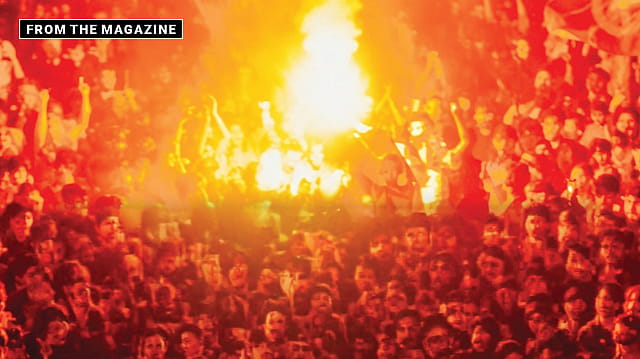
Who can forget Neha Bora’s dash to Jantar Mantar in New Delhi, evading dozens of policemen before she was tackled by a group of policewomen? In those heady days of October, commentary on social media, and even from news outlets, had everyone thinking that India was in the throes of revolution.
A couple of days later, protesters who managed to cock a snook at the police bandobast and reach Jantar Mantar, notably Saurav Das and Ashutosh Ranka of the Cockroach Janta Party (CJP), were dispatched to Tihar Jail in the capital. Despite repeated efforts to regroup over the next month, the protests could not gather even a hundred people, let alone the “mass movement” the organisers had dreamt of. A more spectacular example of a stillborn revolution will be hard to find.
What happened, and why did the so-called ‘Gen Z’ protests fizzle out? One can dismiss the idea in a single sentence: India is not a “revolution country”. But the events of the past six months, ever since Abhijeet Dipke returned from the US and made repeated efforts to dislodge the lawfully elected government by one means or another, merit an explanation.
At the broadest level, three contradictory events intersected to ensure that these protests could not snowball into a politically unsettling situation for the Narendra Modi government. One, the student protest was undone by its ever-expanding horizon. From the specific demand for the resignation of then-Union Education Minister Dharmendra Pradhan in the wake of the examination leaks, the protest mutated into a demand for the resignation of Chief Election Commissioner (CEC) Gyanesh Kumar. Matters did not end there: Prime Minister Modi’s resignation was also demanded. The arc from the immediate concerns of students to regime change was impossible for CJP and its supporters to sustain. What began as a students’ agitation ended up as a political one. Two, once CJP and the organisations supporting it entered the political fray, other parties, including Congress, decided to seek a share of the ‘protest pie’. That competition turned what was an ostensibly non-political movement of students into a quest for political mobilisation along party lines. Finally, the government was not sitting idle: its wider groundwork at the economic and social-welfare level ensured that the people of India functioned as breakwaters in this freak storm.
True, the government experienced a rude shock, a res nova, in dealing with an entity it was unfamiliar with: idealistic students and young people flocking to the protest site to express their solidarity and dominating social media. The establishment came under attack and dormant political commentators began to assert that fear and foreboding had vanished from Lutyens’ Delhi.
In the summer of 2026, however, it did not occur to most of the young men and women who had congregated at what was then a designated protest site in the national capital that the leader of the group that called for the resignation of Dharmendra Pradhan—Abhijeet Dipke or CJP, which was formed immediately in response to Chief Justice of India (CJI) Surya Kant’s alleged comparing of India’s unemployed young people to cockroaches—was neither as mature nor as charismatic as ‘AK’, as Arvind Kejriwal was known in his prime. Many of them may have been too young to remember the sway the former Delhi chief minister once held in the early years of his career, cutting his teeth in the rough and tumble of party politics and resetting the status quo, at least briefly, by championing political entrepreneurship and lowering entry barriers for people aspiring to take part in political decision-making.
It was true that a section of the protesters Open spoke to in June-July, and later in October, expected a social effervescence and a revolution of sorts, forcing the Union government to make huge concessions. In the summer, several young women from Delhi colleges and elsewhere told Open that the July 20 crackdown on protesters had tilted the balance in their favour, with the government forced onto the defensive, especially since the protests struck a chord among the middle class. That the NEET-UG examination paper leak primarily affected a relatively privileged section of students made it more damaging for the government, since it was not about any broader crisis in education.
THE BUDGETARY ALLOCATIONS ARE NOT COUNTERSTRATEGIES TO DEFANG PROTESTS. SPENDING ON WELFARE IS NOW A CONTINUOUS PROCESS. WHAT IT ENSURES IS THAT INDIA’S POLITICAL ECONOMY REMAINS MANAGEABLE
Young adults at the receiving end of police action naturally attracted greater sympathy because they belonged to a more assertive class in society. When the protesters regrouped and re-occupied Jantar Mantar the same night, it culminated in the resignation of Pradhan. In a sense, that concession neutralised the immediate incentive for continued mobilisation. The step was reminiscent of the concessions the Modi government made in the wake of the farmers’ agitation in 2021 when it agreed to repeal the three contentious agriculture laws.
It was clear that Dipke and his team, backed by Left student unions such as the Students’ Federation of India (SFI), the All India Students’ Federation (AISF) and the All India Students’ Association (AISA), and by Left leaders, acted as a force multiplier for young people looking for change, with the BJP-led government completing more than 12 years in power at the Centre and expanding its wingspan across the country. Among the leaders who went on a fast at the time, Neha Bora of AISA, who along with engineer-activist Sonam Wangchuk undertook a 23-day hunger strike, was destined to become a symbol of youth resistance amid a series of examination leaks and irregularities in the marking system.
In hindsight, the anger remained fragmented and politically contested, and was handled with force, so that it did not become a unified rejection of the existing political order. It was nowhere near a revolutionary situation. And India, even at the worst of times, is never ripe for revolutionary change. Most protests of recent vintage—the Anna Hazare agitation of 2011, the Nirbhaya protests of 2012, the anti-Citizenship Amendment Act (CAA) protests of 2019-20, the farmers’ protests of 2020-21 and others—were predominantly about demanding changes within the political system rather than its overthrow.

Even so, there was no great cohesion among the protesters. For instance, Congress was seen as the ‘big brother’ by other allies of the I.N.D.I.A. bloc. When they met on October 12 and Congress went on a march from Mandi House to the Supreme Court, many allies said they joined it for the sake of unity in the anti-BJP alliance. At least three members who took part in the meeting told Open that they did not fully agree with the idea of marching to the apex court, especially after CJI Surya Kant declined the request for a meeting with the bloc’s leaders, citing legal reasons and propriety.
One factor that damaged the protests and their potential for something bigger was the reckless statement by senior lawyer Prashant Bhushan, who openly made a pitch for “gime change” at a press meeting. “We want regime change. Yes, we all want regime change. What is wrong in demanding regime change?” he had asked.
In no time, senior opposition leaders were left scrambling to do damage control. MA Baby, general secretary of the Communist Party of India (Marxist), or CPM, said: “For us, regime change essentially means hope of a change of guard in the 2029 elections, in a democratic way. To that effect, we will continue to campaign against the Modi government over a raft of political issues, including irregularities in the SIR [Special Intensive Revision] of the electoral rolls. The media has exposed the designs of the government and we have evidence at the grassroots level of malpractice. We are going to expose the government through protests and campaigns.”
Similarly, Dipankar Bhattacharya, general secretary of the CPI(ML)-Liberation—the parent party of Neha Bora’s outfit, AISA—told Open: “No amount of accusations of anarchy or the bogey of foreign conspiracy can stop the people from fighting for fair elections on the basis of universal adult franchise, for a responsive government and accountable institutions.” It was a classic statement of operating within the system.
THE REASON BEHIND THE GOVERNMENT’S SUCCESS IS SIMPLE. THE GOVERNMENT’S STRONG FOCUS ON SOCIAL WELFARE AND ITS EFFORTS TO PROTECT THE WEAKEST SECTIONS OF INDIAN SOCIETY AMID GLOBAL UPHEAVALS HAVE STOOD IT IN GOOD STEAD
The tragedy was that, unlike June-July, months later, when CJP called for massive protests demanding the resignation of CEC Gyanesh Kumar over alleged irregularities in the SIR conducted by the Election Commission of India (ECI). She may have been right when CJP’s policy head Mehr Pasricha told Open that the June-July protests had brought back a “culture of dissent” that had been absent from India for more than a decade.
By then, however, the political moment for ‘change’ had come and gone, if it had had any traction to begin with.
There are two answers to why the protests lost energy and ultimately dissipated. One, coming from the protest camp, is that Lutyens’ Delhi was fortified ahead of protests seen as a sequel to the one that had rocked the national capital a few months earlier. Central Delhi saw a massive deployment of forces, notwithstanding the directions issued by the Supreme Court in a special sitting on October 11 when a Bench of Justices Joymalya Bagchi and V Mohana said that there should be no illegal detention of peaceful and unarmed people, particularly beyond the area where Section 163 BNSS prohibitory orders were in operation.
There are, however, deeper reasons why these protests went nowhere. For one, if India were indeed in a ‘revolutionary mood’ or in a mood for ‘regime change’, mere repression could not have stemmed the tide. In fact, had repression been carried out to the extent it was sought to be portrayed, matters would have turned far worse. None of that happened.
The reason behind the government’s success is simple, even if it remains unacknowledged among India’s intellectuals and civil society. The government’s strong focus on social welfare and its efforts to protect the weakest sections of Indian society amid global upheavals have stood it in good stead.
Even a cursory look at the annual Budget proposals and allocations will show that, if one takes out capital expenditure and interest payments from total expenditure, the web of social welfare schemes and subsidies probably forms the largest spending item. Each section has a stake in the welfare pie. Poor and marginal farmers get help through PM-KISAN, a scheme launched in 2019 when it became obvious that this section of farmers needed help. The single biggest political upheaval confronted by the Modi government—the prolonged siege of Delhi by farmers from Punjab—had passed off without the wider participation of farmers from other parts of India.
Workers and labourers, the raw material for almost any political mobilisation, have never shown any interest in the kind of politics on display in Delhi from June onwards. Regular help through MGNREGA, and now the VB-G-RAM-G programme, has ensured that there is no distress in rural India.
Finally, the government provided a cushion to Indians at large, from fertilisers to fuels, in the face of wars in West Asia and Ukraine, ensuring there was no urban distress from price increases and inflationary pressures.
These three budgetary allocations are not counterstrategies to defang protests; that notion would be laughable, as spending on welfare is now a continuous process and not contingent on an event such as an election or a protest. But what they ensure is that India’s political economy never gets out of hand the way it did in Sri Lanka (2022), Bangladesh (2024), and Nepal (2025). Not keeping the redistributive economy on an even keel is the best regime-change strategy anywhere in the developing world. CJP and others who wished for regime change did not understand the inner workings of the Indian economy.
This is the actual ‘secret’ that explains why even the best mobilisation strategies and efforts by the opposition have remained fruitless all these years. The standard political mobilisation strategy on the eve of elections is to promise welfare on a mass scale at the national level. That is what secured victory for the Congress-led coalition in 2009. Since he became prime minister, Narendra Modi has repeatedly emphasised the importance of welfare for the poorest Indians above everything else.
In the end, as summer stretched into autumn, what could have been the single-biggest political crisis faced by the Modi government since 2014 passed quite peacefully. Two days ago, when Neha Bora gathered a band of environmental activists to protest against air pollution in Delhi, not even a hundred people turned up. Such protests will continue sporadically, something par for the course in Delhi’s ‘system of protests’. But the pretence of revolutionary change is gone. These are political mobilisations in preparation for normal political challenges.
On each occasion when a long-running government falls somewhere, or some political upheaval takes place in some corner of the world, observers in India ranged against the Modi government turn hopeful that a ‘revolution’ in India is round the corner.
Call this the 21st-century version of the infamous domino theory. Whenever an alleged strongman or some political figure disliked by the liberal classes of the world bites the dust, a chorus goes up, claiming that despots are falling like ninepins. It is as if there is an international coalition of such oppressors and the wave has now turned against them. Earlier this month, when the Republican Party led by Donald Trump lost badly in the midterm elections to the US Congress and other offices, the same cry could be heard.
A contemporary falling of dominoes could be narrated somewhat like this. The first domino fell in Bangladesh in early August 2024, when the tyrannical Sheikh Hasina was ousted from power, and Donald Trump was dealt a blow this month. During this period, governments and alleged oppressors have been felled in Nepal (September 2025), Hungary (April 2026), and Serbia (October 2026). But here is the rub: in each case, the government and the party or coalition in power confronted some combination of economic and political problems it was unable to solve. Each is instructive, not for any ‘revolutionary lessons’ that can be carried over to some other country but for the unique set of reasons that created the problems in the first place.
If there are any commonalities between these cases, they lie in the background conditions that enabled the ouster of governments in these countries. To blandly label them ‘Gen Z’ revolutions bespeaks misreading current affairs. Two conditions are visible in these cases, even if they do not overlap: ethnic or religious homogeneity that enables cross-class, cross-ethnic mobilisation against governments (Hungary, Serbia and Bangladesh fall in this class), and an utter lack of state capacity to deal with alleged revolutions (Bangladesh and Nepal display this commonality).
Begin with Nepal. The ban on social media by the KP Sharma Oli government on September 4 last year had ignited, in part, the anger that social media posts by the children of the Nepali elite had already generated among young people from disadvantaged backgrounds. Pictures of holidays in exotic locales and expensive goods that ordinary Nepalis could only dream of caused heartburn that Oli and his government realised late in the day. The ostensible reason for the ban was the requirement for these platforms to register under a new law and an effort to generate revenue through a value-added tax on these services. A riot in Kathmandu and the burning of government buildings was all it took for Oli and other established political figures to run into hiding. Five days later, Oli was gone for good.
Something similar had transpired a year earlier in Bangladesh, where an order from the country’s Supreme Court restoring a 30 per cent jobs quota for descendants of freedom fighters caused an upheaval. Against a background of economic distress that began after the Covid-19 pandemic and the war in Ukraine, Bangladesh was forced to approach the International Monetary Fund (IMF) for help in 2023. The country’s economic mainstay, its garments export sector, never recovered from global turbulence. Even two years after Hasina was ousted, Bangladesh has returned to the IMF for more money even as Dhaka remains turbulent. The alleged ‘Gen Z revolution’, an Islamist putsch, has led Bangladesh nowhere.
Nepal and Bangladesh were saddled with governments that lacked the elementary tools to manage complex political situations and simply folded at the first sustained protest in their capitals. In both cases, the armed forces, the only institution with a modicum of ability to restore order, had to step into the political domain. The situation in Hungary and Serbia was different. There, a combination of corruption, senescence of government and voter fatigue turned sentiment against established parties. In Serbia, the collapse of a portion of a refurbished railway station in Novi Sad in 2024 triggered protests against the corruption of the Aleksandar Vucic government. Two years later, Vucic was gone in a student-led protest. In Hungary, apart from corruption and cronyism, a combination of hostility from Brussels and sheer fatigue with Viktor Orbán’s system uprooted Fidesz after 16 years of unbroken rule.
INDIA’S POLITICAL ECONOMY NEVER GETS OUT OF HAND THE WAY IT DID IN SRI LANKA, BANGLADESH, AND NEPAL. IN INDIA, THE CONDITIONS WHICH UPROOTED GOVERNMENTS FROM THE BANKS OF THE DANUBE TO THOSE OF THE PADMA ARE ABSENT
In India, none of these conditions—which uprooted governments from the banks of the Danube to those of the Padma—obtains. If anything, the Modi government has adroitly handled the ‘Gen Z’ protests. The countryside remained peaceful, and there was no other class that could be mobilised against the government. No other section, be it farmers, workers or anybody else, joined the students as they rampaged in Delhi. The exceptional emphasis on welfare measures through the three terms of the Modi government ensured that there was no room for mass anger, in stark contrast to many other countries where governments were toppled one way or another. The famous formula of Antonio Gramsci is neatly inverted in the Indian case: the old is thriving and the new need not be born. There is no interregnum and no room for morbid symptoms. The system works and moves on.