Cabin Fervour
Four years ago when her father was about to turn 75, Suprita Mitter and her family decided to do something special for his birthday. They went on a cruise. The Mitters, who live in Mumbai, took the Cordelia Empress, a 692-foot-long ship that had been introduced by Indian cruise line Cordelia Cruises just a year ago, for a three-day trip to the Mumbai high seas, an area in the Arabian Sea about 200km away off the city’s coast.
“It was a brilliant experience,” she recalls. “It was kind of like going to Goa, where you find a nice property and just stay put there. But more fun. There were shops, stalls that sold curios and jewellery, coffee shops, restaurants, live photo studio, musicals and so much more. It’s also great for elderly people, because you have washrooms close by and your room to retire to whenever you want.”
Celebrating her father’s birthday on a ship was also meaningful. Mitter’s father had spent a lot of time on ships when he worked as a marine engineer. “The last time he was on a ship was when we all took this lovely cruise on the Nile many years ago,” Mitter says. “He was very excited to be back on a ship after so long. He was constantly supervising and telling the staff what to do. We had to remind him to enjoy his birthday,” she says.
Their trip turned out to be so much fun that they’ve since taken the cruise again—with Mitter getting on one with her mother a few months back; and her parents taking one to reach Kochi.

The Mitters represent a small but growing group of individuals in India who are taking to cruises, turning what was once a niche luxury holiday, available only at distant international locations, into a more mainstream option. Cordelia Cruises, which started operations in 2021 with its Cordelia Empress, has just introduced another vessel, the Cordelia Sky, with a third (Cordelia Sun) expected to join soon. It is now planning to expand to new destinations and develop cruise circuits.
International cruise operators are also targeting Indian holidaymakers, either by docking at Indian ports or encouraging travellers to board their ships abroad. And then there is the parallel growth of the domestic river cruise industry, with more travellers discovering the unique charm of slow travel on India’s long and winding rivers like the Brahmaputra and the Ganges. All this comes as the government is stepping up efforts to promote this industry with its Cruise Bharat Mission, which aims to attract 1 million cruise passengers by 2029 through favourable polices, upgrading sea and river ports, and building new terminals and other infrastructure.
Cordelia Cruises claims it has already carried over 8 lakh passengers passengers since it started operations. “Before Cordelia Cruises began operations, an estimated 2 lakh Indians travelled overseas for cruise holidays annually. Today, Cordelia alone welcomes close to 1.8 lakh guests every year,” says Jurgen Bailom, president and CEO of the company. “When you look at these numbers together, we have effectively helped create a domestic cruise market of a scale comparable to the overseas cruise market that existed before us. That is a significant shift in a country where cruising was not traditionally part of the holiday culture. What is particularly encouraging is that we are not just attracting people who have cruised internationally before. We are introducing an entirely new audience to cruising, including families and travellers who may never have considered this type of holiday. We are also beginning to see cruising become an experience people want to return to, rather than something they do only once in their lifetime.”
The industry, however, is still at a nascent stage. Neeraj Singh Dev, the executive vice president for ecommerce, India, and short haul holidays at Thomas Cook India and SOTC Travel, estimates cruise penetration currently stands at approximately 8 to 10 per cent among international holidaymakers and 15 to 18 per cent among domestic travellers. “While cruising is still at an early stage of adoption…, interest is gaining momentum as travellers become more aware of the variety of experiences available,” he says. “One of the biggest attractions is the ability to explore multiple destinations as part of a single holiday, while enjoying the convenience of unpacking just once,” he says, adding that cruise holidays of three to five nights, particularly in destinations like Southeast Asia and the Middle East are popular, while domestic cruises with itineraries that cover destinations like Goa, Kochi or Lakshadweep are also increasingly finding more vacationers. Short cruises across Southeast Asia and the Middle East might be the biggest draw for first-time Indian cruisers because of the proximity of these locations, but repeat travellers are now upgrading to longer and more immersive trips in regions like the Mediterranean, Caribbean, Japan, South Korea and Alaska. “There is also interest in expedition-led journeys, including the Arctic and Antarctica,” he says.
Varun Chadha, CEO of TIRUN Travel Marketing, which is the exclusive Indian representative of cruises offered by the Royal Caribbean Group, one of the large cruise line operators in the world, points out that what makes India interesting is the size of its outbound travel market and the relatively low penetration of cruising within it. “International cruise companies recognise this long-term potential. India offers a young, increasingly experience-oriented traveller base, and as awareness, accessibility and distribution improve, we expect the market to become increasingly relevant to global cruise operators,” he says.
Nalini Gupta, managing director at ClickMyCruise and Lotus Destinations that have been brining many big international cruises to cater to India, says the Indian market has a lot of potential. “When we brought Costa Cruises from [the] 2016 season for four continuous years with the Mumbai-Mangalore-Cochin-Malé-Colombo-Goa-Mumbai itinerary, and again in 2023 when we got Costa Serena for pure domestic sailings, we saw immense interest among Indian travellers in wanting to experience international-standard cruising from their own shores. We are in discussions with a few cruise liners, but there is a lot of groundwork to be done before we can make this happen,” she says.
The government is upgrading maritime and river cruise infrastructure across the country. Modern cruise terminals have been added in Mumbai, Chennai and Visakhapatnam, while others are coming up in Goa and Kochi. Last month, Ballard Pier, which houses the Mumbai International Cruise Terminal, opened a very swanky cruise life experience centre at the terminal with dining, shopping and other lifestyle facilities.
Aditi Dhruv Kotak, director of Ballard Pier Private Limited and JM Baxi Group, which operates several cargo terminals across India, says that the idea behind the experience centre was part of their vision to bring cruising culture to India by building the lifestyle around it. “In the West, cruising is a mature industry, and the traveller there grows up knowing what a cruise holiday is. In India, it is still a new way to travel; for most people, cruising simply isn’t part of the holiday vocabulary yet. So our first challenge was cultural rather than architectural: how do you make cruising part of someone’s lexicon? Our answer was to build the culture before the voyage, creating a destination where the lifestyle of cruising can be expe rienced on land, every day,” she says.
While cruises on the high seas have been growing in popularity, there has been an equal growth in cruise journeys on India’s long and winding rivers. Antara Cruises, one of India’s oldest river cruise operators, offers journeys on the Ganges, Brahmaputra and the rivers of Odisha’s Bhitarkanika National Park. Its itineraries range from weekend trips to a 51-day voyage aboard the Ganga Vilas that stretches from Varanasi to Dibrugarh in Assam, passing through Bangladesh, and which at 3,200km is considered the world’s longest river cruise. When Raj Singh, founder and CEO of Antara Cruises, first began operating vessels on the Ganges, the concept of river cruises in India was non-existent.
“I was living in the UK about 25 years ago, and I had gone cruising in Europe, on the Nile, and had heard about cruises on the Amazon. I thought, if it can be done on those rivers, why not on ours?” Singh says. Since this was unheard of back then, there were multiple challenges, from getting approvals from state governments, surveying the river and the places the vessel would have to pass by, to figuring out aspects like where it could dock and refuel as well as training the staff. Singh was able to put his first ship out only in 2009, six years after he began working on the idea. For the first three months after operations began, Singh would constantly travel on the ship from Kolkata to Varanasi and back, making sure things were in order. There were multiple complications that arose, he says, but over time it stabilised. “It was the first cruise to sail along the Ganga in 200 years or so. Earlier, river transportation was very important and goods and passengers travelled on the Ganga, but once the railways came in, and road constructions happened, travelling on the river gradually disappeared,” he says.
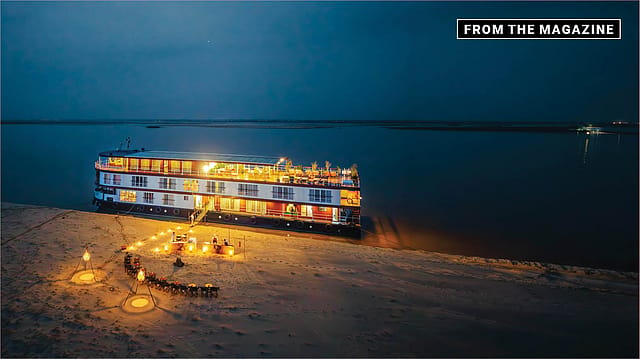
Around the time Singh had first begun researching the possibility of starting a river cruise on the Ganges, Jungle Travels, a well-known firm in Assam that specialises in overland wildlife and birding tours, received an unusual request. A couple from the UK wanted to spend a day or two travelling on the Brahmaputra. This was sometime around 2000 or 2001, and although they had never arranged something like this, the group put together a day-long cruise that would set sail downstream from Tejpur to Guwahati. “We tried to make it as comfortable as possible for them, putting an icebox, some nice rattan chairs, a canopy to shield from the sun, and things like that,” Nirmalya Choudhury, the executive director of operations at Jungle Travels recalls. “Once they reached Guwahati, the owners of Jungle Travels [Ashish and Jahnabi Phookan] went to meet this couple [Andrew and Grania Brock] because we were curious about their interest in the river. It turned out they were tour operators from the UK who had been operating many tours in Asia, selling river cruises on the Irrawaddy, Mekong and other rivers. And they were very surprised to see hardly any traffic on the Brahmaputra River.” The two couples began talking and decided to come together to start Assam Bengal Navigation Company (ABNC), which today offers cruises across rivers like the Brahmaputra and the Ganges. Both Antara Cruises and ABNC are looking to expand their footprint. Antara Cruises is looking to expand its operations in the Brahmaputra and is building new ships for it. ABNC, which has tied up with an international firm to introduce more vessels on the Ganges, wants to also explore coastal cruises, using relatively small vessels to connect locations on and near India’s southwest coast, like Kolkata, Chennai, the Andaman Islands and Phuket.
What is the draw of these river cruises? Is it the luxurious vessels in which passengers can travel, or is it the nature of the journey itself? “Taking a river cruise is slow travel in its essence. You rest, you relax, you go out in the morning for a couple of hours. You come back and sail a bit more, have a relaxing lunch and doze off on the sun deck. In the afternoon, maybe stop in a village, and you go off for a walk, and then you sail a little more, before mooring down for the night,” Choudhury says. “The real star of the show is the river. It’s the people you meet along the course and the journey itself.”
Kalpana Sunder, a writer based in Chennai, has taken several river cruises in India over the last few years. “I’m a big fan of river cruising here,” she says. “I know people talk about the Rhine and the Danube and all that, but I think cruising on the Ganga and the Brahmaputra is really beautiful.”
In 2024, she went on a week-long river cruise from Kolkata that took her through several parts of rural Bengal, where they would drop anchor and go on foot or electric auto to explore tiny hamlets, encountering communities of porters and weaves, seeing temples and imambaras. “The beautiful thing about river cruising is that you get to see life on the riverbank. You just sit on the deck, and there is all this life in front of you—of farmers, villages, stacks of jute, and all kinds of things—passing by.”