Zara, Zudio and the Battle for the Z Generation
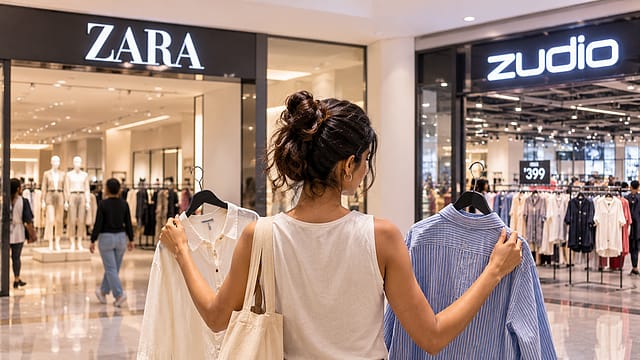
Zara has spent years making international fashion accessible to India's aspirational consumer. But there is a limit to how often that consumer is willing to pay Zara prices. A shopper may like the cut of a shirt, the silhouette of a dress or the styling of a jacket, but still decide that the purchase is not worth the bill. Inditex, Zara's Spanish parent, has another brand for precisely this gap. Lefties, which began as an outlet for Zara's unsold merchandise, has evolved into a standalone value-fashion retailer. Its proposition is not to make Zara cheaper. It is to take the group's design and retail capabilities to consumers who want fashionable clothes without paying for Zara's positioning.
If Lefties eventually enters India, its most interesting competitor may not be Zara's existing rivals such as H&M. It could be Zudio, the value-fashion chain owned by Tata Group's Trent. But this is unlikely to be a straightforward price war. Lefties may have more to gain by occupying the space between Zudio's sharp pricing and Zara's premium high-street positioning. That would put it in front of a consumer who wants to trade up from value fashion but is not ready to trade up to Zara.

The Wealth Issue 2026
06 Nov 2026 - Vol 05 | Issue 45
Portraits of Dreamers and Doers under 35
From Zara's leftovers to a brand of its own
Lefties has an unusual origin. Established in 1999, it began as an outlet for unsold Zara merchandise. The name itself was associated with leftover stock. But what started as a way to clear inventory has become a separate retail proposition within the Inditex portfolio, with its own collections, stores and online operations.
The transformation is significant. Lefties now sells clothing, footwear, accessories and home products across women's, men's and children's categories. It is no longer simply where Zara sends its old merchandise. It is Inditex's attempt to take its fashion capabilities into a more price-conscious market.
The expansion is gathering pace. Lefties entered France in May 2026 and opened its first UK store in Liverpool in August. With that launch, it was present in 20 markets, operating 225 stores globally, according to Reuters. In the UK, its pricing includes T-shirts from £3.99, dresses from £9.99 and jeans from £12.99. These prices put it in competition with budget retailers such as Primark, while giving Inditex another way to retain customers who may find Zara increasingly expensive. Reuters reported that Lefties was the only Inditex brand expanding its store count over the preceding year.
The strategy reflects a change in how the group approaches its customers. As Zara moves towards a more premium store experience and higher price points, Lefties gives Inditex an entry into the other end of the market. Rather than forcing one brand to serve consumers with different spending capacities, the group can offer them different price propositions within its portfolio.
The space between Zudio and Zara
The temptation would be to imagine Lefties as another Zudio, only with an international parent. That may not be the right way to look at it.
Brand experts see a more plausible opportunity in positioning Lefties as a bridge brand. It would not need to compete with Zudio on every price point, nor should it necessarily try. Its proposition could be Inditex design at accessible prices, rather than simply the cheapest way to follow a fashion trend.
A possible Indian price architecture could see Lefties position its basics around 15–30% above comparable Zudio products, with a wider premium on trend-led merchandise. These are indicative positioning possibilities, not confirmed prices or an announced India strategy.
The idea is to give consumers a reason to trade up without having to make the jump to Zara. A shopper might buy a basic T-shirt at Zudio but be willing to spend more on a better-designed shirt, a pair of jeans or a trend-led dress at Lefties. The premium would have to be justified by the product, not merely the Inditex name.
This is where Lefties could become interesting in India. Zara has established a degree of aspiration among urban consumers, offering an accessible entry into international high-street fashion. Lefties could draw on that familiarity while addressing consumers who like Zara's design sensibility but find its prices difficult to justify for regular shopping.
However, brand association alone will not be enough. If Lefties charges more than Zudio, consumers will expect a discernible difference in design, finish and merchandise quality. It would have to establish its own identity rather than be perceived as a cheaper, less prestigious version of Zara.
Zudio has a history Lefties cannot ignore
To understand what Lefties could be up against, it is worth looking at the company that built Zudio.
Trent, the Tata Group's retail arm, began its modern fashion retail journey in 1998 with Westside. The first store opened on Bengaluru's Commercial Street, at a time when organised fashion retail in India was still developing. Westside was not built simply as a multi-brand retailer. It developed a portfolio of exclusively owned labels, with Trent controlling important parts of the value chain, including design, production, sourcing and distribution.
The experience would prove valuable when Trent moved further down the price ladder. In 2016, it launched Zudio, a value-fashion format aimed at consumers looking for fashionable clothing at sharper price points. The distinction between the two concepts was deliberate. Westside offered a more elevated department-store-style shopping experience across fashion, beauty, footwear and home. Zudio was built around accessibility, in-house merchandise and affordability.
This was not simply a matter of selling the same clothes for less. It required a different approach to store economics, merchandise selection, price architecture and consumer behaviour. Westside had helped Trent develop the retail capabilities that could be adapted to a much larger, more price-conscious audience.
Zudio has since become one of India's fastest-growing fashion retail chains. As of March 31, 2026, it had 963 stores, including six in the UAE, across 310 cities in India and three locations in the UAE. During FY2025-26, Trent opened 212 Zudio stores and consolidated 14. Westside, meanwhile, had 300 stores. Together with its other lifestyle concepts, Trent operated more than 1,250 large-format fashion stores across 321 cities, with a footprint exceeding 17.7 million square feet.
Trent's FY2026 revenue from operations increased 18.2% to ₹19,701.41 crore, from ₹16,668.11 crore in the previous year. Profit after tax rose to ₹1,967.82 crore from ₹1,584.84 crore. These are company-wide numbers and cannot be attributed exclusively to Zudio, but they indicate the scale of the retail platform on which the brand operates.
More revealing is Trent's assessment of how much further Zudio can grow. In its FY2026 annual report, the company says it believes each of its fashion brands should eventually target a reach of around 500 million customers across India. Its current assessment puts Zudio's reach at approximately 100 million, applying its own criteria of aspirational and brand-friendly markets.
The 500-million figure is a long-term management ambition, not a forecast. But it indicates that Trent does not believe Zudio is close to exhausting its opportunity. The company specifically identifies secondary cities and towns as markets where rising aspirations and a viable customer base are creating room for expansion.
This is an important competitive advantage. Lefties may bring international design credentials, but it would have to build a retail network and local operating ecosystem in a country where Zudio has already established considerable reach.
Zara's Indian numbers tell another story
The potential arrival of Lefties is also worth examining against the performance of Inditex's existing Indian business.
According to regulatory filings accessed through Tofler, the Indian operating entity associated with Zara reported total revenue of ₹2,760.4 crore for the year ended March 2026, down 2.79%. EBITDA declined 31.2% to ₹315.1 crore, while net profit fell 31.92% to ₹204.1 crore.
The pressure on profitability was considerably sharper than the decline in revenue. Gross margin fell 3.93 percentage points to 36%, operating margin declined 4.97 percentage points to 11.5%.
These numbers do not establish that Zara is losing its appeal among Indian consumers, nor do they explain the reasons for the decline. The Indian operating entity's financials should also not be confused with Zara's global performance. The relevant joint venture operates Zara and Massimo Dutti, so the figures should not be presented as Zara-only financials.
Nevertheless, the numbers are a reminder that an international brand name does not automatically translate into easy growth or expanding margins. Lefties would have to establish a commercially viable proposition of its own rather than rely entirely on the familiarity of its parent brand.
The Trent complication
There is another commercial consideration. Zara operates in India through Inditex Trent Retail India Private Limited, an entity originally set up as a joint venture between Inditex and Trent. Inditex initially held 51% and Trent 49%, but after a series of stake reductions, Trent’s holding fell to 20% in FY26, leaving Inditex with 80%.
Trent, of course, owns Zudio, which could become Lefties' direct competitor. The existing arrangement does not establish that Lefties would enter India through the same partnership, and there is no confirmed India launch announcement. But any potential entry would raise questions about how Inditex would structure its operations.
Would it use its existing relationship with Trent? Would it seek a different operating arrangement? And how would such a partnership work if one of the partners also owned a competing value-fashion chain?
The answers would matter because entering India is not simply about opening stores in large malls. Lefties would need to get its sourcing, price architecture, inventory cycles and merchandise mix right. European prices cannot simply be converted into rupees. Import duties, local sourcing, logistics and store costs would all influence the final proposition.
The consumer may not have to choose
India's apparel retail market, estimated at ₹9.3 lakh crore in FY2025, is projected to reach nearly ₹16 lakh crore by FY2030, according to CareEdge Ratings. Organised retail accounts for around 41% of the market and is expected to grow faster than the overall industry. The expansion of value-fashion chains into Tier II and Tier III cities is an important part of this growth.
Lefties would enter a market with room for more organised fashion retailers, but also one where consumers are becoming increasingly discerning about what they pay for. The same shopper can buy basics at Zudio, a statement outfit at Zara and something in between at another retailer. Fashion purchases are not governed by loyalty to a single price point.
Lefties could find its place in that mix by offering consumers a reason to spend more than they would at Zudio but considerably less than they would at Zara. That could also push Zudio to sharpen its merchandise proposition as competition moves beyond price and into design, quality and shopping experience.
For Inditex, the challenge will be to make its international fashion credentials translate into genuine value in India. For Trent, it will be to protect a business that has considerable room to grow without losing the affordability that made it successful.
If Lefties eventually enters India, it may not be trying to become the next Zudio. It could be trying to become the brand consumers graduate to when Zudio is no longer quite enough, but Zara still feels like too much. That is a much more interesting competitive threat than another retailer promising cheaper clothes.