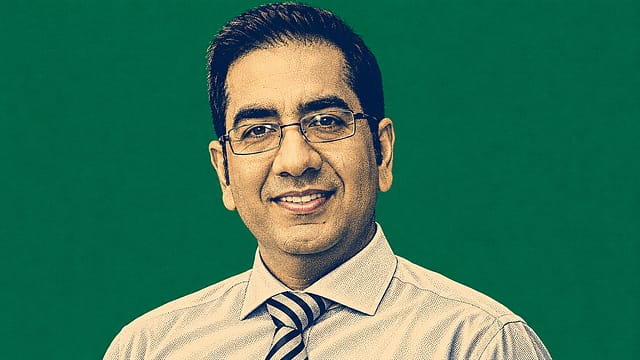
After 32 Years, What Does Mohit Malhotra Take With Him From Dabur?
The trouble with Dabur's new toothpaste became apparent when you spat it out. It left a red stain in the sink.
Mohit Malhotra remembered the colour well enough, years later, to offer me a comparison. "Paan ki stains hote hain na," he said. Think of the mark paan leaves on the floor. Now imagine being the young brand manager who had to sell that toothpaste against Colgate.
He sold it. He kept the stain. And for the next two decades, that decision explained almost everything about him: the instinct, the nerve, the appetite for a fight he wasn't supposed to win.
On 13 November 2026, the man who made that bet left Dabur as global CEO, 32 years after he walked in as a management trainee. His resignation letter gave 16 November as the start date for an overseas role. He confirmed Dubai in his farewell on LinkedIn. The Economic Times, citing people familiar with the appointment, identified his new job as global group CEO of the Dubai-based Group SNS.

The Wealth Issue 2026
06 Nov 2026 - Vol 05 | Issue 45
Portraits of Dreamers and Doers under 35
I interviewed him at length twice, and met him many more times. The interviews were never quite interviews. He argued with my premises, brushed aside my metaphors and, on at least one occasion, told me not to be silly. He could be disarmingly generous about a rival. The harsher words were usually reserved for a company he knew far better: his own.
THE STAIN HE REFUSED TO WASH OUT
In the Delhi summer of 1994, the Pune University management graduate went around neighbourhood shops with Dabur's sales reps. His day ended with a handwritten report. At the kirana he could watch what happened when someone who had bought the same thing for years was offered a reason to change.
A few years later, Dabur had a tricky version of that problem. It had sold Lal Dant Manjan since 1930. The first generation of Burmans, he told me, used to prescribe it to their patients. But the customers who loved the red powder were giving it up anyway. Toothpaste came in a tube. People were moving on.

Following them meant walking into Colgate's territory. In a strategy review around 2001, outside consultants gave Dabur their verdict. Malhotra, who had moved from hair care to oral care and worked with them on the review, remembered it vividly. Colgate had the money muscle. Dabur would bleed for eight years. "Oral care is a completely no-no."
Dabur went in anyway, backed by V.C. Burman, who was then handling marketing. The promise was simple enough to fit on a tube: aapka manjan paste mein aaya. Your manjan, now a paste.
Then came the dilemma. The powder's key ingredient, garik, was abrasive and good for the gums, and it was the reason for the stain. Should Dabur make a gel? Change the colour? The research gave him cover for either. Some people hated the taste. It stung before it cooled.
What interested him was why the others loved it.
"We will keep the DNA intact," he told me. "At times marketers get swayed by the greed of the market opportunity." So Dabur kept the dirty colour, the stain, the sting and the cooling aftertaste. It went after a narrow audience: lapsed manjan users, and Colgate users already leaning towards herbs. It even priced Red above Colgate.
He was scared enough of the consultants' warning to set a conservative first-year target of ₹5 crore. Red did about ₹15 crore. "Completely mind-boggling," he said. "We never looked back."
Years later, when the growth slowed, the brand manager who had been told not to fight went looking for one. Dabur told buyers to bring in their white tube and take a Red home. White toothpaste, the pitch went, was little more than chalk. By FY21, Red was in Dabur's ₹1,000-crore club.
In our second interview he gave me the phrase that, to my mind, explains his best years. Big companies, he said, behave like the fox, chasing every bigger category whatever their core. He preferred the hedgehog. "It is only doing what it's good in doing. And when it goes, it can rub people the wrong way a little bit, but it will be core to itself."
The red stain was the hedgehog's finest hour.
THE RIVAL HE COULD ALMOST THANK
Then came the one opponent no marketing plan could answer.
An actor could endorse a toothpaste for thirty seconds. Baba Ramdev could spend the whole day on television talking yoga and Ayurveda, and still be selling the idea behind Dant Kanti. As Patanjali took off, people who might have tried Dabur tried the baba's products instead. Dabur's trial rate dipped.
"We didn't have another face like a Baba who could fight," Malhotra told me. Not even a celebrity, he thought, could stand up to a personality that charismatic. He caught himself mid-praise: "I can't stop taking great adjectives for him, you know."
In honey, the blow was harder. When Patanjali came in, he said, Dabur lost 20 per cent market share.
But he had noticed something else. Every household Ramdev talked into Ayurveda became a household Dabur could sell to. Natural, herbal and Ayurvedic toothpastes, he estimated in 2020, had grown from about 2 per cent of the market to close to 30 per cent. Colgate itself had launched Vedshakti. And when Colgate advertised its herbal ingredients during the pandemic, he said, "people think it is Dabur only."
He enjoyed the irony. He also watched the price tag. A 100-gram Red cost ₹50 against ₹40 for Dant Kanti. In the Hindi heartland, where Red was weaker, Dabur launched Dant Rakshak to fight on the shelf and protect Red's premium.
By 2022 the tone had hardened. "We should not be seen as a sedate player that anybody can come and walk over us," he said. "We are no pushovers."
WHAT DUBAI TAUGHT THE MAN FROM DABUR
While Red was finding its feet in India, Malhotra was learning what the Dabur name was worth elsewhere. He took charge of the European Union business in 2001, moved to Dubai to head international marketing in 2004 and became chief executive of Dabur International in 2008.
A buyer in the Gulf owed Dabur none of the affection that an Indian family carried over from a tin of toothpowder. He was told Arab consumers would never take to an Indian hair oil. What his team saw instead was an admiration for Indian hair. That was enough of a door.
By 2013, he told the Khaleej Times, the Middle East and North Africa made up about 40 per cent of Dabur International's business. On his watch the group bought Turkey's Hobi Kozmetik and spent $100 million on the US-based Namasté group, whose Organic Root Stimulator brand sold hair products to women of African descent. Dabur kept its founder, Gary Gardner, and his team. A century in Indian hair care bought Dabur a way into American beauty shops. Gardner knew the women who shopped there.
This November, writing to Dabur's business partners, he still remembered the Majlis, the gatherings the company held with its distributors in Egypt, and could list the places they had taken him, from Sharm El Sheikh to Tbilisi.
In 2018 he came home to run the India business. On 1 April 2019 he succeeded Sunil Duggal, CEO for 17 years. Within a year, a pandemic would show him exactly what kind of company he had inherited.
"I SELL NOTHING"
"I don't sell bread. I don't sell biscuits. I don't sell edible oil. I don't sell salt. I don't sell atta. I sell nothing."
That was Malhotra, talking me through the first lockdown of 2020. Marico was allowed to keep selling, he said. Nestlé was allowed. ITC was allowed. Dabur, a healthcare company in a health emergency, was sealed out of the grocery shops that brought in about 80 per cent of its business. Chyawanprash was not seen as medicine. The first quarter was a washout.
He did not dress it up. "I'm one of the leaders who likes to take the bull by the horn," he said. He took the weakness to the promoters and the board. Dabur, he admitted, called itself a consumer staples company. It was really a discretionary one.
When I caught up with him mid-crisis, he sounded more exhilarated than exhausted. "It's been very, very tough and a rollercoaster ride, but I am enjoying it." And then, about himself, a line that says a great deal about him: "Unfortunately, you've got a guy who has got a lot of hunger in him. This hunger is never getting satiated."
The hunger set the pace. There were war rooms on Teams, with the chief executive on the call, actions agreed for that afternoon and the next morning, and the same people back on the call to check who had delivered. "We want our bus to be full of drivers, not passengers," he said. Some of the old guard kept up. Others, in his words, "sidestep."
I suggested the old Dabur had been a Rip Van Winkle, sleeping for years until Covid shook it awake. He took the metaphor and ran with it. "Wake up guys, smell the coffee."
He liked a fight, and he said so. "If there is no skirmishes, then, honestly Rajiv, there is no fun... I don't want to age." And: "Warrior ki life mein agar war nahi hai, then the warrior doesn't have a life."
But the same conversation also produced a rare admission of fear. The situation, he said, was "somewhere giving me thoughts that we may sink, but there's such a strong survival instinct that we'll be successful."
WHEN THE HEDGEHOG RAN LIKE A FOX
The lockdown lesson became a doctrine: Ghar Ghar Dabur. Every power brand would chase a bigger market.
Réal, stuck at a ₹100 litre of juice that belonged in an affluent family's fridge, got a ₹10 drink and a bottle you could carry. Odonil would move beyond its old blocks into air fresheners. Chyawanprash came as tablets. Dabur launched cold-pressed edible oils, face washes and, through Lal Tail's halo, a baby-care range and diapers. In October 2022 it agreed to buy 51 per cent of Badshah Masala for ₹587.52 crore. In January 2022 he told me he wanted to double turnover in three years.
I pushed back on diapers. Surely big-city parents would stick to the brands they trusted? "Not really, if you ask me, Rajiv, it's the other way around," he said. E-commerce had made young parents willing to try anything.
And every time, he insisted he was still the hedgehog. "I'm not locking horns with the big boys out there. I'm sticking to my knitting." Edible oil, diapers, malted drinks. Each was, in his telling, a natural extension of Ayurveda.
The malted drink showed both sides of him. Dabur had already failed with Chyawan Junior. The name itself, he reasoned, killed it: a child wanting something tasty would never pick a drink called Chyawan. "They need Peter, David, Harry Potter." So the new product went to market in December 2021 as Dabur Vita. Vita was the category's own word, borrowed from Bournvita. Using it, he argued, was "half your battle".
It was the exact reverse of the Red decision. With the toothpaste, he kept the old name and the old taste because customers wanted them. With Vita, he stripped the old name away to give the product a chance.
I told him I thought Vita could make an impact. He was more cautious than I was. "I don't know. I hope so."
And then he made a promise. "We are trying to establish a fearless culture in the company. If one NPD is failing, doesn't matter. We'll try, try harder, try even harder next time, but we will not let go."
In May 2025 it fell to him to tell investors which ventures had failed to earn further investment. He named Vita. He named adult and baby diapers. He named Vedic tea.
The numbers told the rest. Dabur's consolidated revenue was ₹10,889 crore in FY22 and ₹12,563 crore in FY25: a long way from double. Across his full tenure, from ₹8,533 crore in FY19 to ₹13,193 crore in FY26, he grew the company by just over half.
This July, asked to look back on three decades, he singled out Chyawanprash, the oldest and most Dabur of his brands, as the business where he felt he could have done more.
THE WARRIOR LOOKS FOR A NEW WAR
At Dabur, the handover was quick and tidy. India CEO Herjit S. Bhalla joined the board. Whole-time director P.D. Narang kept oversight of international operations. When Dabur released its September 2026 quarter, with revenue up 11.6 per cent, it was already Bhalla who spoke for the India business.
So what does Dabur keep? It has the formula for Red. It has people who know how to put a new drink into production, and others who know what sells in Egypt.
What walks out the door is harder to bottle. It is the memory of being the junior man in the room, asking his bosses to let him launch something the experts called foolish, and being proved right by a red stain in a sink. It is a CEO who could later give his own teams that same chance, and who could stand before investors and put his own failed bets on the record.
In his LinkedIn farewell, he remembered colleagues who would message him on WhatsApp at eleven at night, introducing a problem and reassuring the boss in the same breath. "Sir, small issue… ho jayega!"
A warrior, he once told me, has no life without a war. After 32 years, he has gone looking for a new one.
For the first time since 1994, Mohit Malhotra is about to have a first day at another company.
"I carry the same butterflies I had on Day 1 in 1994," he wrote.