Why Flipkart and Other Brands Should Not Flip the ‘Tried & Tested’ Cart
There is a particular anxiety in contemporary advertising: the fear of being ignored.
It is understandable. Consumers have never had more ways to avoid advertising, and brands have never had more data telling them exactly how quickly they are being ignored. A conventional sale message can disappear into the background within seconds. So the creative brief increasingly becomes less about persuasion and more about interruption.
Flipkart's latest campaign is a telling example.
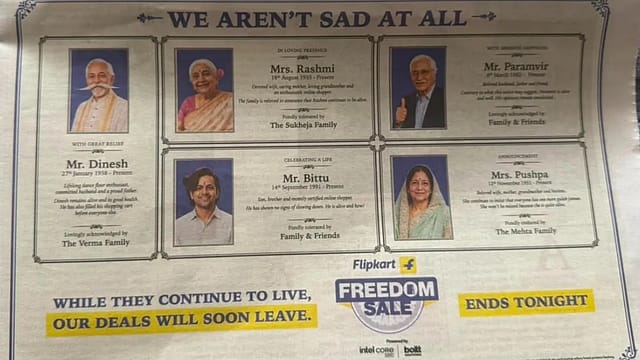
The e-commerce company recently ran a full-page newspaper advertisement designed to resemble an obituary. Five portraits appeared in memorial-style boxes, accompanied by names and dates. At the top was the line: “WE AREN'T SAD AT ALL.” The copy underneath supplied the twist: “While they continue to live, our deals will soon leave.”
The Identity Project
11 Sep 2026 - Vol 05 | Issue 37
Amit Shah leads the mission for a national demographic correction
The people were alive. The deals were dying.
It is an efficient piece of creative construction. The reader encounters something that appears solemn, recognises the incongruity, and then discovers the commercial joke. It is almost impossible to overlook.
And yet, that may be precisely the problem.
The campaign has attracted criticism, including from author Shobhaa De, who described it as “disgusting” and “insensitive” and called for a boycott. The immediate debate is about taste. The more interesting debate is about strategy.
What does the use of death imagery actually contribute to Flipkart's brand?
The answer appears to be: attention.
But attention is not an outcome. It is an input.
Advertising has spent the last decade collapsing that distinction.
The digital economy has made attention measurable in a way that brand affinity is not. Impressions, views, comments, shares and mentions arrive as neat numbers. Brand preference is slower and much less obedient to attribution models.
That creates a subtle incentive for marketers. If attention is measurable and shareability is celebrated, the creative idea begins to acquire an objective independent of the brand.
The advertisement becomes something worth discussing.
The brand becomes the publisher of the spectacle.
This is how advertising ends up optimising for the screenshot.
Flipkart's obituary campaign is not particularly interesting because it is offensive. Advertising has always flirted with bad taste. Some of the most memorable campaigns in the history of the medium have been irreverent, provocative and occasionally uncomfortable.
The question is whether the provocation is strategic or merely theatrical.
A provocative idea earns its place when the provocation reveals something about the product, the category or the brand. It should make the consumer see something differently.
Flipkart's metaphor does not appear to do that. It takes an ordinary commercial proposition — a sale is ending — and gives it an extraordinary visual treatment.
The creative device is doing almost all the work.
The sale itself remains unchanged.
That is an important distinction because a brand is not built by making every communication memorable. It is built by making the right things memorable.
The problem with manufactured shock
India has already seen what happens when attention becomes the primary objective.
In December 2024, home-salon company Yes Madam circulated what appeared to be an internal HR email announcing the termination of more than 100 employees after they reported high levels of workplace stress. The communication quickly travelled across LinkedIn and X. Employees and commentators reacted with anger.
The company later clarified that no one had been fired. The campaign, it said, was intended to draw attention to workplace stress.
By then, the campaign had acquired a different meaning.
The intended conversation was about mental health. The actual conversation became about whether a company had manufactured fear and uncertainty to generate publicity.
This is the fundamental weakness of shock marketing: the audience may remember the emotional experience while forgetting the intended message.
Worse, they may remember the brand as the source of that experience.
That is not a minor distinction. Trust is a form of accumulated brand capital. It takes years to build and can be spent in a single campaign.
Relevance is not topicality
The broader problem is the industry's increasingly loose definition of “relevance”.
Brands are encouraged to be culturally relevant, participate in conversations and respond to the moment. All of that is sensible. But topicality is not the same thing as relevance.
A brand does not become culturally intelligent merely because it comments on culture.
Tanishq's 2020 Ekatvam campaign is instructive, although for very different reasons. The advertisement depicted a Muslim family hosting a traditional Hindu baby shower for their pregnant Hindu daughter-in-law, seeking to make a statement about interfaith harmony. It was met with accusations of “love jihad” and “fake secularism”, followed by boycott calls, and was eventually withdrawn.
FabIndia faced a similar backlash in 2021 over its Diwali campaign, “Jashn-e-Riwaaz”, after the use of an Urdu phrase became the centre of a political and cultural controversy.
The lesson from these episodes is not that brands should stay away from culture.
It is that culture is not a controlled environment.
Once a brand enters a contested cultural conversation, the audience decides what the conversation is about. Context can disappear. Intent can be discarded. A brand's carefully constructed message can become raw material for somebody else's argument.
This is especially significant in India, where commercial communication increasingly intersects with identity, religion, politics and social media mobilisation.
The old advertising model assumed that the brand controlled the message and the consumer interpreted it.
The internet has reversed that relationship.
The consumer now participates in the construction of meaning.
The difference between courage and recklessness
None of this is an argument for bland advertising.
In fact, the opposite is true.
The industry needs advertising that takes risks. But risk is not synonymous with offence, and courage is not synonymous with provocation.
A brave advertisement makes a brand say something it could not have said safely five years ago.
A reckless advertisement makes the brand do something merely because people will talk about it.
That distinction is becoming increasingly important as agencies compete for attention not only from consumers but from the industry itself. Campaigns are consumed by award juries, trade publications, marketing Twitter and LinkedIn almost as much as they are by consumers.
There is a danger here.
Advertising can begin to become self-referential: created to be admired by people who create advertising.
The campaign becomes a clever object.
The consumer becomes an audience for the cleverness.
Flipkart's campaign is perhaps best understood through this lens. The idea is clever. The execution is polished. The metaphor is instantly legible.
But cleverness has diminishing returns when it is not attached to a meaningful brand truth.
Flipkart is not short of awareness. It does not need to prove that it can make people look twice.
The more difficult task is to give consumers a reason to choose it over the alternatives.
An obituary does not appear to answer that question.
The metrics problem
The industry's current measurement culture makes this harder.
A provocative campaign can produce a spectacular dashboard. Reach goes up. Mentions increase. Search interest spikes. Earned media follows.
What is much harder to measure is whether the consumer's underlying relationship with the brand improved.
Did they trust it more?
Did they prefer it?
Did the campaign strengthen an existing association?
Did it make the brand more distinctive in a useful way?
Or did it simply make the brand impossible to ignore for 48 hours?
Those are very different outcomes.
The advertising industry has become extraordinarily sophisticated at buying and manufacturing attention. It should now become equally sophisticated at distinguishing attention from value.
Because the objective of advertising was never simply to prevent the consumer from looking away.
It was to give them a reason to look — and, eventually, a reason to choose.
That is why the Flipkart campaign is worth examining beyond the question of whether it crossed a line.
Perhaps the more interesting question is why brands increasingly feel they must cross one at all.
There is nothing inherently wrong with being provocative. But provocation should be a means, not a strategy.
The best advertising does not leave the consumer impressed by the advertisement and indifferent to the brand.
It makes the idea inseparable from the advertiser.
That is the real test.
Not whether people noticed the campaign. Not even whether they talked about it. But whether, after the conversation ended, they remembered why the brand mattered.
Flipkart has won the first battle.
The more consequential one is still being fought.