Boss, Bot & Album Cover: When Nestlé’s Boss Became the Creative
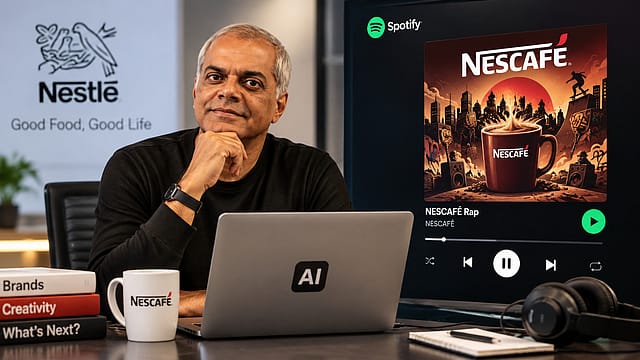
The rap was ready. The recording was done. It had even made its way to Spotify.
There was just one problem. Where was the album cover?
It was the sort of omission that might ordinarily have produced a WhatsApp message from the boss, a quick call to marketing or perhaps another round with the agency.
Manish Tiwary chose another route. The Chairman and Managing Director of Nestlé India decided to make one himself.
Or, more accurately, he got AI to make it.
Tiwary narrated the episode on LinkedIn with enough self-deprecation to ensure nobody mistook his intervention for a hostile takeover of Nestlé India’s creative department. The Nescafe team, he wrote, had got a rap written and recorded, celebrated it and put it on Spotify. But, he wondered, where was the album cover?
The Modi Years
02 Oct 2026 - Vol 05 | Issue 40
A Nation Rebuilt
Then came the chairman’s creative review.
“Hamare zamaane mein…” was invoked. The team was teased. And Tiwary, describing himself as a “completely unqualified creative director”, turned to AI to create the missing artwork.
The post is funny. The implications are considerably more interesting. Because Tiwary is not an intern discovering an image generator during lunch. He runs Nestlé India. And the company he runs has simultaneously been putting substantially more money behind advertising and its brands.
In the quarter ended December 2025, Nestlé India said consumer-focused media and advertising spending had increased 42 per cent year-on-year. More recently, during the company’s August earnings call, Tiwary made the philosophy behind that spending unusually clear.
“These brands deserve more investment,” he said.
He was talking about brands such as Maggi and Nescafe—brands strong enough, in his telling, to justify putting significantly more money behind them. Nestlé has also said its advertising investments had been growing by close to 40 per cent in recent quarters, funded partly by efficiencies elsewhere in the business.
This makes the AI album cover more than a cute chairman-on-LinkedIn moment. Nestlé India is spending more on brands at precisely the moment when technology is making one of advertising’s oldest organisational boundaries increasingly porous.
The client could always reject the creative. Now the client can make one.
Everybody is a Creative Director Now
For decades, advertising depended upon a reasonably well-understood division of labour.
The company had the product. The marketing department had the brief. The agency had the idea. The creative department turned the idea into something people could see, hear or remember. The client approved it, rejected it, mutilated it through seventeen rounds of feedback or occasionally left it alone.
AI has introduced a mischievous new participant into this arrangement: The prompt.
Suddenly the distance between I have an idea and here is what my idea looks like can be measured in seconds. A chief executive does not have to explain the picture in his head to the chief marketing officer, who explains it to the brand manager, who puts it into a brief, which goes to the agency, where somebody interprets it before an art director finally creates something.
The chief executive can type. The machine can draw. And the next meeting can begin with the most terrifying sentence an agency creative may hear in the AI age: “I made something last night.”
Tiwary is clearly having fun. His description of himself as a “completely unqualified creative director” is precisely what makes the post work.
But there is an accidental truth buried inside the joke. AI does not confer creative expertise. It confers creative capability.
The distinction may become one of advertising’s biggest arguments.
A person who could previously imagine an advertisement but could not execute one can now produce something resembling an advertisement. A founder can generate packaging. A marketing head can make a storyboard. A CEO can produce an album cover. A salesperson can write copy. A finance executive can make a campaign mock-up before the agency has opened the brief.
The democratisation is extraordinary. So is the possibility of creative chaos.
Marketing and advertising experts see the distinction between access and expertise as central to what AI is doing to advertising.
“AI has democratised execution, but it has not democratised judgement,” reckons Ashita Aggarwal, professor of marketing at SP Jain Institute of Management & Research. Almost anyone can now make a visual, write copy or create a rough campaign in minutes. The more difficult question is whether it is right for the consumer, right for the brand and right for the cultural moment. “That is where creative expertise continues to matter,” she adds.
The distinction becomes even more interesting when the person prompting the machine also happens to occupy the most powerful chair in the organisation.
An intern’s AI mock-up is a suggestion. The chairman’s AI mock-up can accidentally become a brief.
From Approval to Prompt
Advertising agencies have survived many supposed assassins.
Desktop publishing was going to change creativity. Digital agencies were going to kill traditional agencies. Social media was going to eliminate expensive production. Influencers were going to replace celebrities. In-house creative teams were going to make external agencies redundant.
The agency survived. AI is different in one important respect. It does not merely introduce another medium. It puts rudimentary versions of several agency capabilities directly into the hands of the client. Copy. Visualisation. Storyboards. Music. Voice. Video. Research. Variations. Presentations. Not necessarily brilliant versions. But versions.
That matters because much of the friction in advertising has historically existed between imagination and execution.
“I want something younger.”
“What does younger mean?”
“More premium.”
“What does premium look like?”
“Can we make it edgier?”
“How edgy?”
The agency translated adjectives into advertising. Generative AI allows the client to answer with an image. Like this. The creative conversation changes immediately. The danger for agencies is therefore not simply that AI becomes good enough to replace an art director. It is that AI becomes good enough to make clients believe they no longer need one for certain jobs.
The danger for clients is almost the reverse. They may begin to believe that because they can produce an image, they have produced an idea.
Nescafe Wants to Stay Young
There is another reason Tiwary’s experiment feels appropriate for the brand involved.
Nescafe has spent years trying to remain culturally young while selling a product considerably older than its target consumers. Its communication has moved through music, youth culture, digital storytelling and cold-coffee occasions. The brand has historically worked with McCann India, including campaigns that played with NESCAFÉ’s famous sonic identity.
Rap is, therefore, not an arbitrary detour. Neither is Spotify. Neither, increasingly, is AI.
The interesting inversion in Tiwary’s post is generational. The younger team made the rap. The chairman made the AI artwork. The man invoking “hamare zamaane mein” reached for one of iss zamaane ke most disruptive creative tools. That may be the best joke in the entire episode.
But it also says something about how quickly generative AI has escaped the technology department. Companies once discussed AI as infrastructure. Then as productivity. Then as marketing technology. Now the chairman can use it because an album cover annoys him. That is adoption.
Nestlé India itself has been signalling a broader technology push. At the company’s AGM in July, Tiwary said it was stepping up investment in digital and technology, with the objective of embedding data-led discipline across operations, sales and distribution. The company identified technology-enabled sales and operations alongside consumer centricity, penetration-led growth and reinvestment behind brands among its priorities for the next three to five years.
The album cover obviously does not belong in the same strategic bucket. That is precisely why it is interesting. AI has become casual.
The ₹ Question
There is also money at stake.
Nestlé India’s advertising acceleration is substantial. In the June quarter, advertising expenditure was reported to have risen by more than 40 per cent year-on-year.
Tiwary has been equally clear that this is not indiscriminate spending. Nestlé tracks returns, including ROAS on digital investment, and intends to keep investing when brands produce the desired returns.
That creates a fascinating tension for the advertising business. Brands may spend more on advertising while simultaneously using AI to reduce the cost of producing parts of advertising. More money need not mean more money for agencies. The money can move towards media, creators, platforms, commerce, performance marketing, technology and increasingly sophisticated content systems while routine creative execution becomes faster and cheaper.
That is why the most important question raised by Tiwary’s album cover is not: Was the AI artwork good?
It is: What part of the advertising value chain was somebody previously being paid to perform?
If AI can do that part in thirty seconds, the agency needs to demonstrate that its value existed somewhere else. Strategy. Taste. Cultural intelligence. Originality. Brand memory. Judgement. The ability to tell the chairman that his idea is terrible, especially the last one. Because AI has a structural disadvantage as a creative partner to powerful executives. It does not fear them. But it also does not necessarily challenge them. Prompt it enthusiastically enough and the machine will happily produce Version 14 of an idea that should perhaps have died at Version 1.
A great agency, at least theoretically, can say no.
Aggarwal believes this may ultimately become one of the agency’s most valuable functions in an AI-heavy marketing organisation.
“The agency’s future value cannot simply be that it knows how to make something,” she says. Increasingly, the client can make something too. The value has to move towards knowing what deserves to be made—and sometimes having the conviction to say that something should not be made at all. “AI can give a senior executive twenty executions of an idea. It cannot remove the organisational power attached to that executive’s idea,” she adds.
That changes the old client-agency argument in a subtle but important way. The agency was once paid partly because the client could not execute. Increasingly, it may have to justify its existence because it can judge.
The Boss Has Photoshop Now
There was a time when senior executives could sketch an advertisement on paper.
Many did. David Ogilvy famously dealt with clients who had extremely strong views about advertising. Founders have always interfered in logos, copy, packaging and campaigns. The battle between commercial authority and creative authority predates artificial intelligence by decades.
AI has not invented the interfering client. It has armed him.
That is why Tiwary’s post deserves to be read with affection rather than alarm. He is laughing at himself. There is no evidence here of Nestlé replacing an agency or of a chairman embarking upon a second career in art direction.
The incident is interesting because it is so ordinary. No transformation programme. No AI centre of excellence. No consultant’s PowerPoint about the future of work. A rap needed a cover. The boss opened AI. A cover appeared.
That mundane sequence may tell us more about where generative AI is heading than another corporate announcement promising “AI-led transformation”.
The technology disappears when people stop describing themselves as AI users. They simply use it. And advertising may be among the first industries to discover what happens when everybody who once sat across the table from the creative department acquires a little creative department of their own.
Agencies are unlikely to disappear because a chairman can generate an album cover. But the comfortable assumption that execution itself carries significant value is becoming harder to defend.
The machine can execute. The agency increasingly has to prove why it thinks better. Why it understands culture better. Why it understands the consumer better. Why its idea deserves to exist before anybody asks AI to make it beautiful.
That could ultimately be good for advertising. It could force agencies away from selling labour and towards selling judgement. It could also produce a spectacular amount of mediocre work made incredibly efficiently.
For now, Nescafe still has its marketing team. It still has creative partners. And Manish Tiwary remains Chairman and Managing Director rather than Executive Creative Director.
But somewhere between a rap reaching Spotify and its missing artwork reaching LinkedIn, one small piece of the traditional advertising hierarchy vanished. The chairman did not call the agency. He called the machine. And the machine did not ask for another week.
(DISCLAIMER: The lead visual for this story was created using AI—just as Manish Tiwary turned to AI to create the missing cover for NESCAFÉ’s rap. The boss prompted his cover. We prompted ours. No agency was called in either case)