What’s Behind Too Yumm!’s ‘Korean Co-Star’ Mystery?
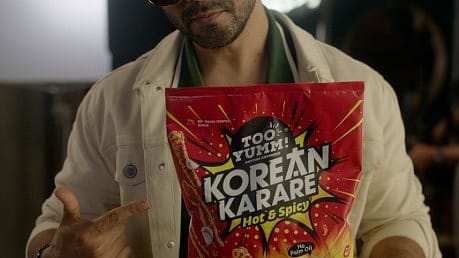
At a time when India’s snacking aisle is being reshaped as much by content as by consumption, Too Yumm! is leaning further into the Korean wave. The RP–Sanjiv Goenka Group-owned brand has launched Korean Karare, a spicy, umami-forward offering that builds on its growing portfolio of Korea-inspired products.
But the play here goes beyond flavour.
Timed with the Indian Premier League (IPL)—arguably the country’s largest annual media moment—the campaign has been designed less like a traditional product launch and more like a piece of entertainment. Rolled out as a paparazzi-style narrative, it teased audiences with glimpses of a “mysterious Korean co-star,” using intrigue and speculation to drive engagement before revealing the product itself.
Actor Varun Dhawan anchors the campaign, appearing in a playful avatar that sustains the curiosity loop. The format reflects a wider shift in how brands are approaching storytelling—moving away from direct messaging towards formats that invite participation, decoding and shareability.

Open Minds 2026
26 Jun 2026 - Vol 05 | Issue 26
The power of ideas and arguments in 50 portraits
This approach is consistent with Too Yumm!’s evolving marketing playbook. In the past, the brand has experimented with edible IPL posters and creator-led formats, positioning itself at the intersection of pop culture and snacking. With Korean Karare, it appears to be extending that strategy into a more structured, culture-first narrative.
The choice of Korea is also deliberate. Over the past few years, the rise of K-dramas, K-pop and Korean food culture in India has created a fertile ground for brands to tap into. From instant noodles to packaged snacks, companies across categories have begun experimenting with Korean flavours—often adapting them to suit Indian taste preferences.
Too Yumm! had entered this space earlier with its K-Bomb Ramen range, followed by products like Spicy Korean Banana Chips. These launches helped the brand test consumer appetite for global flavours that are bold, spicy and distinctly different from traditional Indian profiles.
Korean Karare builds on that learning. Positioned as a non-fried snack made with rice bran oil, it continues the brand’s “better-for-you” pitch while leaning heavily into flavour intensity—an increasingly important lever in a category where health claims alone are no longer sufficient to drive repeat consumption.
“India’s snacking landscape is being shaped by cultural crossovers. Consumers are discovering flavours through content, and engagement today is driven as much by relevance as by reach,” said Yogesh Tewari, Chief Marketing Officer, Too Yumm!. “For us, that means moving beyond product launches to building cultural moments that can travel.”
The comment underscores a broader shift in FMCG marketing. As younger consumers spend more time on short-form video platforms and streaming content, discovery is increasingly happening through cultural exposure rather than traditional advertising. This has pushed brands to think of themselves not just as product makers, but as participants in ongoing cultural conversations.
Within this context, Too Yumm!’s Korea strategy appears to be less about a one-off trend and more about building a sub-category within its portfolio. The brand already operates across chips, namkeen, multigrain snacks and extruded formats, and the Korean range allows it to layer on a distinct identity anchored in global flavours.
Distribution, too, reflects changing consumption patterns. Korean Karare is available across general trade, modern retail, the brand’s D2C platform, and quick commerce channels such as Blinkit and Swiggy Instamart—platforms that have become critical for impulse-driven categories like snacking.
Priced at ₹5, ₹10 and ₹35, the product straddles both mass and urban convenience segments, indicating an attempt to scale beyond niche, trend-led consumption.
The larger question, however, is whether Korea-inspired flavours can sustain momentum beyond their current cultural peak. For now, Too Yumm! seems to be betting that the convergence of content, curiosity and consumption will continue to shape what India snacks on—and how those snacks are sold.