The Jeera Ceiling: Can Lahori Zeera Survive Coca-Cola, Pepsi and Campa?
On August 23, The Times of India woke up calling itself The Thanda of India.
Lahori Zeera had wanted the newspaper on Independence Day. It discovered that half of corporate India appeared to want the same thing, pushing up rates and crowding the available advertising inventory. The homegrown beverage company moved its takeover by eight days and turned defeat into copy. Indian identity, the campaign argued, did not have to expire at midnight on August 15.
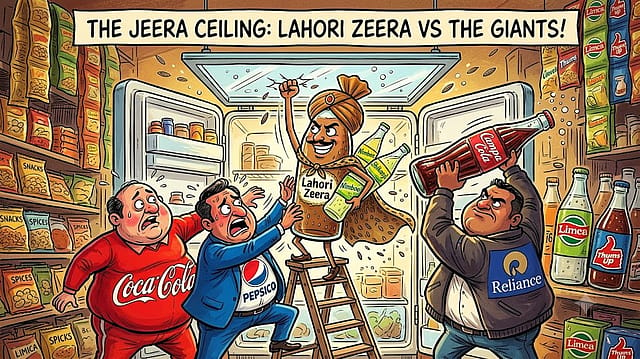
The advertisement looked like a declaration of war on multinational cola. Its most dangerous word was “Zeera”.
Cumin gave Lahori its flavour, its fame and its reason to exist in a refrigerator dominated by sweet brown cola, neon orange fizz and lemon-lime sameness. It supplied an Indian taste, an after-meal occasion and a distinction Coca-Cola and Pepsi could not erase merely by buying more television time.
The Modi Years
02 Oct 2026 - Vol 05 | Issue 40
A Nation Rebuilt
Now the insurgent wants to become national. The flavour that opened the door may also define the size of the doorway.
Can a company known to India as Lahori Zeera persuade the country to buy Lahori Nimboo, Lahori Shikanji, Aamras and Masala Cola? Can “Lahori” become the masterbrand while “Zeera” steps down from identity to product variant? And can one independent company build the manufacturing, distribution and refrigeration muscle required to fight Coca-Cola, PepsiCo and Reliance at the same ₹10 price point?
India’s beverage history is littered with adored local drinks whose owners eventually sold, disappeared or required resurrection by a conglomerate.
THE ₹775-CRORE OPENING ACT
Lahori is already too large to be treated as a charming regional curiosity.
Archian Foods, founded in Punjab by cousins Saurabh Munjal, Saurabh Bhutna and Nikhil Doda, began selling Lahori Zeera in 2017. Its operating revenue rose from ₹312 crore in FY24 to ₹540 crore in FY25, an increase of 73 per cent. The company says it closed FY26 at approximately ₹770–780 crore and is targeting ₹1,200–1,300 crore in FY27. The FY25 financial statements and its expansion plan describe a business growing faster than many famous consumer brands.
Since 2019, Lahori says it has sold everything it could produce; its founders identify manufacturing capacity as the constraint. More than half its volumes now come from outside North India, and it reaches an estimated eight to ten lakh retail outlets.
As FY25 revenue expanded, profit remained near ₹25 crore. Procurement costs rose more than 70 per cent to ₹316 crore. Transportation costs more than doubled to ₹52 crore. Total expenditure climbed from ₹278 crore to ₹499 crore. Lahori spent about 90 paise to earn every rupee, while its EBITDA margin stood near 10 per cent.
The broom is sweeping beautifully. The handle is becoming expensive.
A new challenger begins in the corners incumbents have neglected. It finds consumers priced out of larger packs and retailers willing to try something different. The next phase demands that it clean the entire house without running out of stock or cash.
That is where the cola war moves from advertising to asphalt.
THE ROAD BETWEEN FACTORY AND FRIDGE
Soft drinks are heavy, inexpensive and impatient. A bottle sold for ₹10 cannot travel indefinitely without freight consuming its economics. A campaign may create desire across India in one afternoon. The product still has to arrive chilled at the correct shop before thirst chooses something else.
General trade currently contributes 97–98 per cent of Lahori’s volumes. The company expects to manufacture from eight locations, using owned plants and co-packers in places including Mohali, Lucknow, Vapi, Bengaluru, Bihar, Agra, Bhopal and Muzaffarnagar. Its co-founder has acknowledged that a national beverage brand ultimately requires 20–25 manufacturing units.
Coca-Cola’s largest Indian bottler alone operates 14 plants across ten states. Reliance can place Campa inside a retail ecosystem that extends from neighbourhood distribution to supermarkets and quick commerce. PepsiCo can protect price points, launch pack sizes and deploy decades of bottling relationships.
Lahori must build much of that machinery while defending the affordability that created its ascent.
The ₹10 bottle can also become a trap. When Campa and Lahori made gains at the mass price point, the established players responded with cheaper packs. A diversified giant can tolerate a bruising price fight in one segment. A focused challenger has fewer places to hide the bruise.
The market-share headlines also deserve a cold reading. Campa and Lahori together nearly doubled their share to around 15 per cent during January–September 2025, while Coca-Cola and PepsiCo’s combined share slipped to approximately 85 per cent. That 15 per cent belongs to two challengers, one of which is backed by India’s largest company. It is not Lahori’s standalone conquest.
The solo warrior is therefore fighting four battles: against multinational capital, Reliance’s distribution, its own transport bill and the geographical distance between a Punjab-born taste and a national palate.
WHEN A PRODUCT BECOMES THE COMPANY
The name Lahori Zeera performs brilliantly on a bottle of jeera soda. It signals a familiar, chatpata flavour before the cap is opened. That precision becomes complicated when the portfolio expands.
Lahori’s own website has begun doing the necessary linguistic surgery. It describes a “Lahori lineup” and presents Zeera, Nimboo and Shikanji as its cast of flavours. The corporate task is clear: persuade consumers that they love Lahori, then allow them to choose what follows it.
Consumer memory may refuse to cooperate. People frequently collapse a company into its first famous product. That becomes restrictive when the same name must represent several different promises.
Lahori’s proposed extensions reveal the strategic fork. Nimboo and Shikanji remain within the company’s desi, spiced-refreshment universe. Aamras removes carbonation. Masala Cola walks directly into the giants’ core territory. Each addition increases the addressable market while asking the parent name to work harder.
Keeping every extension close to the original would preserve Lahori as an ethnic-flavour specialist. Stretching widely could produce another beverage label with no sharp reason to be chosen.
Zeera is simultaneously the moat and the ceiling.
“‘Zeera’ gives Lahori sharp memory and cultural ownership,” says Ashita Aggarwal, professor of marketing at SPJIMR. "Its next phase depends on making ‘Lahori’ transferable across drinking occasions," she adds. Nimboo, Aamras and Masala Cola must feel like members of one beverage family. A dominant flagship often leaves every extension looking like a cousin visiting the refrigerator. Lahori must preserve the distinctiveness that created demand while building a masterbrand large enough to travel nationally. "That balance will decide whether Zeera remains its greatest asset or becomes its growth ceiling,” she reckons.
INDIA’S FRIDGE OF DEFEATED CHALLENGERS
Campa Cola supplies the darkest historical warning.
Pure Drinks launched Campa after Coca-Cola left India in 1977. It became part of a generation’s taste and memory. When economic liberalisation brought Pepsi and Coca-Cola back with sophisticated distribution and enormous marketing budgets, Campa faded. Its Delhi plant and offices eventually closed. The name survived largely as nostalgia until Reliance acquired it in 2022 and relaunched it the following year.
Campa needed one of India’s deepest balance sheets to begin its second life. Indian identity, affordability and nostalgia had failed to keep its bottles in refrigerators.
Thums Up offers a stranger ending.
Ramesh Chauhan created it after Coca-Cola’s exit and built a stronger, spicier cola that became India’s leader. When Coca-Cola returned, Chauhan sold Thums Up, Limca, Gold Spot, Citra and Maaza in 1993. Thums Up possessed a following too powerful to extinguish, and Coca-Cola eventually invested behind it. By 2021, it had crossed $1 billion in annual retail sales.
Gold Spot and Citra were phased out as Fanta and Sprite occupied adjacent flavour spaces. Acquisition can preserve a challenger, reposition it or remove it.
Lahori’s opportunity is to write the missing fourth ending: scale without disappearance, surrender or resurrection by a conglomerate.
There is a strong case that “Zeera” will protect Lahori rather than confine it.
Broad appeal can be overrated in beverages. Red Bull built a global empire around an unusual flavour. Dr Pepper’s peculiar formulation created an identity durable enough to overtake Pepsi in US carbonated-soft-drink sales in 2024. Thums Up survived because Indian drinkers would not exchange its strength for a smoother substitute.
Distinctiveness makes Lahori harder to replace. Coca-Cola and Pepsi can match the ₹10 pack more easily than they can make a cumin drink feel culturally credible. Reliance can buy scale for Campa, but it cannot instantly manufacture the years of association Lahori has accumulated around masala fizz.
Lahori could dominate Indian flavours while using separate brands for distant occasions. Parle Agro did not rename every product Frooti; it built Appy Fizz, Bailley and other identities around different propositions.
That may become Lahori’s defining decision. Does it stretch one increasingly famous name across the refrigerator, or use the cash and distribution created by Zeera to build new brands that can stand beside it?
Stretching Lahori is faster and cheaper. Building separate brands demands greater investment but protects clarity. Both become harder while factories, distributors and states are being added simultaneously.
AFTER THE HONEYMOON
The August newspaper takeover announces confidence. Its more important message may be that Lahori no longer wishes to be judged as a regional challenger. A company calling itself an Indian alternative to multinational beverages invites comparison with the entire national machine.
Patriotism earns attention; distribution replenishes the refrigerator.
The next ₹500 crore will come from markets where Lahori is less familiar, from pack sizes beyond its ₹10 hero and from consumers who may enjoy jeera without wanting it every time they feel thirsty. Larger packs currently contribute only about 16–17 per cent of revenue. South India remains the next major frontier. Modern trade, institutions and quick commerce are only beginning to matter.
Lahori has raised capital, is expanding capacity and has preserved profitability while growing at extraordinary speed. Its founders built distribution before pouring money into fame.
Early success cannot disguise the approaching difficulty. Creating a loved drink is the audition. Financing summer inventory, securing cold availability, defending retailer economics and surviving a price response from three giants constitute the role.
Lahori has already turned an Indian flavour into a ₹775-crore company. National scale will test whether the company can grow beyond its founding flavour while preserving its power.
The first battle was getting India to drink jeera with fizz. The next is preventing Coca-Cola, Pepsi and Reliance from drinking Lahori’s lunch.