Canva Has Jio. Adobe Has Airtel. Inside the Battle for India's Next Generation of Creators
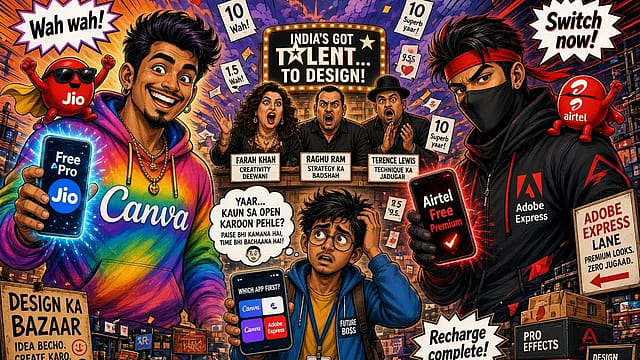
Raghu Ram has run out of objections. Adobe hasn’t.
In Canva’s recent Indian campaign, the familiar authorities of television talent shows encounter an unfamiliar problem: people whose work leaves them with little to criticise. Farah Khan, Raghu Ram and Terence Lewis supply the judging credentials. Canva supplies the creative assistance. The people seeking approval arrive with something they are proud to show.
It is a satisfying little fantasy for anyone who has ever feared a raised eyebrow across a desk.
Outside the advertisement, however, another judge has brought a comparison chart.
Adobe’s Indian website explicitly sets Express against Canva, invites people to switch and promotes a complimentary year of Express Premium for Airtel customers. Canva, meanwhile, has partnered with Jio to put its premium tools into eligible subscribers’ hands for 12 months.

The Health and Wellness Issue
25 Sep 2026 - Vol 05 | Issue 39
The celebrities might have surrendered. The competitor has a telecom partner.
That is what makes Canva’s campaign more interesting than three famous people discovering that artificial intelligence can tidy up a presentation. A creative-software contest is being carried into India’s mobile economy through two of its most familiar distribution networks.
Canva wants to become the natural choice for people who have something to make. Adobe wants them to remember that it, too, can make the job easy.
The next creative habit is available for audition.
THE JUDGES HAVE LOST THEIR VETO
Created by Fundamental, Aap Aur Canva, Jodi Wah Wah! is reportedly Canva’s biggest Indian brand campaign. Its Hindi and Tamil films address creators, working professionals and small businesses. The tools featured include AI-assisted presentations, video creation and Magic Layers.
The casting does more than rent recognition.
Reality television has built an entertainment economy around the privilege of saying no. Contestants arrive with hope; judges arrive with the authority to puncture it. Canva borrows that hierarchy and gives the nervous participant technological backup.
The satisfaction comes from watching judgment lose its teeth.
Read as a brand argument, the joke turns an intimidating activity into an invitation. You have an idea. You have a deadline. You might even have a business. Must a lack of software fluency be allowed to stop the entire production?
Canva’s answer is designed to feel liberating. The aspiring creator need not first become an expert in the machinery of creation.
That is an especially useful promise for someone whose ambitions are larger than their budget. A small-business owner may need a sale announcement before needing a visual identity system. A working professional may need to finish a deck before developing a passionate relationship with typography.
For these users, competence has an immediate, practical meaning: can I make something usable without turning this task into another occupation?
Canva makes that question feel less embarrassing to ask.
Marketing and branding experts reckon that the audience here includes people who would never describe themselves as designers. They have a business to promote, a presentation to finish or something to say. Canva’s advertising gives them permission to attempt the job themselves. "Making intimidating judges applaud is a clever way of dramatising that confidence," says Ashita Aggarwal, professor of marketing at SP Jain Institute of Management & Research.
ADOBE HAS AN EXPRESS ENTRANCE
There is a trap in treating this as the plucky, easy-to-use challenger attacking an incumbent that insists everyone learn Photoshop.
Adobe already sells the shortcut.
On January 29, Airtel announced a partnership offering its 360 million customers access to Adobe Express Premium free for a year. The offer covered mobile, Wi-Fi and DTH customers and could be claimed through its app without a credit card. The announcement explicitly courted students, creators, small businesses and marketers.
The overlap with Canva’s audience is substantial.
Express lets Adobe approach customers who may never want the depth of its flagship professional applications. Its pitch includes templates, quick editing and generative AI, with the reassurance of a familiar creative-software name behind the simpler experience.
And Adobe is quite willing to name its rival. Its Express comparison page places Canva alongside its own plans and promotes connections to applications such as Photoshop and Illustrator.
Adobe is using its professional heritage to sell convenience: ease need not require leaving the family.
Canva, therefore, faces a more demanding assignment than making professional software look intimidating. It must make its own version of easy more attractive, more familiar and more useful.
The customer with a poster to finish is unlikely to feel obliged to honour either company’s place in design history.
THE RECHARGE ENTERS THE CREATIVE BRIEF
Jio’s Canva offer applies to eligible recharges from September 16. Its published terms provide 12 months of Canva Pro with the ₹399 recharge, and Pro Lite with the ₹349 plan or specified other eligible plans. The offer is restricted to users who have never paid for a Canva subscription, with continued access tied to maintaining an eligible active Jio plan.
That restriction makes the acquisition pitch clear: bring first-time premium users through the door without asking them to pay separately for the software.
The telecom relationship supplies the route. The free year reduces the price hurdle. The campaign supplies a reason to care.
Adobe and Airtel had established their arrangement months earlier. Canva and Jio now place another creative proposition within a familiar subscriber relationship. The two offers make distribution part of the competition alongside product and advertising.
A person who would never search for a design subscription might encounter one while checking mobile benefits. A student who would hesitate over another annual bill can try premium features. A shopkeeper can discover a tool through a service already used for other necessities.
The software has found a seat beside the recharge. A telecom bundle can put a creative tool within reach, but the first successful task gives the customer a reason to return. “That is where Canva and Adobe have to compete," says Aggarwal. When someone needs another poster or presentation, which app feels easiest to begin with? Familiarity built through small, repeated successes can become a stronger advantage than the introductory offer.
For the telcos, such benefits can also give customers another reason to value the relationship. Their apps become places to collect useful services, extending the conversation beyond data allowances and network coverage.
Of course, eligibility is only the first step. The user must claim the benefit, make something and find a reason to return. A large subscriber base supplies opportunity; it does not automatically supply an active creative community.
Both partnerships ultimately depend on what happens after the congratulations screen.
THE TARGET GROUP HAS A JOB TO FINISH
Calling this a fight for Gen Z captures only part of the opportunity.
Canva’s campaign groups its audience around what people need to do: create content, communicate at work and market a business. Age can shape those activities, but it does not own them.
The ambitious shopkeeper and the ambitious intern may have more in common here than two people born in the same year. Both need presentable work, quickly. Both may be making something for an audience whose expectations exceed their production budget.
That gives the category a wider cultural opening. Looking polished becomes attainable before hiring a team becomes affordable.
There is a mobile logic, too. Company figures reported in September put the share of Canva’s Indian Visual Suite users creating on phones above 70%. For that audience, a desktop professional’s workflow is a poor starting assumption.
Imagine a neighbourhood baker photographing a cake, making a promotional post and sending it to customers from the same device. The practical attraction is the short distance between the product and the pitch.
Win enough of those small tasks and a platform can become part of running the business. Saved work, familiar controls and reusable brand material give the next task somewhere obvious to begin.
That is the habit both Canva and Adobe want: the moment when a customer stops choosing software and simply opens an app.
EVERYBODY WANTS THE BEGINNER—AND THE EXPERT
The global contest complicates the easy division between Canva’s amateurs and Adobe’s professionals.
Canva’s professional ambitions are explicit. Its Affinity application brings photo editing, vector design and page layout together, with the core software available free. Its recently announced ProSuite connects Affinity, Cavalry, Flourish and Leonardo, presenting a broader proposition for professional creative work.
Adobe, through Express, makes its own case to people seeking simpler tools. The companies are approaching each other from different histories while expanding the territory they want to serve.
The attractive customer can begin with a small task and grow into a much more demanding one. A homemade poster becomes a business’s recurring marketing calendar. A solo creator begins working with collaborators. A presentation becomes the first of a hundred.
Canva wants room for that progression. Adobe wants its professional heritage to remain useful even when the customer starts with an uncomplicated task.
This is why the free trial is only one chapter of the rivalry. A platform needs to remain attractive when a customer’s expectations increase. Otherwise, it becomes the place that taught someone to create before sending them elsewhere to get serious.
Conversely, greater sophistication can bring complexity. A service admired for making things easy must take care that its expanding ambitions do not make the ordinary user feel like a visitor at somebody else’s professional conference.
APPLAUSE IS NOT A DESIGN PRINCIPLE
Canva’s advertising also contains a delicious tension: a campaign celebrating creativity makes universal approval look like the prize.
In the commercial, that is a neat way to dramatise confidence. In actual creative work, disagreement can be useful. Sometimes the awkward question improves the idea. Sometimes the presentation needs fewer slides. Sometimes the correct response to another visual flourish is to remove it.
Producing a finished-looking object and deciding whether it deserves to exist remain different skills.
Templates and AI can help more people participate. They can also make familiar visual solutions easier to repeat. If every business reaches for the same cues of professionalism, looking polished may cease to be much of a distinction.
Canva itself acknowledges the value of craft in its ProSuite announcement, arguing that an abundance of generic AI content makes skilled creative work more valuable. That is a useful counterpoint to the frictionless applause of the Indian campaign.
The brand must reassure beginners that they can start while giving experienced creators reasons to keep demanding more.
Adobe faces its own version of the task. Professional credibility helps only if the everyday customer can feel its benefit. A celebrated software pedigree is of limited comfort when someone cannot finish a simple job.
Then comes the commercial examination: the complimentary year ends. The customer can pay, use a free tier, choose a rival or decide that the extra features were pleasant but dispensable.
Free access postpones the price question; it does not settle the value question. “By the time the offer ends, the platform needs to have earned a place in how the customer works," says Aggarwal. The tougher test is whether users value what they can accomplish with it enough to keep paying. A celebrity can make the promise memorable. "The experience has to make it worth keeping,” she adds.
Canva’s films make approval entertainingly easy. Its partnership makes premium access easier to try. Adobe has its own product, its own distribution partner and a very explicit invitation to switch.
The decisive performance will happen when the next task arrives and the customer reaches for the phone. Farah, Raghu and Terence can put their scorecards away. The customer still has a thumb.