Just Google It. Or Ask ChatGPT? The Battle to Become India’s First Answer
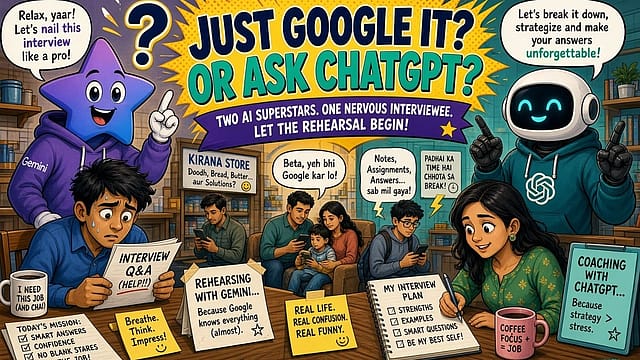
The interview has not begun. The competition has.
In ChatGPT’s first integrated India campaign, a young woman prepares for a job interview with help from the AI assistant. In a Google Gemini film, a man in a shirt and tie rehearses for a sales-manager interview at his mother’s kitchen table. Two candidates. Two phones. Two technology companies hoping to be remembered when somebody needs a little help becoming the person they want to be.
Neither candidate needs to explain a large language model. Each needs to get through tomorrow.
That is where this advertising contest becomes interesting. The familiar question about which AI is smarter gives way to a more intimate one: when an Indian consumer feels stuck, which name arrives first?
Just Google it. Or ask ChatGPT?

Losing Memory
16 Oct 2026 - Vol 05 | Issue 42
The making of a medical and social emergency
For years, the first phrase made a brand name sound like common sense. The second now offers a competing instruction. India’s AI advertising is trying to put that choice into everyday life, one interview, household problem and half-formed ambition at a time.
The prize is the reflex before the question.
The Target Group Has a Problem
It would be tempting to draw a neat demographic border: ChatGPT for the young and ambitious; Google for everyone already comfortable with Google. The campaigns make that division difficult to defend.
ChatGPT’s December 2025 India launch used two films directed by Bharat Sikka, with a rollout in seven Indian languages across television, streaming, digital, print and outdoor. Voice and linguistic familiarity were central to the proposition. The interview film made preparation an accessible starting point.
Google’s seven-film Gemini series, published by production house First December Films in May 2026, spread its attention across an interview candidate, shopkeepers, an aspiring creator and an older couple choosing an air conditioner. The films also covered a passport, a GST return and a maturing fixed deposit.
Read together, the casting suggests a target group better described by a predicament than a birth year: people who know what they want to do but are uncertain about the next step.
Age still matters to media planning. Income, occupation and geography still shape access. The creative appeal, however, travels across those boxes. A young jobseeker and an older shopkeeper can share the same uncomfortable distance between wanting to do something and feeling equipped to attempt it.
AI enters that distance with an offer of assistance.
This is a reading of the work, rather than evidence that the companies have identical audience plans. But the overlap is visible enough to puncture the easy story of two brands courting two separate Indias.
Both want the India that would like to feel more capable. And both have discovered that capability sells better when it has something due tomorrow.
Google Has a Verb to Defend
Google’s advantage begins before an advertisement starts. “Google it” already supplies a familiar answer to the problem of not knowing. ChatGPT’s opportunity is to expand what people expect from the act of asking.
An interview rehearsal illustrates the shift neatly. The consumer can seek information about common questions. They can also seek practice, feedback and another attempt. The advertising asks them to imagine technology participating in the task.
Google is making that invitation too. Its Gemini interview film is precisely why this cannot honestly be written as a contest between an old search box and a new conversational assistant. Both companies are advertising help that extends beyond locating information.
Their starting positions nevertheless create different marketing problems. Google must persuade people that a familiar name can accommodate a broader behaviour. ChatGPT must persuade them that its name deserves to be the starting point for more of their lives.
The incumbent can benefit from recognition. It can also be confined by an old mental picture of what it does. The challenger can benefit from a newer association with conversational AI. It must still turn that association into a reason to return after curiosity has worn off.
This is the competitive tension the ads expose. They do not establish that either company has won it. A compelling demonstration is evidence of a pitch, not of customers switching allegiance.
Google’s own advertising history offers a useful parallel. Its “Parisian Love” film, shown during the 2010 Super Bowl, told a romance through successive searches, travelling from studying abroad towards marriage and parenthood. A functional interface acquired emotional meaning because it accompanied a life.
The instinct survives. Put the technology beside something that matters to a person. The contemporary argument is over how much of that journey the product can help with—and whose name the person remembers along the way.
When Anupama Meets the Algo
Google’s collaboration with JioStar takes this contest into an especially revealing setting: the television serial.
The partnership brings Google Search’s AI Mode into Anupama and Yeh Rishta Kya Kehlata Hai through vignettes and in-show integrations. The advertised situations include household budgets, career decisions and children’s education. In the Anupama brand film, uncertainty about the first steps towards building a house becomes an occasion to try AI Mode.
Here, the product distinction matters. Search’s AI Mode and the Gemini assistant are separate Google offerings. The campaigns should not be bundled into one imaginary commercial. Strategically, however, they show two routes through which Google is making conversational assistance familiar: an assistant people can try and a new experience under the Search name they already recognise.
Anupama gives Google something a product demonstration cannot supply on its own: a familiar face in a familiar living room. Viewers already know the character. Her curiosity about AI gives them a way to approach it themselves.
The demonstration can make the viewer’s first question smaller. Instead of wondering what this entire technology means, they can recognise a task they have struggled with themselves.
It also gives the AI race a wonderfully Indian staging. Companies discussing the future of intelligence still need a place in the family’s evening viewing.
There is a practical argument beneath the irony. An advertisement reaching the person who manages household decisions can make everyday usefulness visible beyond the office, the campus and the technology enthusiast’s feed.
The domestic setting deserves to be read as a site of decision-making. Calling it merely a way to reach “non-tech users” understates the work being done there—and the commercial importance of being invited to help.
Th Hero Doesn't Need to Code
ChatGPT has been widening its cast too. Its “Everyday Superheroes” campaign in April 2026 comprised seven films set in IPL home cities, with distribution announced across more than 150 television channels and over 25 digital platforms in nine languages.
In “Bala vs Waterfall”, a leaking water purifier becomes the problem through which ChatGPT-assisted resourcefulness turns an ordinary man into a neighbourhood hero.
The exaggeration is recognisably advertising. The strategic ambition is clear: give the user the satisfying role of the person who managed to sort things out. An abstract promise of intelligence becomes a small, socially legible achievement.
That broadening continued with OpenAI’s recent announcement of a multi-year partnership with Sachin Tendulkar. The launch film includes Tendulkar asking ChatGPT to identify him through ten questions. He also described being introduced to the service by his daughter Sara while planning a family holiday.
Google, meanwhile, brought Shah Rukh Khan into its Gemini advertising in August, in work created with Prasoon Joshi, McCann India and Nirvana Films to make the tool more approachable, particularly in smaller towns.
Sachin versus Shah Rukh would make an irresistible thumbnail. It would also shrink the story.
The more useful question is what their familiarity does for an unfamiliar behaviour. A celebrated person trying something can offer the audience permission to try it too. Tendulkar’s account of learning about ChatGPT from his daughter is especially useful to that argument: expertise in one part of life does not eliminate the need for an introduction in another.
Celebrity supplies recognition. The ordinary task must supply relevance.
Your Language, your Doubt
The campaigns’ emphasis on familiar languages makes the target-group story more consequential than a casting exercise.
A person may know exactly what is troubling them while lacking the vocabulary they imagine a technology product requires. Showing someone state a problem conversationally lowers that apparent entry barrier. It says that the first requirement is having something to ask.
There is an emotional benefit available here as well. Rehearsing a question, admitting confusion or trying again can feel exposing in front of another person. These films invite consumers to imagine a space in which uncertainty is an acceptable beginning.
For the advertiser, that is powerful territory. The product can become associated with the moment before confidence arrives.
But the same creative convergence creates a branding problem. If both companies repeatedly show ordinary people overcoming ordinary difficulties with conversational help, each may contribute to making AI familiar while doing less to distinguish its own service.
The viewer can remember the possibility and forget the provider.
Google has to make its different AI entry points intelligible. ChatGPT has to make its broad usefulness distinctive enough to survive a rival demonstrating a similar task. Neither problem is solved simply by adding another relatable person to another film.
The brand must remain attached to the useful thing the audience remembers.
The Second Question
There is a limit to the reassurance an advertisement can provide. A mock interview can be repeated. Decisions involving money, paperwork or a business can carry consequences beyond the closing frame. The confidence of a demonstration should not be confused with independent evidence that its advice is reliable in every circumstance.
This is also a branding risk. The warmer the promise of help, the more disappointing a misleading answer can feel. A product introduced as an everyday ally has to sustain that relationship when the problem becomes messy and the answer needs checking.
Nor must consumers select a permanent camp. Someone can use Google for one task and ChatGPT for another, compare their answers or return to a human expert. A versus headline should illuminate the competition without inventing a population divided into loyal rival armies.
The meaningful test comes after the advertisement: did the person try the service, find it useful and remember to return when a different problem appeared?
That makes the target group in these campaigns unusually revealing. The aspiring candidate, the shopkeeper and the household decision-maker are connected by the possibility of a next step. Both brands want to become part of how that step gets taken.
Google would like a familiar instruction to retain its usefulness as the task changes. ChatGPT would like a newer instruction to become equally natural.
The interview will end. The leak will be fixed. Another problem will turn up. The battle is for the name that comes before the question.