Aarambh Hai Prachand: The Voice, the Mischief & Brand Piyush Mishra
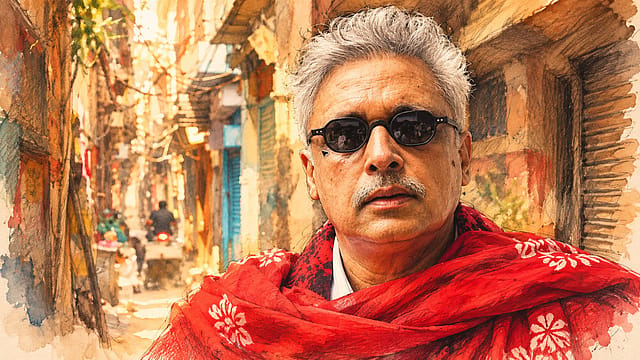
Before the iPhone offer, there was a song.
In Ranchi on August 8, Piyush Mishra joined young recruitment-exam aspirants protesting over alleged irregularities in the JPSC-JSSC examination system. He sang Aarambh Hai Prachand, the song he had written, composed and sung for Gulaal in 2009. A film song had found another life among people fighting for their futures.
“I like young people. I sing for you and act for you, so I came here,” he said during the visit. He had watched interviews with the protesters and been moved by their distress.
Now watch him in Flipkart’s recent commercial.
Mishra inhabits an elaborate fantasy about being the romantic hero of Maine Pyar Kiya. McCann India’s mockumentary turns his brush with the role into a performance of extravagant regret, then connects a missed career opportunity with missing Big Billion Days iPhone offers.
Prem has entered the electronics department.
Together, the two appearances reveal Mishra’s range. There is the songwriter people turn to for resolve. There is the actor willing to make an extravagant spectacle of himself. Both belong to a personality whose appeal has room for conviction, tenderness and mischief.
Welcome to Brand Piyush Mishra. The man comes with considerably more than the commercial.
The Modi Years
02 Oct 2026 - Vol 05 | Issue 40
A Nation Rebuilt
GEN Z HAS FOUND ITS PIYUSH
An artist in his sixties occupies an interesting place in the scramble for young consumers’ attention. His songs ask listeners to engage with language and emotion. They give the audience something to sing, argue with and make its own.
Mishra has described that connection with evident pleasure. In an October 2025 interview, he rejected the suggestion that Gen Z lacked an interest in literature and the arts. Young listeners sang Ik Bagal with him, he said, while songs from Gulaal remained favourites. He described students playing Aarambh Hai Prachand on campuses, before examinations and when applying for jobs.
For those listeners, the song has acquired a practical emotional function. It can accompany the moment before an examination or the uncertainty of seeking work. The song lends some of its defiance to the person facing the test.
There is something revealing about the vocabulary making that journey. Even its title, Aarambh Hai Prachand, has a ceremonial weight. The attraction suggests that young listeners can enjoy language that demands something of them. A song can feel contemporary because of what it allows them to express.
This gives his appeal a dimension that nostalgia alone cannot explain. A younger listener discovering an older song can build a fresh relationship with it. The music becomes part of that listener’s present.
His band, Ballimaaraan, keeps that encounter alive. Mishra has traced its beginnings to guitarist Nishant Agarwal and percussionist Jayant Patnaik, with a first performance in Gurugram in December 2016. By the 2025 interview, he described an expanding repertoire and a 14-member band. The performer audiences encounter is still creating and rearranging his work.
His affection for younger audiences also leaves room for disagreement. In a February 2026 interview, he admired their creativity and appetite for art while wishing they would acquire more patience. He spoke of the years artists spend developing their craft and the dangers of expecting immediate results.
The singer of their motivational anthem is also the older artist telling them that some things take time. That difference in perspective gives the relationship room to grow.
In Ranchi, that relationship extended beyond a concert. Having watched the students describe their distress, he turned up to support them.
For an advertiser, the wider significance is that Mishra already means something to people before the script arrives. A campaign enters an existing conversation.
THE ACTOR WRITES THE SONG
Mishra’s occupations can look like a crowded visiting card: actor, lyricist, composer, singer, writer. His own explanation makes them feel more closely connected.
“I write my songs as if speaking a dialogue, as we do in theatre,” he said in a 2023 interview. His training at the National School of Drama remained central to the way he imagined other forms of work. “Acting is the source of everything else for me.”
Listen to his songs with that explanation in mind: somebody is speaking, somebody is being addressed, and something matters between them. His delivery can persuade, provoke, tease or console.
It also helps explain why his work moves between intimate listening and collective performance. The listener can enter the situation; a crowd can take possession of the refrain.
Mishra has said that relatively few filmmakers sought him out for music, and that this helped his songs develop an unconventional life beyond the film industry. He described wanting songs people could readily join in singing.
That makes the familiar story of the romantic role he almost played rather inadequate as a definition of his career. It measures him against a single version of film success. His work has found audiences through several other routes, including people who turn up specifically to hear his words.
The man imagining a lost career in a commercial has spent years building one on his own terms.
THE GRAIN IS THE SIGNATURE
Mishra’s voice has a recognisable roughness. It can sound weathered, conversational, amused or suddenly commanding. The grain gives the words an owner.
Its versatility becomes apparent across his work. In Aarambh Hai Prachand, the delivery gathers force. In Google’s 2013 Reunion, where he sang the theme, the voice serves longing. The film follows childhood friends separated by Partition, brought together with help from their grandchildren and Google Search. Mishra’s presence comes through the soundtrack.
A voice capable of summoning a crowd can also accompany the ache of missing one person.
Parle-G used his singing for Roko Mat, Toko Mat, its celebration of childhood curiosity. It returned to his narration for a 2022 Republic Day film tracing the biscuit’s journey alongside India’s. Curiosity and collective memory called for different moods; the same voice could accommodate both.
That versatility has a foundation in acting. “Being a fine actor he can bring nuance to a voice over,” advertising creative Sumanto Chattopadhyay observed in 2015.
Nuance is what keeps that roughness interesting. Mishra can change the emotional temperature of a line while remaining recognisable.
His face offers a related advantage. It can carry authority without promising serenity. There is room for impatience, suspicion and comic injury. A script can give him something awkward to feel and trust the performance to make the discomfort interesting.
That is why reducing his appeal to a “powerful voice” misses so much. Power is one setting. The real pleasure lies in the changes.
Tata Tea Premium offered a different setting in 2025, pairing his voice with an AI-created film celebrating regional art. As advertisers experiment with machine-generated imagery, his phrasing and texture give this film a recognisable human presence.
THE FATHER AND THE ALMOST-HERO
There is also a quieter Mishra.
The Man Company cast him as Ayushmann Khurrana’s father in its 2022 #GiftYourDadAHug film. Khurrana’s character, a chef, cooks for his father; their relationship moves through awkwardness towards affection.
Here, the difficulty of expressing love gives the actor his material. A father can feel deeply while making an ordinary conversation unnecessarily difficult. Mishra lets affection show through the reserve.
Flipkart gives that emotional weight an altogether more comic use.
His imagined life as Prem requires him to participate in the joke. He can summon the gravity of a consequential missed opportunity, then let that gravity become absurd. The advertisement invites us to enjoy the performance of regret.
His own account of the history makes the distinction clear. In May 2024, Mishra said he had been considered for Maine Pyar Kiya at an early stage, had never been signed and had not been replaced by Salman Khan. He also said he was glad he had missed the opportunity because he would have struggled with the resulting stardom.
The commercial gives him an alternative self to play. Treating its lament as his definitive judgment on his career would miss the acting.
The joke depends on the career he actually built. An audience familiar with Mishra can appreciate the incongruity of placing this particular man in that romantic fantasy. The more familiar he is, the funnier that unlikely transformation becomes.
Here is a particularly attractive part of his X factor: he can make seriousness persuasive and then turn it against himself.
IRRFAN, PANKAJ AND THE POWER OF PRESENCE
Indian advertising has found considerable use for performers whose distinctive manner can carry a commercial.
Irrfan brought conversational ease and dry humour to his work for Hutch. In one commercial for its ₹10 recharge, even communicating by carrier pigeon became an unfavourable comparison. The sales argument arrived with the actor’s poker-faced amusement.
By November 2007, he said he had made five ads for the telecom brand, which had become Vodafone, and that the company had raised his fee without his asking. The advertiser evidently saw value in keeping that relationship going.
His understated manner made room for the audience to catch the joke. Mishra can work at a more theatrical pitch: a sentence may swell, a lament may become ridiculous, a song may take over. Each gives the writing a particular rhythm.
Pankaj Tripathi offers another route. Britannia Milk Bikis built its 2024 Papa Tripathi campaign around his voice, using an AI-enabled interactive system and local dialects to discuss shared parenting with families in Uttar Pradesh. The persona was approachable enough to become someone a parent might listen to on the telephone.
The choice shows how an actor’s perceived character can shape an entire campaign. Tripathi’s familiarity supports the role of an accessible elder. Mishra’s repertoire allows a creative team to reach for the storyteller, the searching father or the gloriously overcommitted almost-hero.
Raghubir Yadav is an especially close comparison because musicality is part of the attraction. His advertising work includes singing for Pepsi and voice work across brands such as Parle and Vim. For performers like Yadav and Mishra, a distinctive voice can do much of the work usually assigned to a celebrity’s face.
Each performer gives the writer different possibilities. Casting Mishra should change what can be written.
FAMOUS ENOUGH TO BE FUNNY
Elsewhere, advertisers have made a joke of the audience’s familiarity with a performer.
Snickers put Betty White into an American-football game in 2010, making an unexpected celebrity appearance central to its hunger joke. Uber Eats had Jennifer Aniston fail to recognise David Schwimmer in its 2024 Super Bowl film. Familiarity with the performers supplied much of the pleasure.
Mishra offers Flipkart a related opportunity. Viewers bring knowledge of the actor, the film or the almost-casting story; the advertisement rearranges it.
Old Spice’s 2010 campaign with Isaiah Mustafa illustrates a different relationship. Its spokesman became widely identified as the Old Spice Guy. Mishra arrives with associations built across songs, cinema, theatre and advertising. A single sponsor has to find a memorable place among them.
His personality is available for a performance. It remains larger than the assignment.
THE APPLAUSE BELONGS TO WHOM?
That creates a difficulty for the brands hiring him.
A viewer can enjoy Mishra immensely and still forget who paid for the film. In Flipkart’s case, the actor shares the audience’s attention with Maine Pyar Kiya, Salman Khan and the iPhone. The retailer needs its own place in that memory.
Mishra’s voice, manner and backstory give the commercial its character. They can also leave the sponsor playing a supporting role in its own advertisement. Flipkart’s best chance of staying in the picture lies in the connection between his theatrical regret and a shopping opportunity the viewer might miss.
In its competition with Amazon for festive shoppers, Flipkart can use Mishra to give an offer a personality. Price, availability and delivery still enter the purchase decision. The performance provides a reason to watch; the offer must remain worth considering.
There is a creative risk for Mishra too. Repeatedly asking him to supply the same gravelly wisdom would reduce a versatile performer to a familiar sound effect. Repeatedly casting him as an eccentric would produce another kind of confinement.
His range is the asset worth protecting. The affection in a father’s awkwardness, the longing in a song and the extravagance of a comic lament keep that identity expansive.
Aarambh’s force is one part of the Prachand Man. So is his willingness to look faintly ridiculous while advertising an iPhone offer.
The students, the concertgoers and the viewers encountering him in a commercial come to him through different doors. What connects those encounters is an unmistakable performer with something to give each audience.
Mishra can summon resolve, accompany a reunion and audition for the romantic life he never had. Prem was one possible role. Piyush has proved a much larger part.