Bisleri's FSSAI Row: The Cost of Being India's Default Water Brand
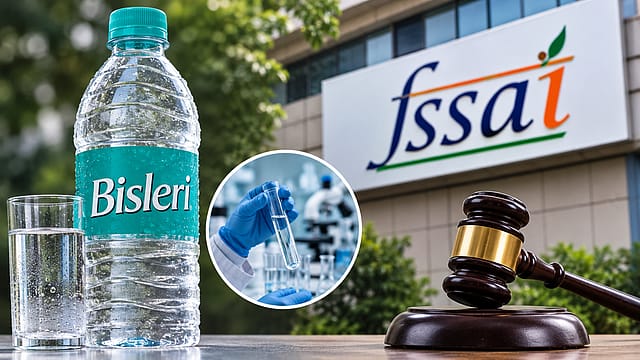
There is a reason consumers ask for a Bisleri rather than simply a bottle of water. In a category where products look much the same, the name offers a shortcut: a familiar brand, an established presence and, above all, the assurance that what is inside the bottle is safe to drink.
That assurance is now facing a test.
On November 22, the Food Safety and Standards Authority of India (FSSAI) sanctioned prosecution against Bisleri International Pvt Ltd after a regulatory sample of its packaged drinking water was declared unsafe. The sample failed to comply with prescribed bromate limits. Following an appeal by the company, a referral laboratory also declared it unsafe after detecting polynuclear aromatic hydrocarbons (PAHs).

The Wealth Issue 2026
06 Nov 2026 - Vol 05 | Issue 45
Portraits of Dreamers and Doers under 35
Bisleri has contested the findings, insisting that its products remain safe for consumption. In a statement on November 23, it said the matter concerned a single batch manufactured in September 2025 at its Goa facility, one of 143 plants in its network.
According to the company, FSSAI collected six samples from the facility on September 30, 2025. Five initially met the applicable standards, while the sixth recorded bromate levels of 12 micrograms per litre against the prescribed limit of 10. Following an appeal, the referral laboratory found bromate within the permissible limit but separately flagged PAHs. Bisleri subsequently commissioned testing at an FSSAI-approved laboratory, which it said also found bromate within limits. It submitted those results to the regulator's Western Regional Office on February 2, 2026.
The company said it received no further communication and understood the matter to be closed. It also claimed it had received no formal notice of the prosecution sanction.
"Drinking water safety is a priority for Bisleri. We maintain stringent quality controls of over 90 tests across our 10-step manufacturing process and will continue to cooperate with FSSAI to address the matter through the appropriate regulatory process. A trusted brand for years, Bisleri remains safe for consumption," the company said.
The distinction between a prosecution sanction and a conviction matters. The regulatory process has not established that every Bisleri bottle, or even its current production, is unsafe. Nor does the company's independent bromate test settle the separate question of PAHs flagged by the referral laboratory.
But this is precisely where Bisleri's problem begins. The company is talking about one sample and one manufacturing facility. Consumers are looking at one brand.
The problem with selling trust
For most consumers, buying packaged water is a low-involvement decision. They rarely study the label, compare laboratory reports or investigate the source. They pick up what is available, familiar and reasonably priced. The brand is expected to take responsibility for the assurance of safety.
That makes a controversy involving water different from one involving a snack or a soft drink. Consumers may tolerate a change in taste or packaging, but there is little room for doubt about the basic promise of drinking water.
"A brand is a trust statement. And to that extent, when that trust is questioned or shaken, consumers tend to reassess their ability to want that exact brand. I do believe this is going to suffer the downside of this FSSAI issue, and rightly so," says Harish Bijoor, brand and business strategist.
The reputational risk is not necessarily an immediate collapse in sales. It could be more subtle: a consumer asking for Kinley instead, a restaurant reconsidering its water supplier or a household switching brands for a few weeks. These are small decisions, but in a category where switching costs are negligible, they can add up.
Bijoor believes the expectations from packaged water brands are also changing.
"Fundamentally, consumers today are asking questions which are beyond convenience. The first is purity, although purity is always relative: purity compared to what, perhaps tap water? The second is convenience: can you get the product anywhere and everywhere? The third is price and cost," he says.
He expects regulatory scrutiny to make the category more demanding. "As regulators sit up and begin asking tougher questions, brands that have hitherto taken their position as the best in the category for granted will find themselves under scrutiny. And when the best in the category is questioned, virtually everyone in the category comes under question."
That last point deserves attention. A safety controversy involving the category leader can make consumers question the category itself, rather than simply move to another brand.
A bigger question about quality control
There is a regulatory dimension to this episode that goes beyond Bisleri. In October 2024, FSSAI removed the requirement for packaged drinking water and mineral water manufacturers to carry mandatory BIS certification. The regulator subsequently classified the category as high-risk and introduced a new testing scheme, effective January 1, 2026.
The new framework requires manufacturers to follow prescribed testing protocols and maintain records to demonstrate compliance. It also provides for inspections and third-party food safety audits for centrally licensed manufacturers.
The timing is relevant. The Bisleri sample was collected in September 2025, before the new testing scheme came into effect. The present case, therefore, should not be treated as evidence of a failure of the new framework. But it does underline why the quality of testing, documentation and regulatory follow-through matters in a product that consumers cannot independently verify.
There is also a technical distinction worth making. Bromate is a chemical that can form during certain water disinfection processes. The World Health Organization's guideline value for bromate in drinking water is 10 micrograms per litre. PAHs, meanwhile, are a family of compounds, some of which are carcinogenic. Their presence needs to be assessed by identifying the specific compounds and concentrations. A detection alone does not establish that consuming the product causes cancer.
For Bisleri, the more immediate question is why the referral laboratory flagged PAHs and what subsequent testing established about them. Its statement discusses the independent bromate results, but does not provide equivalent detail on the PAH finding. That gap is more consequential than another general assurance about quality checks.
Ambi Parmeshwaran, brand and business strategist, believes the company has the recognition and scale to withstand the setback, provided it communicates effectively.
"Bisleri is a well-recognised national brand and, given its scale and consumer familiarity, should be able to withstand a setback of this nature. The matter appears to concern a sample from its Goa plant dating back to 2025. While I am confident that the company adheres to the prescribed safety standards, an episode like this is bound to affect consumer perception."
He adds that the company needs to explain its quality processes proactively. "Bisleri needs to address the concerns transparently and ensure that they do not escalate into a wider national debate. More importantly, it must proactively communicate the quality checks and safety measures it follows to assure consumers that its water is safe to drink."
The challenge is to make that communication specific. Saying that five of six samples passed, or that the company conducts more than 90 tests, provides context. It does not explain the disputed laboratory findings. Consumers need to know what was detected, at what concentration, how the discrepancy arose and what corrective steps followed.
(Queries sent to team Bisleri remained unanswered at the time of filing this story)
Can competitors turn doubt into an opportunity?
The commercial stakes are considerable. India's packaged drinking water market was valued at approximately ₹32,040 crore in 2025 and is projected to reach ₹57,850 crore by 2032, according to estimates cited by the India Brand Equity Foundation. Bisleri operates in a competitive market that includes Coca-Cola's Kinley, PepsiCo's Aquafina and Reliance's Campa Sure, alongside regional players.
A loss of confidence in the category leader could create an opening for these competitors. But consumers will not necessarily switch to another brand simply because Bisleri is facing regulatory action. Availability, pricing and the ability to offer credible quality assurances will determine whether rivals can convert the controversy into market share.
There is a useful precedent in Nestlé India's Maggi crisis in 2015. Following regulatory concerns over lead levels and labelling, the company withdrew Maggi noodles from the market. In the September 2015 quarter, Nestlé India's net sales fell 32 per cent year-on-year and net profit declined 60 per cent. Maggi eventually returned and rebuilt its position, demonstrating the resilience that consumer familiarity and distribution can offer. But its recovery also required sustained effort. A legacy brand is not automatically insulated from a crisis.
Bisleri's situation is different. There is no nationwide recall or ban, and the company says the matter relates to a single batch from one plant. But the Maggi episode offers a relevant lesson: when the product's basic promise is questioned, brand equity alone cannot do all the work.
For Bisleri, the first task is to resolve the regulatory dispute and explain the laboratory findings. The second is to show consumers that the issue was identified, investigated and addressed, rather than asking them to accept a blanket assurance of safety.
The regulator, too, has a responsibility to communicate its findings and the status of the proceedings clearly. Consumers should not have to piece together a safety dispute from a regulator's announcement and a company's rebuttal.
Bisleri has spent decades building a name that consumers recognise almost instinctively. That is a substantial advantage in a market where many products are difficult to distinguish. But recognition and trust are not the same thing. The former can be built through distribution and advertising; the latter depends on whether a company can demonstrate that its promise holds up under scrutiny.
In the packaged water business, the consumer does not have to think twice before switching. There is always another bottle on the shelf. For Bisleri, that may be the most uncomfortable part of this controversy.