Ghantewala Since 1790: Why Hasn’t a Famous Name Become a Chain?
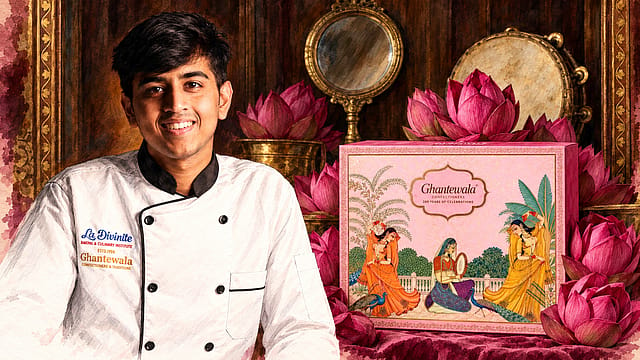
Ghantewala has had 236 years to become a chain.
That is a generous amount of thinking time. Empires have disappeared. Delhi has acquired new neighbourhoods, new appetites and a metro. A sweet can now arrive at your door before you have properly reconsidered eating it. Ghantewala’s name, meanwhile, still sends you to Chandni Chowk.
Old Delhi. Old-world charm. A shopfront with a very old date. 1790.
For Aryan Jain, the eighth-generation owner of Ghantewala Confectioners, that date is both an inheritance and an assignment. He wants to make the name matter to people whose grandparents might remember the shop, as well as people whose first encounter with it could be on a phone.
The Modi Years
02 Oct 2026 - Vol 05 | Issue 40
A Nation Rebuilt
“The larger vision was to bring Ghantewala back in a way that felt authentic to its roots while being relevant to a new generation of consumers,” he says.
Back is the important word. Ghantewala closed in 2015 and reopened in 2024. Its history includes a nine-year reminder that even a name familiar across generations can disappear from the daily business of buying sweets.
Now Aryan wants a national brand. The ambition has grown legs. The shop remains attached to its Old Delhi roots.
ONE ADDRESS, PLEASE
Chandni Chowk has never needed a diffuser.
Across the bazaar, appetites follow their own directions. Khari Baoli has the pungency of spices. Chaat offers fried crunch and tang. Mithai brings the richness of ghee. Cloth, jewellery and wedding finery compete for attention along lanes with far more things to buy than space to browse.
Old Delhi makes you work a little for your indulgence. The reward includes the place itself.
An address here can function as a family instruction. Wedding trimmings from that lane. Sweets from that shop. Someone recommended it to your father; your father recommended it to you. The errand acquires a pedigree of its own.
Ghantewala’s website lists 1862-A, Chandni Chowk Main Road, Delhi. The product promise is equally direct: desi ghee, no artificial colour. A contemporary website has made room for a very traditional appetite.
The business dates to the reign of Shah Alam II. Sohan halwa and Karachi halwa are among the sweets associated with its name, with sohan halwa particularly central to its reputation.
Here is a brand whose calling card can be eaten. Ghee, sweetness and nuts do the introduction; the date supplies the conversation.
Yet a name with this much recognition has not developed into a sprawling retail chain. Its fame has travelled considerably farther than its counters.
That is the puzzle. A celebrated sweetshop is usually offered a familiar route to becoming a bigger business: add outlets, enter cities, make the purchase easier. Ghantewala still draws much of its identity from the fact that there is a particular place to go.
Aryan’s answer leaves room for a different sort of growth.
“Growth for us is not only about opening more stores,” he says. “It is about expanding the number of ways in which a consumer can experience Ghantewala.”
He has not promised that the outlet count will remain fixed forever. But he is asking us to look beyond it.
THE EIGHTH GENERATION HAS A DIFFERENT CUSTOMER
A legacy sweetshop can enjoy an advantage that a new brand would dearly like to buy: people already know the name.
It can also inherit a problem a new brand does not have. People think they already know everything about it.
For the older customer, Ghantewala might mean a familiar sweet, a festive purchase or an errand from childhood. For someone discovering it today, 1790 is impressive but remote. A young buyer can respect the family tree and still order dessert elsewhere.
Aryan has to give both customers a reason to come.
“One of the biggest challenges was that we were working with a name that already carried expectations,” he says. With a heritage brand, consumers have a certain memory of what the brand represents. "So, every decision has to respect that equity," he adds.
Those without a personal association require another introduction. He describes the task as building a bridge between nostalgia and discovery.
“We had to ask ourselves how we could communicate the story of Ghantewala to someone experiencing the brand for the first time, without making it feel like history was the only reason to engage with it,” he says.
That is a useful admission from a business with such an enviable birthday. The date cannot be asked to do all the selling.
Aryan believes younger customers are receptive to familiar products, provided the presentation fits their lives. Packaging, visual discovery and digital storytelling feature prominently in his replies. The sweet still has to earn the second purchase.
“The challenge, therefore, was not simply rebuilding a business, but rebuilding relevance,” he says.
Ghantewala has already put some changes on the menu. Its revival reportedly brought chaat, chhole-bhature and ragi laddus into the offering alongside established sweets.
The old customer can look for recognition. The new one can find something to discover. Aryan needs both to leave with a box.
NOSTALGIA DOESN’T PAY THE ELECTRICITY BILL
The shutters came down in July 2015.
Weak business, low profits and difficulties associated with workshop regulations featured in accounts of the closure. A business with more than two centuries behind it had encountered problems that its age could not solve.
This is the part of the story that keeps the old-world charm honest. People can love a shop, remember it fondly and regret its disappearance without buying enough to sustain it.
“A business can have a widely recognised name and a very narrow customer base,” says Ashita Aggarwal, professor of marketing at SP Jain Institute of Management & Research. People may remember it fondly without buying from it regularly. "That is the commercial danger of nostalgia: affection does not necessarily become revenue,” she adds.
Ghantewala returned online before its physical reopening. Demand for its sweets reportedly helped encourage the family to bring the shop back in August 2024. Aryan, who studied hospitality at IHM Bengaluru, joined his father Sushant Jain in the revival.
“The decision to revive it came from the belief that a legacy like this deserves to have a place in the present, not just in the past,” says Aryan.
There is responsibility in that reply, but also a commercial task. Bringing the name back gives the family another opportunity. It does not automatically restore the buying habits that once sustained the business.
The address can help.
“For a heritage sweetshop, the address can become part of the product,” says Aggarwal. But having one store does not automatically create desirability. "Customers must still find the journey worthwhile,” she says.
Chandni Chowk gives Ghantewala a setting. Ghantewala must give customers a reason to make the trip.
SECOND SHOP? COME BACK IN 169 YEARS
There are businesses elsewhere that have taken their time over the next counter.
In England’s Lake District, Sarah Nelson invented Grasmere Gingerbread in 1854. Its second shop opened in Hawkshead 169 years later.
Some brands announce their next hundred stores. Grasmere Gingerbread took 169 years to announce its second.
The business has two permanent shops, complemented by mail order and sales at shows and events. The second shop is about nine miles from the original and offers coffee, more browsing space and products from other local businesses. The company describes it as a different experience rather than a replica of the first.
In London, the family-owned Lock & Co. Hatters traces its history to 1676, with its St James’s Street shop central to the business and online shopping extending its reach. The bakery Poilâne, founded in Paris in 1932, currently lists five shops across Paris and London, alongside international delivery.
These businesses have found ways to reach customers beyond their immediate neighbourhoods while keeping their own shop networks modest. There is room between a treasured local counter and a chain on every convenient corner.
“A single outlet can build a healthy business through repeat purchases, stronger sales, gifting and wider delivery,” says Aggarwal. “Equally, remaining small can conceal stagnation.”
Ghantewala’s opportunity is to make that small physical footprint support a wider buying habit. Its history has already made the name memorable. Delivery and gifting could make it more readily purchasable.
LET THE BOX DO THE TRAVELLING
Mithai has always been good at entering someone else’s home.
A visit, a wedding, a festival, an announcement: there is often a box involved. For Ghantewala, gifting provides a way to reach people who may never have stood at its counter.
“Our heritage gives the gift itself a story,” says Aryan. “People want something that looks beautiful, feels distinctive and carries meaning.”
A Ghantewala box can bring an association with Chandni Chowk to a dining table elsewhere. The recipient encounters the name through the product, with the history available to discover afterwards.
This route to growth suits Aryan’s desire to take the “idea” of Ghantewala beyond Delhi. The shop can remain a destination while the sweets become available to customers who cannot make the journey.
But the romance must survive the delivery.
“A business can widen access to its products while keeping its physical shop as a destination,” says Aggarwal. “However, that requires reliable fulfilment, suitable shelf life and a product that reaches the customer in the intended condition.”
A beautiful box gets opened once. What is in it determines whether another is ordered.
Aryan also wants more occasions for that purchase. His ambition includes bringing Ghantewala into everyday cultural conversation rather than reserving it for festive appearances. New formats, a wider portfolio and digital visibility are among the routes he identifies.
“We see heritage as a foundation, not a boundary,” he says. The question is: “What should remain timeless, and what should move with the consumer?”
The family cannot renew the founding date. It can renew the reasons to buy.
THE NEXT GENERATION OF SWEET TEETH
Aryan wants Ghantewala to preserve its connection with Delhi, become a larger national name and build a contemporary Indian brand around mithai, craftsmanship and celebration.
“For us, success would be to achieve all three, but in the right sequence,” he says.
The sequence matters to a business rebuilding its place in the present. There is an old customer’s expectation to honour and a new customer’s attention to win. The task is to keep enough familiarity in the product while making the purchase fit a life very different from the one in which the shop began.
“The date gives a consumer a reason to be curious,” says Aggarwal. “The product must give that consumer a reason to return.”
Back in Chandni Chowk, Ghantewala’s name still belongs to a bazaar of remembered errands. Spices, sweets, cloth and wedding finery give the neighbourhood an appetite all its own. A customer can take home a box and a little of the association that comes with buying it there.
Aryan wants that association to travel. Perhaps another outlet will eventually follow. For now, a box can make the journey while the shop keeps its address.
Ghantewala has spent 236 years making a name. The eighth generation wants it on more doorsteps.