TMT: The Mad Trend of Selling Steel With Superstars
This category could organise its own film awards and field a cricket team.
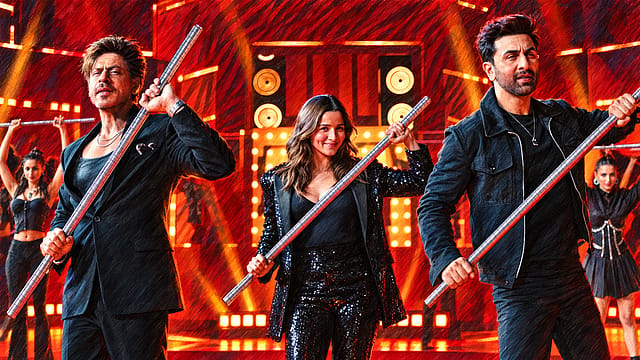
Shah Rukh Khan, Alia Bhatt and Ranbir Kapoor sell Rungta TMT. SRMB has brought together Kapil Dev, MS Dhoni and Rohit Sharma. Across other steel-bar campaigns, the cast has included Salman Khan, Hrithik Roshan, Ajay Devgn, Mohanlal, Virat Kohli and Anushka Sharma.
All this for a product whose eventual public appearance is cancelled by concrete.
TMT bars reinforce buildings. Once construction is complete, the homeowner is unlikely to admire them over dinner, show them to visitors or explain how beautifully they complement the curtains. Their job is consequential. Their visibility is terrible.
The Modi Years
02 Oct 2026 - Vol 05 | Issue 40
A Nation Rebuilt
Indian advertising has supplied a remedy: put some of the country’s most visible people in front of them.
The resulting spectacle raises a question worth taking beyond the celebrity fee, which is seldom disclosed. Can a superstar make a homeowner insist on a particular steel brand when a dealer or contractor recommends something else?
The casting director has done the job. Now comes the purchase order.
THREE STARS WALK INTO A STEEL ADVERTISEMENT
Rungta’s recent film makes the advertising business part of the entertainment. A brand manager presents an idea; Shah Rukh, Alia and Ranbir offer their own larger-than-life alternatives. The meeting develops into a musical selling “Ekdum Solid Strength”.
Created by The Script Room, the campaign has the wit to recognise that TMT advertising has accumulated conventions ripe for parody. The celebrities can play with their personas while the brand gets a lively route into an unglamorous subject.
“Rather than parodying a film, we decided to parody the category itself,” Ayyappan Raj, founder of The Script Room, reportedly said in a recent media report.
That is an intelligent creative choice. A category accustomed to solemn declarations of strength is being invited to laugh at its own performance.
There is also something delicious about deploying three film stars to send up a category that keeps deploying film stars.
The joke works. The commercial question survives it.
Rungta wants its name to travel with the entertainment. Its rivals want much the same outcome, armed with their own recognisable faces. The contest is therefore about whether the audience can retain a useful distinction between brands after enjoying the people employed to represent them.
Three stars can make an advertisement hard to miss. They cannot, by themselves, explain why one manufacturer’s bars should make the shortlist.
THE REINFORCED RED CARPET
The category’s casting history is substantial.
Shyam Steel has worked with Virat Kohli and Anushka Sharma, used Sonu Sood for its “Build India” association and signed Vijay Deverakonda for Andhra Pradesh and Telangana. The regional appointment offers a particularly clear commercial rationale: familiar celebrity, specific geography, local connection.
Shyam Metalics, a separate company, signed Salman Khan in 2021 for its S-E-L TMT rebars.
GK TMT has used Hrithik Roshan to communicate strength and flexibility. Gallantt announced a two-year agreement with Ajay Devgn in 2021. Kairali TMT’s agency identifies Mohanlal as its ambassador. JSW signed Rishabh Pant in 2020 for a three-year association covering Neosteel TMT bars and Colouron+ roofing sheets.
Those dated agreements establish the category’s history; they should not all be mistaken for contracts still running today.
More recently, SRMB’s 2025 campaign assembled Kapil Dev, Dhoni and Rohit. Captain Steel’s 2026 campaign features Sourav Ganguly.
The selection committee appears adequately reinforced.
There is a recognisable logic to these choices. Sporting achievement can suggest dependability under pressure. An action star can embody toughness. A familiar couple can make a home-building proposition feel domestic. A regional actor can supply recognition that a national campaign struggles to reproduce locally.
But the same logic can become a trap.
Marketing and branding experts reckon that a celebrity gives an unfamiliar brand a recognisable face, which can be valuable when the buyer finds the product difficult to evaluate. But when competing brands use celebrities to communicate the same promise, endorsement can become a convention of the category. "The brand then has to establish what the buyer should remember beyond the person: a relevant benefit, a credible assurance or a reason to ask for it by name,” says Ashita Aggarwal, professor of marketing at SP Jain Institute of Management & Research.
Everyone wants to be dependable. Everyone wants to protect the home. Everyone has found somebody famous to stand beside the promise. The danger is a category spending heavily to sound familiar in slightly different voices.
THE PERSON WHO WASN’T IN THE AD
Imagine the less photogenic sequel.
A homeowner arrives with a budget and a construction schedule. An engineer has specified requirements. A contractor needs material on site. A dealer has particular brands available, particular delivery commitments and a price to quote.
A remembered advertisement enters that conversation. It does not chair the meeting.
This is why the claim that the retailer simply decides everything needs qualification. The decision can involve several people, and their influence will differ by project. A family building its own home is also a different buying situation from a large developer procuring to technical specifications.
The homeowner may insist on a name, approve a recommendation or delegate the choice. The contractor may have experience with certain suppliers. The dealer must turn preference into an available order.
KPMG’s India CX Report 2025 on TMT bars identifies product quality and specifications among important considerations before purchase, and supplier support, payment terms and quality assurance during purchase. It also identifies availability as a factor affecting both loyal customers and those inclined to switch.
That is a rather crowded room for a celebrity to enter.
“We should look at what advertising does to the conversation between the homeowner and the intermediary," says Aggarwal. A familiar brand may be easier for a dealer to recommend because the customer has already heard of it. Equally, a homeowner who asks for a brand by name changes the dealer’s starting point. The commercial value could lie in either route. "The important question is whose behaviour the campaign is trying to change, and whether it gives that person something useful to act on,” she adds.
The advertisement could be helping the intermediary persuade the customer. Celebrity spending becomes less easy to dismiss when the audience includes the person making the recommendation.
That is a plausible route to commercial value. The campaign coverage does not establish how often it happens, or what it is worth.
The question for the advertiser becomes more precise: has the star created a preference the dealer must accommodate, or a sales argument the dealer finds useful? Both could matter. Neither can be measured by counting compliments on the film.
STRONG IS THE STARTING POINT
The category’s recurring promise has another difficulty. Strength is something the buyer is already entitled to expect.
A homeowner is unlikely to arrive requesting moderately reassuring reinforcement.
Advertising must, therefore, make the promise specific enough to be useful. Which product, grade or property is relevant? What evidence supports the claim? How can the buyer identify the correct material and obtain dependable supply?
Those questions do not require every commercial to become an engineering lecture. They require the route from entertainment to purchase to contain more than another photograph of the ambassador.
Captain Steel’s recent Ganguly film, for example, seeks to explain the different roles of cement and TMT rebars. It gives the celebrity an educational task.
JSW One TMT’s 2025 campaign takes its story to a construction-material shop, where a contractor insists on BIS-certified bars. Created with Little Odd Marketers, it also used employees to lead the campaign launch. Certification is the communicated buying criterion; the commercial does not establish an exclusive advantage over other certified products.
These executions suggest a different competitive opportunity: help buyers ask a better question.
A rival need not answer three stars with four. It could answer vague reassurance with an intelligible reason to choose, supported by the product and the buying experience.
That response is less spectacular at a launch party. It may be considerably more useful when somebody is about to pay.
THE CHIP, THE JACKET AND THE DIAMOND
The broader history of branding supplies three instructive comparisons.
Intel’s “Intel Inside”, launched in 1991, made a largely hidden component something ordinary computer buyers could recognise. Crucially, the campaign worked with computer manufacturers: cooperative advertising helped put Intel’s identity on their products and in their communications.
The component acquired a consumer-facing name while the companies selling the finished machine helped carry it.
For TMT, the relevant lesson is the connection between consumer recognition and the selling ecosystem. A brand can become meaningful without requiring the buyer to understand every technical detail. But that meaning must survive the conversation with the person supplying the product.
GORE-TEX offers a second lesson. Its “GUARANTEED TO KEEP YOU DRY” promise, introduced in 1989, translates a technical material into an understandable benefit. Its testing and guarantee arrangements give the words practical backing.
The homeowner’s equivalent need is equally human: explain what this product contributes to the building, and why the claim deserves confidence. “Strong” begins that conversation. A credible, comprehensible benefit takes it further.
Then comes De Beers’ “A Diamond Is Forever”, coined in 1947. The line attached enduring emotional meaning to a material, connecting the diamond with love and commitment.
Its relevance to steel lies in the emotional stakes. A home can represent years of savings, family ambition and a desire for security. There is ample feeling available to a TMT brand.
There is also a warning. An emotional association can benefit a category more broadly than one seller. If every steel brand celebrates the same dream home with the same reassurance, the buyer may remember the importance of good steel without remembering why this particular brand deserves the order.
These comparisons suggest three jobs: make the hidden product recognisable, make its promise understandable and make the association identifiable with the brand.
A celebrity can help. The celebrity cannot substitute for all three.
THE BRAND MUST OUTLIVE THE APPEARANCE
The question “Can TMT become a brand?” has already been overtaken by the work of companies trying to build precisely that preference.
Tata Tiscon’s consumer-facing home-building guidance and Tata Steel’s Aashiyana platform, for instance, extend the relationship into planning and purchasing. They offer a useful reminder that branding also happens when someone needs information, material or assistance.
The more searching question is what kind of brand a celebrity campaign creates.
For a purchase like this, recognition is an opening. "Preference becomes more meaningful when it survives a competing recommendation, a difference in price or a question about availability," underlines Aggarwal. A brand has to equip the customer to make that choice, and equip the seller to support it. "If the entire association disappears when you take the celebrity out of the communication, the company should ask what lasting meaning it has built around its own name," she adds.
A useful test would follow the enquiry beyond the screen: named requests, dealer recommendations, resistance to substitution, relevant product understanding and eventual orders. Establishing an advertising effect would also require separating it from distribution changes, pricing and other commercial activity.
The publicly available campaign accounts reviewed for this story do not provide that evidence. They establish creative choices and endorsement associations, rather than a verdict on sales effectiveness.
Rungta’s film can consequently be enjoyed for what it does well: making a difficult category entertaining, with enough self-awareness to turn its conventions into comedy. The broader celebrity parade can still be questioned.
That tension gives “The Mad Trend” its bite. There is nothing inherently foolish about trying to brand steel. The expensive mistake would be believing that a famous person has completed the task.
The category has assembled its film awards and picked its cricket team. The dealer is still waiting for the order.