Eveready’s Mosquito Repellent Has a Bigger Target: The Wall Socket
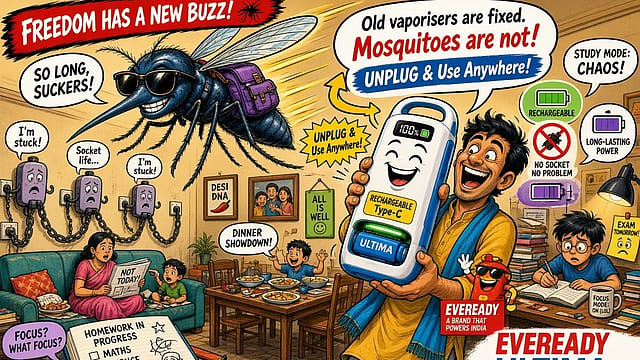
The mosquito has never needed a plug point.
It moves from bedroom to dining room without consulting an electrician. It can attend homework, dinner and an intimate conversation in the same evening. Nobody has to carry an extension board behind it.
The liquid vaporiser has generally led a more settled life.
Now, Eveready has spotted the discrepancy. Its new ULTIMA portable liquid vaporiser enters a crowded category with a wonderfully impolite observation: “Old Liquid Vaporisers are fixed. Mosquitoes are not.” The accompanying instruction is equally economical: “UNPLUG and Use Anywhere.”
For a company associated with batteries, this is a particularly convenient problem to discover. The mosquito-repellent industry has spent years discussing what goes into the bottle. Eveready would like some attention paid to what keeps the machine attached to the wall.
The Modi Years
02 Oct 2026 - Vol 05 | Issue 40
A Nation Rebuilt
That changes the conversation with established players such as Goodknight, Mortein and Odomos. A challenger can spend heavily trying to make its protection claim sound more reassuring than theirs. Or it can identify an accepted inconvenience and make acceptance itself look slightly ridiculous.
The mosquito has been wireless all along. Apparently, it took the battery company to notice.
A SMALL UNPLUGGING, A LARGE REPOSITIONING
The product is a rechargeable liquid vaporiser with Type-C charging, two operating modes and a claimed battery backup of up to three hours. Eveready describes it as India’s first rechargeable liquid vaporiser and says a patent has been applied for. These are the company’s claims, rather than an independent verdict on novelty or performance.
The advertising’s most useful move is to translate that specification into a household question. Why should the position of an electrical socket determine where a device can be used?
This is the sort of inconvenience that can survive for years because everyone has learnt to work around it. The furniture goes here. The socket is there. The appliance belongs to the socket. A arrangement made by the builder quietly becomes a rule for the family.
Eveready proposes a small domestic rebellion.
Its campaign places the product around ordinary activities, including dining, studying and play. The ambition is to give portability a recognisable occasion rather than leave it stranded in a features list.
Ashita Aggarwal, professor of marketing at SP Jain Institute of Management & Research, puts the strategic opportunity this way: A challenger becomes interesting when it makes consumers question something they had stopped noticing. "Eveready is taking an accepted limitation of the format and turning it into a reason to reconsider the category,” she reckons.
That reconsideration matters. Familiar products often benefit from being mentally settled. Consumers know what to buy, where to place it and how to replenish it. A new entrant needs a reason to interrupt that routine.
Here, the interruption is almost physically demonstrable. Pick up the machine. Move it. The sales argument comes with a handle, metaphorically speaking.
THE INCUMBENTS HAVE BEEN BUSY
It would be convenient for Eveready if the existing category had spent its life doing nothing. Unfortunately for the launch presentation, the neighbours have receipts.
When Goodknight introduced Gold Flash in 2020, its proposition included visible flash vapours, upgraded heating technology and automatic switching between modes. It made the machine’s activity part of the reassurance: consumers could see something happening.
Mortein’s SmartPlus proposition includes dual-mode operation and refill compatibility. Its protection claims also come with specified laboratory conditions. This is a category already accustomed to engineering, performance language and fine print.
Dabur’s Odomos entered liquid vaporisers in April 2024 with Universal, emphasising a refill that fitted standard machines. That addressed another practical friction: whether the bottle would work with the device already at home.
These are three different ways of making the purchase feel sensible. Visible action reassures. Adjustable operation offers control. Compatibility reduces the inconvenience of choosing another refill.
Eveready adds another consideration: location.
Its opportunity lies in persuading people that where the device can operate deserves a place alongside how it operates. That is a sharper entry strategy than arriving with an additional adjective attached to “powerful”.
It also avoids requiring consumers to believe that every product they have previously bought was useless. Their existing machine may work satisfactorily where it sits. The new machine offers an additional possibility elsewhere.
A challenger does not always need to demolish the incumbent’s promise. Sometimes it only needs to find the edge of it.
BATTERIES INCLUDED. CREDIBILITY UNDER CONSTRUCTION.
Eveready has a plausible reason to make this argument. Rechargeable power is close to its established identity. The extension is easier to understand than a familiar logo wandering into an unrelated category because the diversification spreadsheet had an empty column.
In the launch announcement, chief executive Anirban Banerjee describes the move as bringing the company’s “expertise in portable and rechargeable power into a new category”.
That is the bridge. It still has to carry weight.
A consumer’s confidence in a battery does not automatically settle questions about a mosquito-repellent formulation. Eveready must make two capabilities work together: the power system that enables movement and the repellent that gives movement a purpose.
Ashita identifies the distinction: “Brand familiarity can make an extension easier to try, but the new category decides what the brand must prove. Eveready brings credibility in portable power. It still has to earn confidence in mosquito protection through the product experience.”
There is a useful discipline in that observation. The company cannot allow the rechargeable feature to become a substitute for the fundamental job. A beautifully portable disappointment would merely travel further.
The commercial ambition is real, though still an ambition. Eveready has said it is targeting a 2–4 per cent share of the liquid-vaporiser market. It had already entered mosquito racquets before this launch. The vaporiser therefore extends a developing home-care presence rather than marking its first encounter with an insect.
What makes this extension worth watching is the fit between the brand’s inherited competence and the inconvenience it has chosen to attack. The product gives Eveready a reason to be here beyond the fact that consumers recognise its name.
FREEDOM HAS A CHARGING CABLE
Then comes the part that every liberation campaign would prefer to print a little smaller. Up to three hours.
That is the stated battery backup. It could be useful for a particular activity or an interruption in electricity. It is not a claim of an entire night of cordless operation. The device still needs charging.
The wall socket has lost exclusive custody. It has not disappeared.
This is the campaign’s central tension. Portability can remove one inconvenience while introducing another task: remembering to charge, relocate and retrieve the device. For some households, that exchange may be worthwhile. For others, leaving a conventional machine in its usual place may remain perfectly satisfactory.
Convenience is an experience, not a specification.
A product that moves also invites questions about where it should be placed and how it should be used. “Anywhere” is expansive advertising language; actual use still has to follow the product’s directions. The headline cannot do the instruction manual’s work.
Nor has Eveready invented the broader idea of mosquito protection that travels. Odomos already offers personal-use formats such as creams, lotions and sprays. The distinctive proposition here concerns the mobility of the liquid-vaporiser device.
That narrower claim is strong enough. Inflating it into the invention of portable protection would weaken the story.
The household’s decision will be less theatrical than the campaign’s. Does this solve a problem I actually face? Is it easy to maintain? Will I keep using it after the novelty wears off?
The mosquito, regrettably, will not wait for the customer-satisfaction survey.
THE REFILL GETS A VOTE
The machine attracts attention. Replenishment decides whether the relationship continues.
A consumer might try an unfamiliar device because the feature is interesting. Buying its refill repeatedly requires the product to become dependable and easy to find. The appeal of a new format can quickly evaporate if replenishing it becomes a minor research project.
Compatibility also gives rivals an established competitive language. Odomos Universal and Mortein both foreground refill fit. Eveready’s mobility story therefore enters a market where consumers can be offered other kinds of convenience, including keeping equipment they already own.
Ashita offers a useful test. The first purchase may be driven by curiosity about portability. Repeat purchase will depend on whether the benefit becomes part of everyday life and whether maintaining the product feels effortless. "Innovation has to survive the routine it creates,” she adds.
That gives incumbents several possible responses. They could emphasise value, familiar performance or replenishment. They could defend the usefulness of a fixed device for fixed routines. They could develop portable alternatives of their own.
Those are strategic possibilities, not documented responses to this launch. Eveready has issued a challenge to the format; the category has not yet supplied the ending.
The company’s task is to make portability sufficiently useful that it survives beyond a clever demonstration. A consumer who enjoys the advertisement has understood the joke. A consumer who changes the next purchase has understood the benefit.
WHO OWNS THE INCONVENIENCE?
The larger branding lesson concerns the problems companies choose to regard as theirs.
A battery company sees dependence on a socket and recognises an opening. Established repellent brands have different assets to defend: familiar products, trusted routines and the recurring purchase of refills. Eveready is trying to insert a new question into that decision before habit supplies the old answer.
That is why the campaign has more bite than a routine category-entry announcement. Its provocation can be understood without a market-size slide. The insect moves. The conventional device stays put. The challenger offers to change one side of the equation.
Whether that becomes a durable advantage will depend on performance, price, availability and how much consumers value the freedom to move it. A good observation can open a category. It cannot, by itself, hold it.
For now, Eveready has made the wall socket look less like household infrastructure and more like a competitive constraint.
The mosquito has always enjoyed the run of the house. Eveready would like to know why the incumbents gave it such a generous head start.