The Big Fight: Aquaguard Wants Four Years of Peace. Urban Company Wants a Piece
A water purifier is supposed to remove impurities.
The bills can be harder to filter out. There is the machine. Then there are the filters, the servicing and the annual maintenance contract. A purchase made for peace of mind can acquire a surprisingly busy calendar.
Aquaguard wants to clear four years of it.
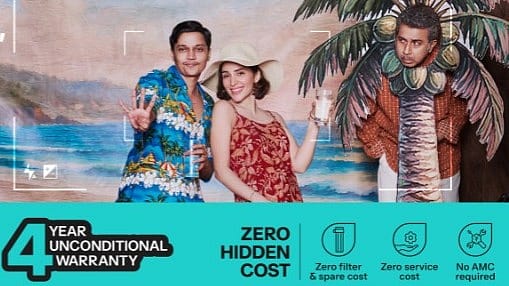
Its “Four Years Sorted” campaign promotes a four-year unconditional warranty on select purifiers, covering filters, spares and servicing without a separate AMC during that period. The film puts the proposition into a humorous family setting: planning the future, with one household expense apparently taken care of.

Zeroing In on ECI
09 Oct 2026 - Vol 05 | Issue 41
Constitutional legitimacy versus political opportunism
Across the kitchen, Urban Company wants a piece of the business.
Its purifier brand, Native, has made longer filter life and lower maintenance costs central to its pitch. Its M2 advertises two-year filter life and a two-year unconditional warranty; the newer M3 range raises the filter-life promise to three years.
The competitive tension is delicious. A company people can call to service a purifier now sells them one designed to need less routine attention. A familiar purifier brand is putting a longer stretch of ownership costs into its sales proposition.
The next big feature on the kitchen wall might be fewer reasons to think about the machine.
THE SECOND PRICE TAG
The sticker tells you what it costs to take a purifier home. Ownership tells you what it costs to keep it there.
That difference gives both brands something more useful to discuss than another impressive-looking collection of initials. RO, UV, copper, alkaline: the specifications still matter. But a buyer can understand a service bill without completing a chemistry course.
Aquaguard’s ASPIRE Glow 4X product page promises no filter, spare or service charges for four years, including unlimited repair visits. The campaign’s warranty proposition applies to select models, rather than the entire Aquaguard range.
Anurag Kumar, chief growth officer at Eureka Forbes, reportedly describes the objective as “taking away the uncertainty around recurring filter, spare and maintenance costs”.
Marketing and branding experts reckon that uncertainty is the operative word. A predictable expense can be budgeted for. An unfamiliar bill, attached to a machine that supplies drinking water, is harder to evaluate.
A challenger does not always need to convince consumers that the established product is bad. "It can identify something people dislike about owning it and make that the basis of choice,” says Ashita Aggarwal, professor of marketing at SP Jain Institute of Management & Research. The opportunity here is to make the cost and effort of ownership easier to understand.
"That is a much bigger argument than whose purifier has the smarter light," she adds
THE REPAIRMAN HAS A PRODUCT
Native has a credible route into that conversation.
Urban Company says its work servicing water purifiers revealed the expense and inconvenience consumers faced. The company has used that experience to explain why it built its own machines.
That makes service experience part of its product-development story.
For the M2, Native promises replacement of filters, membranes and spare parts under its two-year unconditional warranty. Its website also presents an illustrative ownership-cost comparison against unnamed alternatives, with periodic filter-change charges after the initial period. Those savings are the company’s calculation, rather than an independent verdict on every competing purifier.
The newer M3 range’s three-year filter-life pitch shows Native is extending the same argument.
But longer filter life and warranty coverage answer different questions. One concerns how long a component is designed to work; the other concerns who pays when covered work is required. Counting the years alone will not produce a meaningful winner.
Native’s opening is nevertheless clear: make the less glamorous part of appliance ownership the reason to choose the appliance. Its challenge is equally clear. Knowing what frustrates customers creates an expectation that your own product will spare them that frustration.
The service company has volunteered to be judged on service.
THE OG HAS AN ANSWER TO SELL
Aquaguard’s position deserves more respect than the stock script of a sleepy incumbent surprised by an app.
An established name can make a long warranty reassuring in a different way. Consumers must believe that the company offering it will be available to honour it.
Eureka Forbes says its service network reaches more than 19,500 pin codes. That is a company claim, but it shows the asset Aquaguard can put behind its promise: the ability to reach the kitchen after winning the sale.
The “Four Years Sorted” film translates coverage into domestic reassurance. It gives the buyer a period of time to picture, rather than a list of components to memorise.
The strategic possibility is stronger still. If an established brand can offer recognisability and predictable upkeep together, it can make a challenger work harder to explain why switching is worthwhile.
Native, meanwhile, can argue that the product was built around reducing maintenance in the first place.
Their propositions meet at the same consumer anxiety: what happens after the installation team leaves.
A WARRANTY CAN DO THE BRANDING
There is a useful parallel in cars.
Hyundai markets its US warranty package under “America’s Best Warranty”, prominently featuring a ten-year, 100,000-mile powertrain limited warranty. The coverage has its own terms and is not a ten-year promise covering every part of the car.
The branding lesson travels better than a direct product comparison.
A warranty can make a claim about the manufacturer’s confidence while reducing the buyer’s perceived risk. It can become something people remember about the brand before they understand the machinery.
For Native, reassurance can help a newer appliance brand earn consideration. For Aquaguard, a longer coverage proposition can make familiarity feel more valuable.
But a warranty also hands the customer a very specific yardstick. The longer the promise, the more the brand is asking consumers to trust its future behaviour. “If getting a covered repair becomes a struggle, the warranty itself becomes the evidence against the brand," says Aggarwal. The advertising and the service operation have to make the same promise.
Four years is a long time to keep a headline honest.
THE FIGHT AFTER INSTALLATION
The flip side of this contest is that a bigger number can become another distraction.
Buyers still need a purifier suited to their water supply, clarity on covered work and a service operation that turns up. Native’s M2 filter-life claim, for instance, cites testing at specified water conditions and usage volumes. Its installation information also identifies potentially chargeable extras such as pressure-management equipment.
The relevant question is what the complete ownership proposition means for a particular household.
There is also a commercial test for both companies. More generous coverage brings obligations: replacement parts, technicians, scheduling and the cost of honouring the offer. A promise that attracts buyers must also survive being used.
Native can win attention by challenging how people evaluate a purifier. Aquaguard can defend consideration by showing that an established name can offer a sharper ownership proposition too.
Who wins will depend on the purchase price, the product, the coverage and the experience when something needs fixing.
The cleverest campaign gets a household to consider a different machine. The better business gives that household fewer reasons to regret it.
Aquaguard wants four years of peace. Urban Company wants a piece. The customer would quite like a glass of water without a follow-up invoice.