A Paper Bottle. A Bootstrapped Bet. Can AUM Make a Splash?
The water comes from the Himalayas. The challenge is getting someone to ask for it by name.
Jagriti Motwani is building AUM Premium in a category where an unfamiliar bottle must answer a familiar question: why this one?
Purity is expected. Provenance needs explaining. A premium needs justifying. Somewhere between the first curious purchase and the next order, a young brand must become worth remembering. For a bootstrapped business, that distance can be expensive.
Motwani’s answer includes changing the bottle itself. AUM plans to introduce paper-based bottles by the end of next few quarters, giving its premium spring water a proposition consumers could see before taking a sip. A different package could earn the brand a second look. The business will need a second purchase.

Zeroing In on ECI
09 Oct 2026 - Vol 05 | Issue 41
Constitutional legitimacy versus political opportunism
THE MOUNTAINS ALREADY HAVE TENANTS
Himalayan origins are hardly vacant advertising territory. Bisleri’s Vedica already builds its proposition around spring water from the Himalayan foothills in Uttarakhand, combining natural provenance with premium positioning.
AUM, therefore, enters a conversation established brands have helped shape. Mountains, minerals and purity provide a vocabulary consumers may recognise. They also make differentiation harder.
Motwani is attempting to add an emotional layer through an affirmation-led collection. Each bottle carries a positive message, turning the label into something the customer might read rather than merely recognise.
“For us, premium hydration is not only about the quality of the water but also about the experience surrounding it,” says Motwani, founder and CEO, AUM Premium.
Water is consumed repeatedly through the day. The bottle offers repeated opportunities for recognition. But a positive sentence can make a bottle more distinctive without making the water more desirable. A customer may appreciate the message and still choose another brand at the next checkout.
Motwani believes the combination matters. “We see AUM Premium as a combination of quality, thoughtful design and a brand philosophy that people can relate to,” she says.
That philosophy must eventually interrupt a familiar purchase. A buyer reaching for a trusted brand needs a reason to reconsider. An unusual bottle could create that moment of curiosity; AUM must make the difference matter quickly enough to influence the choice.
The founder can explain the proposition at length. The bottle on the shelf gets much less time.
A BOTTLE WITH SOMETHING TO PROVE
The paper-based format gives AUM’s ambition a more tangible expression.
“One of our key initiatives is the development of paper-based bottles,” says Motwani, claiming that the company responsibly sources paper with a food-grade barrier to protect the water. It presents reduced plastic use as the immediate proposition and a completely plastic-free future as the ambition.
The finished package will have to make that promise precise.
For an unfamiliar brand, packaging can be particularly valuable because it works at the point of choice. A visibly different container could attract attention on a restaurant table, at an event or among product images on a shopping app. It also gives the buyer something to explain. Choosing a lesser-known brand becomes easier when the difference is apparent.
But water is an unforgiving passenger. Its container must survive storage, handling and transportation, preserve product quality and remain convenient to use. Environmental ambition does not excuse a leaking package. Customers will judge the promise through ordinary encounters: how the bottle feels in the hand, whether it travels comfortably in a bag, how easily it opens and what happens when they have finished drinking.
Motwani acknowledges the commercial challenge: “The solution also needs to be scalable and commercially viable as we expand.”
That is where an attractive branding idea meets the less photogenic work of building a business. The bottle must be manufacturable at an acceptable cost, delivered reliably and sold at a price customers will pay again.
The test is repeat purchase at a viable margin. A launch photograph will settle neither.
THE CARTON HAS TRAVELLED BEFORE
Global brands offer useful precedents for making the container central to the proposition.
America’s Boxed Water Is Better puts its packaging argument in the brand name itself. The carton becomes both the product’s container and its advertisement.
JUST Water similarly combines spring-water provenance with a packaging story. It says 88% of the materials in its carton originate from plants, including paper and sugarcane-derived plastic. Its explanation also identifies an aluminium layer used to protect the contents.
These examples demonstrate a creative opportunity: a water brand can make the package a central reason for consideration.
They also reveal why the details matter. Paper-based, plant-based and plastic-free describe different things. JUST explicitly explains that its carton, despite containing plant-based materials, is not biodegradable.
AUM’s opportunity is to make its eventual proposition equally understandable. What is the bottle made of? What does it reduce? What should the customer do with it after drinking?
Clear answers would strengthen the advertising. They would give consumers a specific benefit to evaluate and help retailers, restaurants and event organisers explain their choice. The package may be the first thing people notice. Its credibility will depend on what they learn next.
GETTING INTO THE HAND
AUM is already looking for occasions where its product has an immediate role.
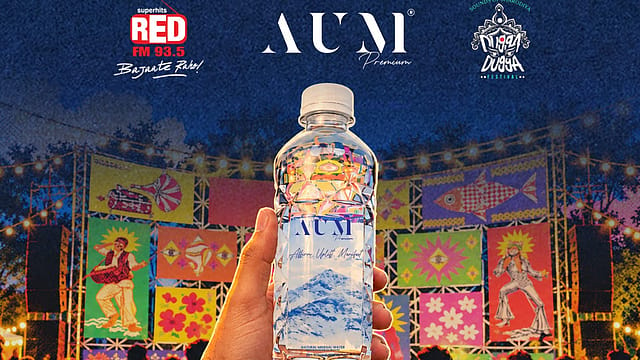
At Red FM’s Dugga Dugga Festival in Noida, it participated as hydration partner during a celebration of Bengali music and culture. The practical logic is sound. People attending a music festival need water. The brand can enter their experience through something useful.
For a young business, such an occasion could help make an unfamiliar name less unfamiliar. But the distance between supplying water and creating preference remains substantial. An attendee may remember the concert, appreciate the drink and forget the label.
Digital distribution presents a related challenge. Motwani lists Amazon India, Blinkit, Instamart, JioMart, Flipkart and the company’s own website among AUM’s routes to customers. She also sees these channels as sources of feedback about consumer behaviour and preferences.
Being available creates the possibility of a sale. Being selected requires more. On a shopping screen, the bottle competes with familiar names, prices and delivery promises. For repeat buyers, the novelty will already have worn off. The experience must supply the next reason.
For a bootstrapped challenger, this makes the choice of battleground consequential. Becoming a preferred option in a few settings could provide a stronger foundation than stretching resources across too many channels before a buying habit takes hold.
A restaurant table, a hotel room or a recurring event could give AUM both visibility and repeated use. Each would also demand reliable supply and a price the buyer can justify.
THE GIANTS CAN CHANGE THEIR BOTTLES TOO
Established brands need not surrender the packaging conversation. They could respond through changes to their containers, pricing, distribution or clearer environmental claims of their own.
AUM will, therefore, need to build recognition for the name attached to the material. If consumers remember only the paper bottle, another brand’s version could become an easy substitute. The challenge is to connect the package, the water and the experience closely enough that customers seek out AUM.
Motwani says the company has partnered with Scrapbuddy to make bottle recycling easier for customers. That provides another part of the proposition to develop: what happens after consumption.
Its value will depend on how conveniently the arrangement works. A customer should be able to understand the next step and carry it out without turning a routine purchase into a project.
For Motwani, the audacity lies in committing resources to an alternative before knowing whether enough customers will reward it. Attention can give a small brand an opening. Orders must eventually pay for the ambition.
The paper bottle remains a promise. Turning it into a product will be an achievement. Turning the product into a habit will be the business. Motwani wants people to reconsider what holds their water. Then she must give them a reason to keep choosing hers.