Tesla Took Off. The Brands Hitched a Ride
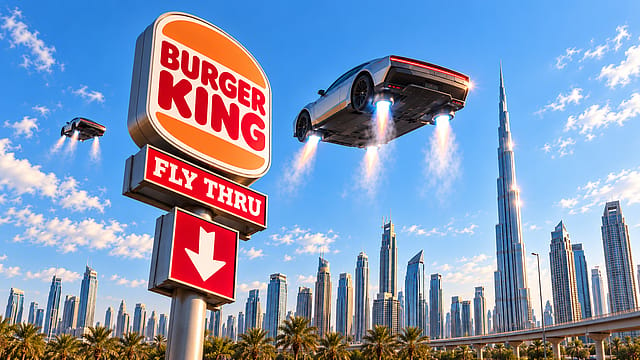
Elon Musk supplied the flying car. Burger King supplied a reason to pull over. Or whatever the aerial equivalent might be.
In its October 16 Instagram post, Burger King UAE imagined a “Fly Thru”, complete with airborne cars beside its roadside sign. It tagged Tesla and offered a modest suggestion: “Maybe it’s time…”
Civilisation had barely processed the possibility of cars leaving the road. Fast food was already considering the next window.
McDonald’s France had an elevated drive-thru idea too. IKEA Taiwan recreated the spectacle with toy cars and a towel. In India, Domino’s found a connection between an airborne vehicle and the smell of pizza.

Zeroing In on ECI
09 Oct 2026 - Vol 05 | Issue 41
Constitutional legitimacy versus political opportunism
Tesla had staged a demonstration. Other brands had received a brief. Nobody needed to sell an electric supercar to find a use for one.
PLEASE KEEP YOUR BURGER UPRIGHT
Tesla’s October 15 demonstration in Texas showed a Roadster prototype performing airborne manoeuvres. Production remains a future proposition, with a 2028 target. For the brands joining the conversation, however, the useful product was already available: a spectacular visual.
It could be understood in a second and repurposed almost as quickly.
Burger King’s response made the connection unusually easy. A drive-thru serves people in cars. If the cars acquire an altitude, the service acquires a new spelling.
The joke exaggerates something the brand already does. It doesn’t require a paragraph explaining why a burger chain has suddenly developed an interest in aerospace engineering.
McDonald’s France imagined a drive-thru structure above a restaurant, a response shared on October 16 by Guillaume Huin, a senior marketing director at McDonald’s.
Two burger brands had found room in the same patch of sky.
That is also the first complication. When a cultural moment supplies an obvious joke, competitors can arrive at neighbouring punchlines. Being quick gets a brand into the conversation. Being recognisable within it requires more.
Marketing and branding experts reckon that a borrowed moment works when the brand adds something that belongs to it. "The audience should understand both why the joke is funny and why this particular brand is telling it,” says Ashita Aggarwal, professor of marketing at SP Jain Institute of Management & Research.
A logo can identify who posted the picture. The idea has to explain why they bothered.
IKEA BROUGHT A TOWEL TO A ROCKET FIGHT
IKEA Taiwan’s response is the more interesting piece of advertising.
Its October 16 Instagram post used LILLABO toy cars and a BROKGLIM towel to recreate Tesla’s curved ramp. The fabric supplied the improbable road. The cars supplied the action. The reassurance was gloriously domestic: “Safe, affordable.”
Musk’s spectacle had become something you could assemble at home without consulting an aviation authority.

There is a proper brand argument inside that silliness. IKEA brings an extravagant vision down to the scale of familiar, accessible products. The toys and towel are the creative device and the merchandise.
Remove the products and the joke disappears. That matters. A weaker response could paste a logo beneath a flying car and call the afternoon productive. IKEA makes its own range do the work. The contrast between Tesla’s technological theatre and the retailer’s household improvisation gives the post its bite.
It also offers a small corrective to the idea that joining a trend means admiring it. IKEA doesn’t need to promise the same future. It has a cheaper afternoon in mind.
INDIA ADDED DINNER
Domino’s India found its way into the conversation through the nose.
“Car Pizza ki khushboo,” read the text in its October 16 creative. “Both are in the air today!” The accompanying Facebook caption carried the idea further: “All roads lead to pizza, even air routes.”
A futuristic transport demonstration had been reassigned to the familiar business of making people hungry. Swiggy too reportedly used a khayali pulao food pun and CarDekho offered a Hindi playlist for the Roadster, including “Udta Hi Phiru”.
The responses show how easily the same visual can acquire local references. The car remains the common object; the language, appetite and soundtrack change.
For an Indian audience, a flying vehicle can become a food joke or a film-song cue before it becomes a serious transport question. That flexibility is why the spectacle travels so well. Nobody needs to share Musk’s enthusiasm, understand the machinery or plan to buy the car. Recognising the reference is enough to join in.
The brands are selling participation as much as a punchline: we saw what you saw, and here is our version.
WHO IS GETTING THE LIFT?
There is a catch in all this cheerful hitchhiking.
Tesla remains the reason the jokes make sense. Every response asks audiences to recall its demonstration. Even the teasing versions give the flying Roadster another appearance in the feed. A brand borrowing the spectacle may also be helping the spectacle’s owner.
That doesn’t make the exercise pointless. Advertising has always borrowed from culture. The question is what remains attached to the responding brand when the moment passes.
Does someone remember IKEA’s affordable ingenuity? Burger King’s Fly Thru? Or simply another funny picture of Musk’s car?
The risk is that people remember the event and forget the advertiser. "A useful response should reinforce an association the brand wants to own; engagement alone cannot tell you whether that has happened,” says Aggarwal.
The posts establish creative participation. They do not, by themselves, establish increased sales, stronger preference or a lasting change in how consumers see these businesses.
A laugh is a response. It isn’t a purchase order.
THE CAR IS OPTIONAL. THE CONNECTION ISN’T
The strongest examples here earn their place by bringing something specific to the spectacle.
Burger King reworks a service format. Domino’s turns flight into an appetite cue. IKEA stages the fantasy using the very things it sells.
Each gives the audience a route back to the brand.
The danger comes when joining in becomes the entire objective. If every topical event produces the same scramble to insert a logo, the feed starts to resemble a roomful of people laughing loudly so somebody will notice them.
Speed is useful. So is having something to say.
Tesla has offered advertisers a particularly generous opportunity: an instantly legible fantasy, an extravagant demonstration and a founder whose announcements already invite reactions.
The brands can borrow the attention. They still have to supply their own point. Musk made the car leave the ground. The harder trick for everyone hitching a ride is making the joke land on their own brand.