Red Bull vs FSSAI: Who Gets to Decide What an Energy Drink Is?
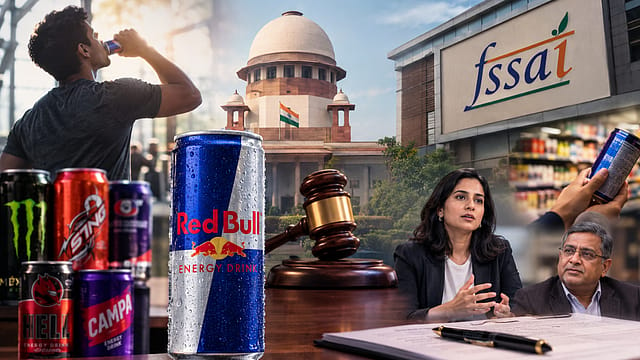
A beverage can be more than a beverage. It can be a promise of alertness before a long night, a burst of energy before a workout, a companion through a demanding workday or simply a familiar brand picked up from a refrigerator. For companies selling energy drinks, the words printed on the can are part of that promise. For regulators, however, those same words must accurately describe what is inside.
That distinction is now at the centre of a legal dispute between Austrian beverage company Red Bull and the Food Safety and Standards Authority of India (FSSAI). Red Bull has approached the Delhi High Court challenging an order directing it to stop using the term “energy drink” on its products. The company argues that the regulator issued the order without a show-cause notice or an opportunity to be heard, raising concerns about procedural fairness and uncertainty for its investments in India.

Losing Memory
16 Oct 2026 - Vol 05 | Issue 42
The making of a medical and social emergency
The immediate question is whether FSSAI followed the appropriate process. But beneath the courtroom argument lies a more fundamental question: When a product category has acquired a distinct identity in the marketplace but lacks separate recognition under the regulatory framework, who gets to decide what that product should be called?
For a category built around the idea of energy, the answer has consequences extending well beyond packaging.
When a marketing category meets a regulatory one
FSSAI's position is that India does not have separately prescribed standards for products marketed as energy drinks. Instead, these beverages are regulated under the category of caffeinated beverages. The regulator has objected to the use of the term 'energy drink', arguing that such descriptions may not accurately reflect the recognised classification of the products.
The directive has affected several major brands, including Red Bull, PepsiCo's Sting and Adrenaline Rush, Monster and Reliance Consumer Products. Companies were given 90 days to remove the disputed descriptor and comply with the regulator's requirements. Notably, PepsiCo dropped 'energy' label from Sting cans ahead of FSSAI deadline
For the beverage industry, the issue is not simply whether a particular phrase is permitted. The term 'energy drink' has become a familiar commercial category, helping consumers distinguish these products from carbonated soft drinks, juices and other beverages. Removing it could require companies to rethink how they present their products, communicate their purpose and differentiate themselves in a crowded market.
Yet the familiarity of a category does not automatically establish its regulatory validity. A name that has become commercially meaningful must still meet the standards governing how food and beverages are described and marketed.
This is where the dispute becomes more complicated. A regulator may seek to ensure that consumers are not misled by a product's description, while a company may argue that the same description is central to the identity it has built over years.
The business of selling energy
The energy drink market has expanded as brands target consumers looking for convenience, alertness and a sense of heightened performance. The category has attracted established beverage companies as well as new entrants seeking to capture different price points and consumption occasions.
But growth does not necessarily mean the category has settled into a stable form.
Brand consultant Ambi M. G. Parameswaran, speaking to OPEN Digital for an earlier story on the FSSAI crackdown, describes the influx of new products as characteristic of a young category still finding its shape.
“In principle, energy drinks are not good for you. But it is a fast-growing category and more brands are being launched across price points. Not all of them will survive in the long run,” he says.
His observation points to a market in which the number of products is expanding faster than the category's long-term structure may be established. As more brands enter, companies must find ways to distinguish themselves, whether through price, taste, packaging, distribution or the functional benefits they claim to offer.
The term “energy drink” serves as a convenient shorthand in this environment. It tells consumers what kind of product they are looking at and suggests the purpose for which it might be consumed.
But that shorthand also carries expectations. Consumers may associate the category with increased alertness, improved concentration or enhanced physical performance. Whether a particular product can substantiate those expectations is a separate question, one that becomes especially important when marketing language begins to suggest specific physiological benefits.
What a label promises to the consumer
The regulatory dispute is not confined to the technical distinction between a caffeinated beverage and an energy drink. It also raises questions about the relationship between product descriptions and consumer understanding.
Manisha Kapoor, CEO and Secretary General of the Advertising Standards Council of India (ASCI), told OPEN Digital in the earlier story that advertisers and marketers should use recognised food categories when a term does not have recognition under the applicable regulatory framework.
“If a category such as 'energy drink' does not have recognition under the applicable regulatory framework, advertisers and marketers should avoid presenting it as such,” Kapoor says.
Her argument is that product descriptions should help consumers understand what they are buying rather than rely on a category name that may not align with the regulatory classification.
The distinction matters because labels do more than identify a product. They help consumers form assumptions about its composition, purpose and effects. A familiar category name can shape expectations even before a consumer reads the ingredients or nutritional information.
For brands, this makes naming an important commercial asset. For regulators and advertising watchdogs, it makes the accuracy of that naming a matter of consumer protection.
The challenge is to ensure that product descriptions communicate meaningful information without allowing a marketing term to imply benefits that have not been established.
The claims behind the name
If the words “energy drink” are being scrutinised, the claims associated with the category are also likely to attract attention.
Kapoor argues that advertising claims about energy, performance and focus require particular care because they can influence consumer decisions.
“Claims that imply enhanced energy, performance, focus or other functional benefits can significantly influence consumer perceptions and purchase decisions, making it essential that such claims are appropriately substantiated and communicated responsibly,” she says.
This introduces another layer to the dispute. Even if a product's classification is settled, the language used to describe its effects must still be supported by evidence and communicated responsibly.
The difference between saying a beverage contains caffeine and suggesting that it improves performance is significant. The former describes an ingredient; the latter makes a claim about an effect.
For consumers, the distinction can be difficult to navigate when packaging and advertising combine ingredient information with broad promises about how a product might make them feel or perform.
Kapoor also notes that the current FSSAI scrutiny remains at the initial stage of investigation. The broader implications of the action, therefore, need to be considered alongside the regulatory process and the specific claims under examination.
A warning from the advertising industry
The debate comes at a time when the food and beverage sector is already facing scrutiny over advertising claims.
According to ASCI's Annual Complaints Report 2025-26, the sector was among the top five categories requiring intervention. The report recorded 376 cases involving food and beverage advertisements, with 88 per cent requiring modification for non-compliance.
These figures do not establish that energy drink advertisements as a category are misleading. They do, however, underline the importance of scrutiny in a sector where claims about ingredients, benefits and product attributes can shape purchasing decisions.
Kapoor says advertising should remain truthful, evidence-based and capable of substantiation.
For brands, that principle means the language used to sell a product must withstand scrutiny beyond its ability to attract attention. For consumers, it means being able to distinguish between what a product contains, what it is marketed to do and what the available evidence supports.
What the Red Bull case could change
Red Bull's challenge brings these questions into a legal setting. The company has argued that it was not given prior notice or an opportunity to present its case before the regulator issued the order. It has also raised concerns about the uncertainty created for its business and investments in India.
The Delhi High Court's consideration of the matter places procedural fairness at the centre of the immediate dispute. The case also has implications for other companies affected by the directive, particularly if the court's eventual decision influences how the regulator implements its classification and labelling requirements.
But the larger commercial question will remain even after the legal dispute is resolved: how should brands communicate the identity of a product when the language consumers recognise does not correspond neatly with the category regulators prescribe?
For a company such as Red Bull, the descriptor is closely associated with the product's identity. For FSSAI, the priority is that a beverage's description should conform to food safety regulations and should not mislead consumers.
Neither the familiarity of a brand's language nor the existence of a regulatory classification, by itself, resolves every question about what consumers understand from a label. That understanding depends on the product's ingredients, the claims made about it and the context in which those claims are communicated.
The Red Bull-FSSAI dispute is therefore about more than a few words on a can. It is about the boundary between the identity a company creates for a product and the identity the regulatory system permits it to claim.
In a fast-growing category where brands compete not merely on taste but on the promise of what a beverage can do, that boundary could shape how the next generation of energy drinks is marketed, understood and sold.
Update: The Delhi High Court on Tuesday cancelled a Food Safety and Standards Authority of India (FSSAI) order directing Red Bull to stop using the term “Energy Drink” on its products, ruling that the company was not given an opportunity to explain its position before the order was issued.
Justice Amit Mahajan allowed Red Bull’s petition on the limited ground that the food regulator had not followed the principles of natural justice while passing the June 30, 2026 order.