Don’t Follow the Herd. Follow TARA? ixigo’s AI Holiday Paradox
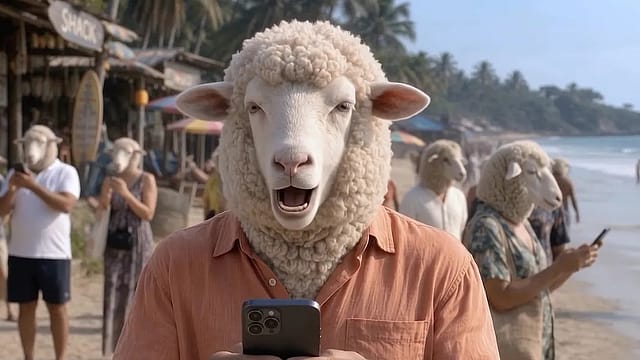
Everybody has come to the beach to get away from everybody.
The result is predictable. The shore is crowded. So are the cafés. The holiday has delivered another crowd, with better scenery.
In ixigo’s recent film for TARA, its AI travel assistant, the tourists have sheep’s heads. One traveller consults the app, finds a quieter seaside spot and regains his human appearance. The instruction is succinct: “Don’t follow the herd.”
It is a funny way to sell a holiday. It is also a demanding promise to make on behalf of a recommendation engine. Because the traveller has escaped one set of instructions by accepting another. Everybody else followed the crowd. He followed TARA.
That need not make his choice less personal. A good assistant could help him discover somewhere he would never have found alone. But the transformation from sheep to human asks us to accept something larger than convenience: that a machine can help restore the individuality we surrendered while planning a supposedly personal escape.

Zeroing In on ECI
09 Oct 2026 - Vol 05 | Issue 41
Constitutional legitimacy versus political opportunism
What happens when everybody asks it to do the same?
There are two stories here. One concerns the tourist’s desire to feel different. The other concerns ixigo’s need to look different in a category where rivals, including MakeMyTrip, are also building AI into the journey. The sheep must carry both.
The holiday before the booking
The creative device works because it gives an abstract behaviour a body. A row of similar travel decisions becomes a flock. There is no need to explain recommendation loops or deliver a lecture on conformity. The viewer gets the joke before the product arrives.
There is flattery in it too. Nobody watching wants to identify as the sheep. The advertisement offers a comfortable bargain: recognise the foolishness of the crowd, then imagine yourself as the person clever enough to leave it.
Yet travelling somewhere popular is hardly evidence of an absent personality. A familiar destination may have affordable flights, reliable accommodation, food the family likes and activities that work for children or older relatives. Predictability can be valuable when leave is limited and the holiday has taken months to save for.
That is where the film’s shorthand needs to remain a joke. A traveller deserves a better match, whether that produces a quiet cove or a thoroughly enjoyable week at a famous resort. Obscurity alone does not make a holiday more authentic.
The more interesting promise is that TARA can begin with the person’s requirements. Imagine a traveller explaining that the family wants the sea, dislikes nightlife, cannot manage long transfers and has a fixed budget. The useful answer would connect those constraints, explain the compromises and offer plausible choices.
Marketing and branding experts reckon that the opportunity is to become useful before the customer has decided what to buy. “But personalisation earns trust only when the recommendation reflects the traveller’s constraints as well as aspirations,” says Ashita Aggarwal, professor of marketing at SP Jain Institute of Management & Research.
This is the strategic territory the film opens up. The app wants to participate in the formation of desire. It would like to be present when the customer is still deciding what a good holiday should feel like.
Six weeks, one developing argument
ixigo had already been encouraging travellers to look beyond the familiar in its Independence Day campaign. The in-house rap video invited Gen Z to explore India’s landscapes and heritage, including Ajanta, Hampi and Kutch, and used AI as a creative tool.
The connection matters more than the interval.
The Independence Day work offered an invitation: there is more to discover. The TARA film attaches a product to that invitation. The traveller who accepts the argument is given something to do next.
There is an intriguing change in AI’s role as well. In the earlier execution, it helped make the communication. Here, the assistant is the service being advertised. Technology moves from helping construct the travel fantasy to promising help in constructing the trip.
Read together, the two campaigns suggest a developing position around discovery. That is a more useful interpretation than treating every new film as a fresh declaration of brand intent.
It also raises the standard for the product. An inspiring film can leave viewers with an attractive impression of somewhere else. A planning assistant must deal with the inconvenient particulars: dates, distance, cost, availability and what the traveller means by “quiet”.
The beach in the commercial has plenty of space. The real itinerary has constraints.
MakeMyTrip is already in the conversation
MakeMyTrip provides the competitive pressure that makes ixigo’s choice interesting. Consider its May 2026 campaign, Book The Trip Now. Think Of An Excuse Later. The three-film campaign used Jaideep Ahlawat and a discount proposition to turn the justification for taking a holiday into comedy.
The two executions intervene at different points in the traveller’s thinking. MakeMyTrip gives the desire to go away an entertaining push. TARA questions the destination that desire has settled on.
One makes the excuse amusing. The other makes imitation embarrassing.
That distinction gives ixigo a recognisable creative route without requiring it to outbid a rival for another familiar face. Sheep can perform the work of an argument very quickly. The risk is that viewers remember the animals and forget which travel company supplied them. The connection between the visual joke, TARA and the useful action must survive the entertainment.
But this is not a neat contest between an advertising-led incumbent and an AI-led challenger. MakeMyTrip has Myra, its own AI trip-planning assistant. An announced Mastercard collaboration adds another expression of that ambition, combining personalised discovery with curated experiences and offers.
AI assistance, therefore, cannot by itself establish ixigo’s distinctiveness.
The contest is becoming more specific: whose assistant understands the brief, produces useful alternatives and explains why they fit? Which one can handle the untidy family discussion behind a clean search query? Which recommendation still looks sensible after the user checks the price and the journey?
When competitors can make similar technology claims, the brand has to own a recognisable benefit. "The sheep create attention; the quality of the holiday advice has to create preference,” says Aggarwal.
There is a commercial reason to compete for that earlier conversation. A platform consulted only after the destination is fixed enters a relatively narrow comparison. A platform that helps the customer choose the destination has a chance to become part of the decision’s logic.
It can earn influence before the booking screen appears. That influence makes the quality and transparency of its recommendations more consequential.
Everybody wants a different holiday
The global travel business offers another version of this problem. In May 2024, Airbnb introduced Icons, including a recreation of the house from Up and a stay at the Ferrari Museum. These were experiences built to be recognisable and extraordinary enough to generate desire in their own right.
The comparison is revealing. Airbnb made the unusual experience the attraction. TARA promises help finding an experience suited to the individual. Both approaches reach beyond the transaction into the imagination of the trip.
But an experience can be highly distinctive while attracting remarkably similar aspirations. Thousands may want the same unusual thing. That does not make their enthusiasm false. It does show why “different” and “personal” should not be treated as interchangeable words.
A holiday can feel deeply personal at a famous destination. An obscure destination can feel entirely borrowed if the traveller is there only because a screen said it was the next essential discovery.
The real advantage of conversational planning would be to examine those differences. Some travellers want solitude; others want a place where their children will find company. Some want an unfamiliar cuisine; others need dietary certainty. An assistant that takes those differences seriously could spread interest across more places and seasons.
That is the strongest defence of TARA’s premise. AI need not send everybody towards the same alternative. It could widen the practical choice available to each person.
The film cannot prove that outcome. It can make the proposition worth investigating.
Who leads the next herd?
Now imagine the same request arriving repeatedly: a beautiful beach, fewer tourists, a reasonable price, easy access and somewhere good to stay.
The set of places satisfying all those conditions is not limitless. If assistants repeatedly identify the same excellent alternatives, discovery can concentrate demand again. The quiet place becomes a recommendation, the recommendation becomes an itinerary and the itinerary acquires company.
This is a possibility the story should question, rather than a failure it can already pin on TARA. A capable system could respond through greater variety, better seasonal advice and a more precise understanding of what different travellers value.
Nor should a quiet destination be treated merely as empty space awaiting someone else’s holiday. There are residents, businesses, services and limits to consider. Helping visitors find alternatives works best when those alternatives can accommodate them.
For ixigo, the test is, therefore, larger than whether a sheep-headed crowd produces a memorable advertisement. Does the product reward the viewer who takes its invitation seriously? Can it make a recommendation feel understood rather than merely surprising?
That is how the brand can distinguish itself from MakeMyTrip and every other assistant promising a trip that feels like your own.
The first traveller reaches the quiet beach and becomes human again. The more revealing scene begins when the next traveller opens TARA.