Haq Se Maango. Now, Ask Priyagold for Answers
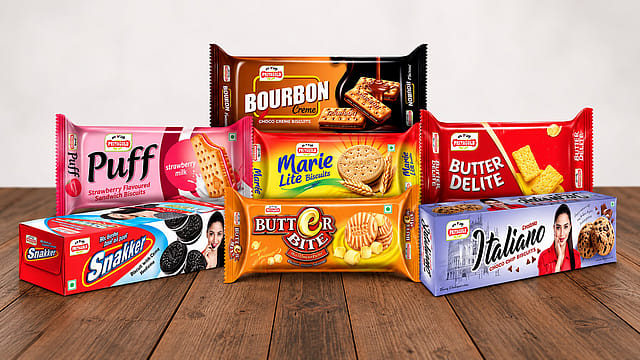
Three words taught the customer to insist. Haq se mango (Ask for it as your right).
At the shop counter, it was an invitation to choose Priyagold by name. A small act of consumer confidence, compressed into a line that could travel with every packet.
Now those words invite another request. An explanation.
The Food Safety and Standards Authority of India has announced prosecution proceedings against Surya Food & Agro, the manufacturer of Priyagold biscuits, over alleged food safety violations. The regulator says an inspection following a consumer complaint found bran intended for cattle feed being used as a source of fibre in biscuit manufacturing.

Zeroing In on ECI
09 Oct 2026 - Vol 05 | Issue 41
Constitutional legitimacy versus political opportunism
For a company selling something as familiar as a biscuit, the allegation reaches an especially sensitive part of the purchase: the assumption that the basics have already been taken care of.
Priyagold’s own communications make that assumption explicit. In a public LinkedIn post, the company described its guiding brief as “affordable should never mean inferior”. It connected its signature slogan with the proposition that “quality is every Indian’s right”.
That is a substantial promise to make for an everyday product. It is also a reasonable promise for the customer to hold a company to.
THE COMPLAINT BEHIND THE SLOGAN
The detail that gives this story its force is where the inspection began.
A consumer complained. According to FSSAI’s account, officials subsequently found gunny bags containing bran marked for cattle feed. The regulator also reported deficiencies involving hygiene, pest control, raw-material storage and segregation, and other manufacturing practices. It said the company’s licence had earlier been suspended and prosecution had subsequently been sanctioned.
These are the regulator’s findings and allegations. Prosecution is a legal process. But the branding question exists already. A consumer-rights slogan has encountered a consumer complaint. A promise about quality now faces questions about the ingredients and processes behind it.
The customer does not have to become a food technologist to ask those questions. Indeed, part of the value of a packaged-food brand is that the buyer should be able to rely on work happening beyond their sight.
Marketing and branding experts reckon that the consumer buys a familiar brand partly because it reduces the work of choosing. When a serious quality allegation emerges, that convenience is disturbed. "The brand has to give people a reason to feel confident about the next purchase,” says Ashita Aggarwal, professor of marketing at SP Jain Institute of Management & Research.
For Priyagold, the challenge is to explain what happened, the extent of the issue and what consumers should understand about the products they buy. A familiar line can get their attention. Specific answers have to do the rest.
THE PACKET THAT DOESN’T NEED A SALES PITCH
The everyday biscuit has an enviable marketing advantage.
It can become part of a routine so settled that nobody in the household remembers the first purchase. Tea arrives. A packet opens. Somebody reaches for another.
The brand receives the benefit of a decision made long ago. That is the commercial value at stake when questions arise about manufacturing. A purchase that once required little thought can acquire a new question: should I buy the same packet?
There is no evidence of consumers switching brands, retailers withdrawing support or competitors gaining market share. Yet the competitive risk is clear enough to examine. On a shelf offering alternatives, an established habit is valuable precisely because the customer usually has no reason to reconsider it.
An allegation can create such a reason. A credible response can help address it.
Price and taste will still matter. So will availability. The company’s task is to preserve confidence in the ordinary transaction while answering an extraordinary allegation.
The temptation in a crisis is to reach for the language that has worked before: decades of service, generations of customers, a commitment to quality. Those things may explain why people trusted a company. The immediate question is what they can verify now.
WHEN THE FACTORY BECOMES THE BRAND STORY
Advertising ordinarily brings the finished product forward and leaves procurement, storage and production in the background.
A food safety case reverses the view.
The supplier, the raw material, the checks and the factory become central to the brand’s story. They are the work that makes the promise credible in the first place.
That is why a response needs detail. Which findings does the company accept or dispute? What production is involved? What has been checked? What action has followed? What information can a customer use?
Priyagold’s case will have its own legal and regulatory course. The marketing response needs to make that course understandable without asking consumers to treat reassurance as evidence.
A company’s response should help consumers understand what is known, what is being examined and what action follows. Broad statements about commitment cannot answer specific questions about a product. "The clearer the information, the less the customer has to guess,” says Aggarwal.
There is an obligation on the regulatory side too. Clear information about the scope and basis of an action helps consumers assess it accurately. Precision protects the buyer. It also helps prevent a specific allegation from becoming an indiscriminate verdict on an entire range.
THE CANADIAN LESSON
A useful global example comes from Maple Leaf Foods in Canada.
In August 2008, investigators linked the strain of listeria associated with illness and deaths to some of the company’s food products. Chief executive Michael McCain publicly acknowledged the failure and apologised. The company expanded its recall to cover all production from the Toronto facility concerned and published affected product details.
The events differ profoundly in their facts and severity. The Canadian case offers a lesson about the form of a response, rather than a comparison of wrongdoing.
The company put an identifiable leader in front of the problem. Its communication connected acknowledgement with a defined facility, an expanded recall and product codes that consumers could consult.
That gave the public something more useful than an expression of concern.
It provided information on which to act. No communication can undo harm. Nor does a public apology, by itself, prove that a business has fixed its systems. The relevant lesson is that a response becomes more credible when people can examine the action behind it.
For a brand facing scrutiny, the job is to make its next steps as legible as its familiar name.
WHO GETS TO SAY ‘HAQ’?
Priyagold’s slogan still offers a strong starting point for the story.
It gives the customer a voice. There is dignity in the idea that an affordable product should come with an assured standard of quality. A modest purchase does not make the buyer’s expectations less important.
That principle gives the brand something worth defending. It also gives consumers a standard against which to examine the defence.
The legal proceedings will test the alleged violations. The everyday transaction will pose its own question: has the company explained enough, and done enough, for the customer to choose it with confidence?
A biscuit brand can spend years becoming a name people ask for. When a serious allegation arrives, it must be prepared for what they ask next. Haq se.