Put a Sumo on It: How Greenply Entered Advertising’s Product Torture Chamber
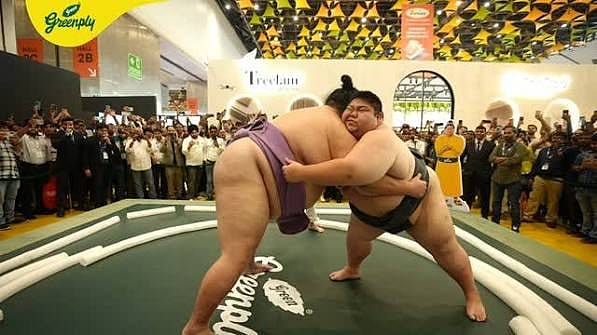
Two Japanese sumo wrestlers flew to Delhi and climbed onto a sheet of engineered wood. Together, they weighed more than 510 kg. They did not stand politely for photographs. They fought.
Belly met belly. Feet pounded the surface. More than half a tonne of human force shifted, lunged and landed on an MDF board that remained, rather crucially, beneath them.
This was not a sporting contest. There was no trophy for the winner. The MDF was the contestant.
Greenply Industries staged the bout at MATECIA Expo 2026 to demonstrate the strength, durability and load-bearing capacity of its board. A product normally condemned to a life beneath laminates, inside furniture and outside interesting conversation suddenly found itself sharing the stage with two enormous men from Japan.

Zeroing In on ECI
09 Oct 2026 - Vol 05 | Issue 41
Constitutional legitimacy versus political opportunism
Advertising has invented many units of measurement: Horsepower. Whiter whites. Miles per gallon. Ten times more protection. Greenply may have found a new one. How many sumo wrestlers can your furniture take?
The answer, according to the company, is at least two.
Ashok Jaiswar, its chief marketing officer, reportedly underlined the category had become crowded with brands speaking the same commodity language and listing similar features. Greenply wanted to demonstrate its claim instead.
A laboratory might have produced a chart. Greenply produced combat.
Please Try to Destroy the Product
Somewhere along the way, advertising grew tired of describing products and began trying to kill them.
Watches were drowned. Suitcases were mauled. Phones were pulverised. Trucks were suspended above water. Brands placed their products in danger and invited audiences to anticipate the moment of failure. Surely the watch will stop. Surely the suitcase will crack. Surely that blender cannot eat an iPhone. Surely the board will buckle beneath two sumo wrestlers. That surely is where the advertisement lives.
“Consumers have developed a discount rate for advertising adjectives. Every brand claims to be stronger, safer, faster and longer-lasting,” says Ashita Aggarwal, professor of marketing at SP Jain Institute of Management & Research (SPJIMR). A demonstration converts an abstract promise into a mental picture. "People may forget the technical specification, but they will remember the board that survived the sumos," she adds.
Nobody enters a furniture store asking for the MDF’s modulus of rupture. Someone may, however, remember the wood upon which two wrestlers attempted to rearrange each other.
The sumos make an invisible property visible. They also interrupt the category. A carpenter testing the board would be credible but expected. A laboratory machine would be accurate but visually lifeless. Sumo wrestling and MDF do not normally belong together. That incongruity makes the brain look twice. Sumo plus MDF. Van Damme plus trucks. Gorilla plus luggage. iPhone plus blender. The absurdity is not decoration. It carries the idea into memory.
When Timex Tortured Time
Greenply’s feat belongs to a tradition that predates Instagram, YouTube and the desperate instruction to “make it viral”.
In the 1950s, Timex began subjecting watches to televised torture tests. They were strapped to baseball bats, placed in washing machines and attached to speedboats, jackhammers and outboard motors.
News broadcaster John Cameron Swayze would retrieve the battered watch and deliver the line that entered American popular culture: “It takes a licking and keeps on ticking.”
During one live demonstration, a Timex reportedly flew off an outboard motor’s propeller and disappeared. This presented a minor obstacle to proving that it still worked. Swayze recovered beautifully. The missing watch, he suggested, was probably at the bottom of the tank, still ticking.
When the demonstration failed, the slogan survived. By the end of the 1950s, one in three watches sold in the United States was reportedly a Timex. Specifications inform. Survival fascinates.
The Gorilla Ate the Brand
In the 1970s, American Tourister placed its luggage inside a zoo enclosure with a gorilla.
The animal threw the suitcase, battered it, stomped upon it and appeared personally offended by its continued existence. The suitcase survived. The gorilla did not take questions.
The execution converted a familiar consumer fear into a character. The gorilla was every airport baggage handler who had ever mistaken a suitcase for sporting equipment.
It also delivered a warning. Many viewers remembered the famous commercial as an advertisement for Samsonite, which later became American Tourister’s corporate sibling. The gorilla beat the luggage. It may also have beaten the advertiser’s name out of the commercial.
“A stunt can become more famous than the brand financing it,” says Agarwal. “If people remember the sumos but forget Greenply, the campaign has created sumo equity rather than brand equity.”
Advertising calls it the vampire effect: the creative device sucks attention away from the product paying for the party. The advertisement wins the memory contest. The advertiser misplaces the trophy.
Let Us Sacrifice an iPhone
Three decades later, Blendtec discovered that the internet was a giant room full of people eager to watch expensive objects being destroyed.
Its premise required four words: Will it blend?
Company founder Tom Dickson fed his blenders golf balls, marbles, rake handles, cameras and phones. Most famously, he dropped an iPhone into the jar, switched on the machine and watched consumer technology become dust. The films looked like something a cheerful uncle might shoot in his garage shortly before being asked to leave the neighbourhood.
That was their genius.
Blendtec took the dreariest part of appliance selling, the product demonstration, and spliced it with the suspense of an execution video. Nobody needed an iPhone smoothie. Everybody understood what the destroyed phone said about the blender’s motor. The product benefit and the punchline became the same thing.
Van Damme Makes Steering Famous
Then came the split.
In 2013, Jean-Claude Van Damme stood with one foot on the mirror of one Volvo truck and the other on a second. Both vehicles reversed. One gradually moved away until the action star’s legs formed the split that launched a million involuntary winces. Enya played. The sun rose. Van Damme remained serenely suspended between two moving machines.
The film demonstrated the precision and directional stability of Volvo Dynamic Steering. An engineering feature that might have died inside a brochure became one of the world’s most famous automotive advertisements.
Its madness remained attached to the product. The trucks’ precision made the split possible. Remove the steering benefit and the spectacle loses its reason to exist.
That is the line separating a demonstration from a circus.
Volvo’s larger “Live Tests” campaign also included a hamster steering a truck and company president Claes Nilsson standing on a vehicle suspended more than 60 feet above Gothenburg harbour. The truck’s towing hook held the vehicle. The president supplied the anxiety.
Forsman & Bodenfors, the agency behind the campaign, reported underlined that half the viewers surveyed became more interested in buying a Volvo truck after watching the films. Among those viewers, two-thirds visited the company’s website or contacted a dealer. Nobody risked his neck merely because the creative team had experienced a lively Thursday afternoon.
Why Brands Are Doing It Again
Product demonstrations solve four modern marketing problems.
Competing products increasingly sound alike. Every board is durable, every detergent defeats stains and every technology company has discovered AI. A strange demonstration gives a generic claim a proprietary image.
Attention has also become viciously scarce. Greenply is competing against cricket clips, dance reels, political fights, celebrity feuds and cats falling off cupboards. A technical specification rarely survives that feed. A sumo wrestler might.
Then comes earned media. A conventional commercial ends when its media budget does. A sufficiently mad demonstration travels through news stories, reels, reaction videos and conversations.
Greenply paid for an activation. It received a story.
Physical proof has also acquired fresh value in the age of synthetic imagery. Greenply says 60 to 70 per cent or more of its content this year has been produced using AI. Yet when it needed to make its most basic promise believable, it flew in 510 kg of real human flesh.
AI can create a thousand sumo wrestlers before lunch. It can make them fight on a board floating above Delhi and finish with a tiger performing carpentry.
The more easily technology manufactures impossible images, the less an impossible image proves.
“Real demonstrations reduce the trust tax that consumers impose on advertising,” says Agarwal. The brand appears to place its own claim at risk and asks people to judge the result. In an AI-heavy environment, ‘we actually did this’ can itself become a powerful proposition. Real wrestlers. Real weight. Real impact. Real board.
Proof or Performance?
There remains a difference between a demonstration and independent evidence.
The bout proves that one board survived one controlled performance. It does not establish how every board will behave after years of moisture, variable installation, termites or an Indian family discovering that every flat surface can become permanent storage.
Was the tested product identical to the one being sold? Were the conditions representative? Can the result be reproduced? Does the stunt prove the entire claim or one carefully selected dimension?
Greenply says its MDF carries a 20-year warranty. That matters more commercially than the body weight of its visiting athletes.
The wrestlers make the confidence visible. The warranty makes it accountable.
“A demonstration can accelerate belief, but it cannot replace substantiation,” reckons Agarwal. Without data, certification or warranty behind it, proof advertising risks becoming a magician asking the audience not to inspect the table.
The finest product-torture campaigns follow a simple grammar: Find the product’s central promise. Identify its greatest enemy. Arrange a fight.
For a watch, the enemy is punishment. For luggage, it is the baggage handler recast as a gorilla. For a blender, it is an object that should never become powder. For precision steering, it is Van Damme’s groin. For MDF, it is 510 kg of moving sumo wrestler.
The product does not defeat a competitor. It defeats the doubt already sitting in the consumer’s head.
The sumos have proved they can make people look at an MDF board. Whether they can make people remember Greenply when it is time to buy one is the heavier test.