Micro-Drama’s ₹5,500-Crore Cliffhanger: Will Brands Buy the Plot?
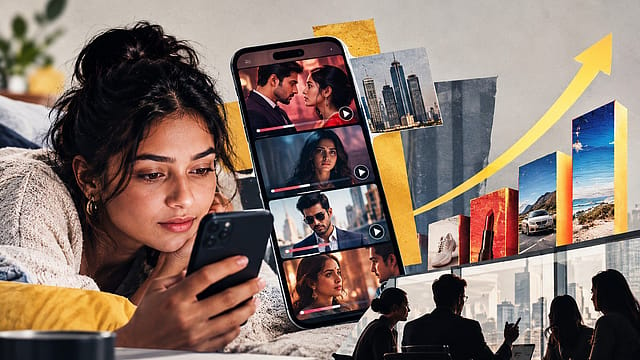
Micro-drama has already done the difficult part. It has made people watch.
Now it has to convince brands to buy.
That may prove considerably harder.
A new report by strategy consulting firm Redseer projects that advertising could become a ₹5,000-5,500 crore business for India’s micro-drama industry by FY32, up from roughly ₹24 crore in FY26. The forecast implies a spectacular expansion of the category, with advertising daily active users expected to rise to 140-150 million from just about 18 million in June 2026.
On paper, it is the sort of number that makes a new advertising medium look inevitable.
In reality, India’s micro-drama industry is still trying to answer a more basic question: will brands treat these tiny, cliffhanger-heavy episodes as serious advertising inventory, or as another cheap reach product sitting somewhere between social video and television?
Losing Memory
16 Oct 2026 - Vol 05 | Issue 42
The making of a medical and social emergency
That distinction will determine whether the ₹5,000-crore opportunity is a new advertising pool or simply an optimistic projection of where the category could go.
The audience is real. The ad market isn't, yet
There is little doubt that micro-drama has found an audience.
Redseer estimates that nearly 40 million Indians paid for micro-drama at least once in FY26, while 15-17 million were average monthly paying users. Nearly half of surveyed users said they watched micro-drama daily. More importantly, the format is not asking consumers to learn an entirely new behaviour. It is borrowing from one they already have.
About 64 per cent of users surveyed said they first discovered micro-drama through short-form video and social media, while another 20 per cent came through friends and family. Users typically consume the content in short, unplanned windows, while scrolling, taking a break, commuting or simply filling time.
That makes micro-drama interesting for advertisers because it combines two things that rarely sit comfortably together: the snackability of short-form video and the narrative pull of serialised entertainment.
The engagement numbers are equally striking. Redseer estimates that Indian users were consuming the equivalent of around 2,100 years of micro-drama content every day by June 2026, up 3.5 times in eight months.
But there is a catch.
Watching is not the same as monetising.
The current micro-drama business is still overwhelmingly subscription-led. Redseer puts subscriptions at roughly 99 per cent of industry revenue today, with advertising still nascent. In other words, the category has demonstrated willingness to pay, but it has not yet demonstrated that advertisers are equally willing to pay for access to that audience.
That is the gap the industry now has to close.
₹5,000 crore sounds impressive. Look under the hood
Redseer estimates India's micro-drama advertising market could rise to ₹210 crore in FY27 and ₹5,000-5,500 crore by FY32. The calculation is not based simply on the number of viewers. It is built on several moving parts: the number of advertising daily active users, viewing intensity, ad load, fill rate and eCPM.
And several of those variables are still moving targets.
The report expects AVOD DAUs to reach 140-150 million by FY32. Viewing intensity is projected at 60-65 episodes per user per day. More significantly, ad fill is expected to rise from 24-28 per cent today to 50-55 per cent, while eCPM is projected to move from around ₹40 to ₹60-65.
The logic is straightforward: more users, more viewing, better inventory utilisation and eventually better prices.
But this is precisely where advertisers should remain cautious.
Redseer itself says the improvement in fill rates depends on advertiser familiarity and maturing programmatic demand, while its eCPM projection assumes greater advertiser confidence. Even at maturity, the projected ₹60-65 eCPM remains below long-form OTT benchmarks.
That means a significant portion of the projected advertising growth depends on the very thing the market has yet to establish: brand confidence in micro-drama as an advertising environment.
The report's more aggressive scenario takes this further. If awareness grows, ad-tech improves and advertiser demand strengthens, Redseer sees the market potentially reaching around ₹10,000 crore by FY32, with roughly 190 million DAUs, a 60 per cent fill rate and eCPMs approaching ₹75.
It is an attractive upside case. It is also a reminder of how much needs to go right.
Why brands may eventually care
There is nevertheless a compelling advertising proposition here.
Micro-drama users do not simply watch one video and leave. The story creates a reason to return. A cliffhanger creates another viewing session. Another session creates another advertising opportunity.
Redseer envisages a freemium model in which users discover a story through a feed, watch several episodes for free, encounter a cliffhanger and then either watch an advertisement to unlock more content or pay ₹5-20 to continue. After the story arc ends, they return to the feed and discover another series.
For brands, that potentially creates something more valuable than raw impressions: repeated attention around a narrative.
There is also a large audience sitting outside the subscription economy. Nearly six in 10 surveyed users said they would watch more micro-drama if it were available free with advertising. More than 65 per cent expressed interest in a platform offering free viewing with ads and one-time payments to skip them.
That could make AVOD the bridge between micro-drama's early paying audience and the much larger pool of consumers who are unwilling to maintain another subscription.
For brands, the opportunity could be particularly interesting in categories that depend on frequency, discovery and regional penetration. As the format moves into Tier-2 and smaller cities and expands across vernacular languages, it could offer advertisers a way to buy attention that is both mass-market and narrative-led.
But again, could is doing a lot of work.
The biggest opportunity may not be Kuku TV
One of the most important points buried in the report is that micro-drama is unlikely to scale simply through standalone micro-drama apps.
China's experience suggests that ownership of distribution matters enormously. High-traffic platforms with captive audiences have a structural advantage because they can redirect existing traffic into micro-drama at a much lower acquisition cost. Redseer notes that such platforms controlled more than 60 per cent of category traffic in China, while standalone AVOD platforms faced substantially higher customer acquisition costs.
India is beginning to show the same pattern.
The format is likely to spread across dedicated micro-drama platforms, large OTT services and short-form video ecosystems. A large OTT platform has already launched free micro-drama, while short-form platforms are emerging as an important distribution layer. Redseer notes that one leading short-form video platform already captures the majority of India's micro-drama AVOD market.
That matters for advertisers.
If micro-drama remains trapped inside a handful of small apps, it may struggle to generate enough scale, measurement and buying efficiency to attract serious brand budgets.
If it becomes another content layer inside the broader OTT and short-form ecosystem, the proposition changes.
The ad inventory can potentially be sold alongside existing video inventory. Recommendation engines can drive discovery. Existing identity, targeting and measurement infrastructure can be reused. And the platforms already have relationships with advertisers.
In other words, the future of micro-drama advertising may depend less on micro-drama apps becoming advertising giants and more on existing advertising giants deciding that micro-drama is worth carrying.
The brand-safety problem nobody should ignore
There is another issue.
Micro-drama is built around heightened emotion: revenge, romance, hidden identities, family conflict, suspense and cliffhangers. Those are precisely the mechanics that drive engagement. They are not automatically the environments in which every brand wants to appear.
Redseer explicitly flags brand safety as an increasingly important consideration and argues that advertisers partnering early can gain greater control over targeting and content adjacency as standards develop.
That is a polite way of saying the category still needs to grow up.
Brands will want to know where their ads appear, what content surrounds them, how inventory is measured, whether impressions are genuinely viewable and whether audiences can be independently verified.
They will also want to know whether micro-drama can command the same kind of pricing as other premium video environments.
At present, the evidence is not there.
Redseer expects fill rates to improve to 50-55 per cent by FY32 and eCPMs to rise towards ₹60-65, but still below long-form OTT benchmarks. The report's own methodology therefore acknowledges that advertiser demand has to mature before the economics can mature with it.
AI could make the opportunity bigger, and messier
The other wildcard is production.
Redseer expects GenAI to reduce the cost of producing a roughly 100-episode micro-drama series from ₹15-20 lakh today to ₹5-6 lakh over the next three to four years. Lower production costs could allow platforms to create more titles, expand libraries and generate more advertising inventory.
That is potentially transformative.
But cheaper content does not automatically mean better advertising inventory.
If AI makes it possible to flood platforms with thousands of interchangeable stories, the category could face the same problem that has plagued parts of the short-form ecosystem: enormous supply competing for finite attention.
For advertisers, quality, context and measurement will matter more than the sheer number of episodes available.
The winners may therefore not be the platforms producing the most micro-dramas, but those capable of producing enough good ones, finding the right audience and proving that the audience is worth paying for.
The ₹5,000-crore question
The bullish case for micro-drama advertising is easy to understand.
There is a large and growing audience. Consumption is frequent. The format is naturally mobile. Discovery is already happening through ad-supported feeds. A substantial share of users say they would watch more if the content were free with ads. Production costs are falling. And the Chinese market offers a powerful precedent, where advertising eventually became the dominant monetisation engine.
But India is not China, and a precedent is not a guarantee.
The more immediate test is whether brands move beyond experimentation.
Micro-drama has already proved that consumers will give it their time and, in some cases, their money. The next stage is harder. It needs advertisers to give it their budgets, agencies to give it a place in media plans, platforms to give brands credible measurement and studios to give advertisers an environment they are comfortable appearing in.
Until that happens, ₹5,000 crore is best viewed not as the size of an established market, but as the size of the prize if the ecosystem manages to make the leap from consumer curiosity to advertiser confidence.
And that leap is still very much underway.