Micro Drama or Just Drama? Pocket FM's Exit Sparks a Reckoning
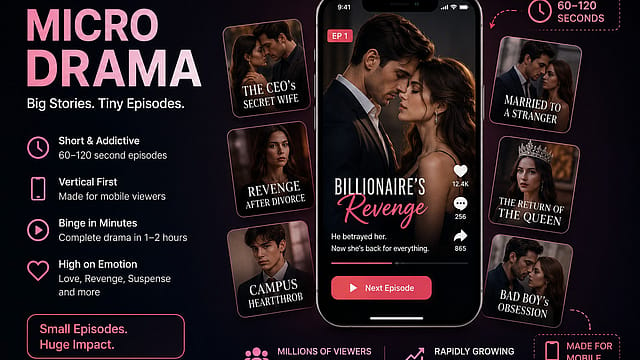
The history of digital media is filled with products that consumers loved but businesses struggled to monetize.
From blogs to podcasts to short-form video, audience adoption has often arrived long before sustainable economics. Every new format goes through a period when enthusiasm collides with the harder realities of customer acquisition costs, monetization models and content economics.
Micro dramas may be approaching that moment.
Pocket FM's decision to shut down Pocket TV, its micro-drama vertical, has revived questions about one of the fastest-growing segments in digital entertainment. The move does not necessarily signal trouble for the category. Pocket FM itself insists Pocket TV was a beta experiment rather than a strategic pillar of the company. But it does highlight a broader question facing the industry: Can micro dramas evolve from a consumer trend into a sustainable business?
The Vanguard
21 Aug 2026 - Vol 05 | Issue 34
BJP Rearmed for 2029
At first glance, the category appears to have everything going for it.
The format is built for smartphones, caters to shrinking attention spans and aligns with the growing habit of consuming entertainment in short bursts throughout the day. Episodes are brief, cliffhangers are frequent and the viewing experience feels native to the scroll-first internet.
The audience, at least according to industry observers, is not the problem.
"Micro dramas are a fairly recent phenomenon, but they have been gaining traction across audience segments. They are particularly popular among consumers at the bottom of the pyramid—people such as ride-hailing drivers, fishmongers, and others who have short pockets of downtime during the day. The format's brevity and accessibility make it highly engaging for these audiences," said Harish Bijoor, business and brand-strategy specialist.
Yet popularity alone does not guarantee commercial success.
The rapid growth of the category has created an increasingly crowded ecosystem of platforms, genres and distribution channels. As more players enter the market, audience attention is being spread across a growing number of titles, making loyalty harder to build and monetization harder to scale.
"The audience itself is highly fragmented. In many ways, micro-drama viewers form micro-segments of their own, which can make monetization challenging," Bijoor said. From an advertiser's perspective, reaching scale often requires spreading a campaign across dozens of micro dramas. A brand may need to place its message in 60 or 70 different titles to achieve meaningful reach, which fragments marketing budgets and reduces efficiency, he added.
That challenge sits at the center of the industry's debate.
Micro dramas have proven that they can attract viewers. The bigger question is whether they can attract profits.
Industry executives argue that Pocket FM's decision should not be mistaken for a verdict on audience demand.
"Pocket FM's decision to move away from micro dramas shouldn't be interpreted as a sign that audiences are losing interest in the format. If anything micro dramas have emerged as one of the most engaging forms of digital storytelling, particularly among mobile first consumers who prefer quick, bite-sized content that fits into their daily routines. The audience demand is clearly there," said an industry executive who requested anonymity.
The problem, according to the executive, is that audience demand and business sustainability do not always move in lockstep.
"What Pocket FM's move does highlight is that audience demand and business sustainability are not always the same thing. Building a successful micro drama platform requires far more than attracting viewers. It requires a business model that can consistently support content creation, distribution, marketing, and user retention over the long term."
The economics become more complicated when platforms attempt to scale.
While episodes may last only a few minutes, viewers expect a constant stream of fresh stories and frequent episode releases. That requires a steady investment in writing, production, talent, post-production, localization and marketing. What appears inexpensive at the level of a single episode can become significantly more costly when multiplied across dozens of active titles and markets.
Creators face a similar challenge. Unlike traditional storytelling formats, micro dramas have only a few seconds to capture attention. Every episode must end with a hook strong enough to bring viewers back for the next installment, while maintaining enough narrative momentum to sustain hundreds of episodes.
Monetization remains another unresolved issue.
Platforms across the category continue to experiment with subscriptions, advertising, virtual currencies and hybrid models. Yet the challenge is not simply attracting viewers but ensuring that content investments and user-acquisition costs generate sustainable returns.
Competition further complicates the equation.
Micro dramas are no longer competing solely against one another. They are competing against short-form video apps, social media feeds, streaming platforms, mobile gaming and the broader creator economy. Consumer attention has never been more fragmented, making retention as important as acquisition.
For some observers, that does not necessarily make micro dramas a bubble. It simply reflects the growing pains of an emerging category.
Every new media format goes through a period of experimentation before durable business models emerge. The winners are rarely the companies that arrive first; they are often the companies that discover how to balance consumer demand with sustainable economics.
Pocket FM, for its part, rejects the idea that Pocket TV's closure reflects a broader assessment of the category.
"Pocket TV was launched as a beta product to explore the emerging microdrama category and is not a material contributor to Pocket FM's business. As with any product experiment, we periodically evaluate performance and strategic fit, and any decisions related to Pocket TV are part of that normal process," a Pocket FM spokesperson said.
The company added that its focus remains on its core audio business.
"Our core focus remains building the world's leading audio entertainment platform. Audio continues to account for the overwhelming majority of our business, and we remain focused on scaling the category globally. Today, Pocket FM is one of the largest audio entertainment platforms globally and continues to see strong growth across its key international markets."
That explanation may well be accurate. Companies routinely shut down non-core experiments to focus on businesses with clearer strategic value.
Yet Pocket TV's closure has inadvertently surfaced a larger question for the industry.
The real debate is no longer whether consumers want micro dramas. The evidence increasingly suggests they do.
The debate is whether platforms can build businesses around that demand that are profitable, scalable and durable.
Until that question is answered, micro dramas will continue to occupy an uncertain space between breakout entertainment format and business model in search of sustainability.