Meet Shridhar Venkat, the CEO Without Profit
The kitchen wakes before the city does.
It is barely dawn when the first truck rolls in Rajajinagar, some 3 kilometres from the heart of Bengaluru.
A mountain of vegetables follows—sacks of rice, crates of carrots, drums of lentils. Forklifts whirr. Steel gates clatter open. Inside the cavernous hall, giant cauldrons—each the size of a small swimming pool—wait to be lit.
Soon the silence dissolves.
Steam rises. Conveyor belts begin to move. Ladles plunge into vats of boiling sambar.
Rice tumbles down polished chutes like white grain waterfalls. By mid-morning, this place will produce more meals than most restaurants cook in a year.
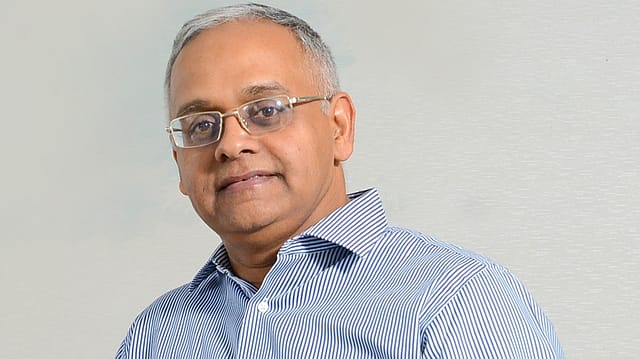
Standing quietly on the sidelines is Shridhar Venkat. He is not donning a chef’s uniform.
There is no need for it. Just a hard helmet and a still gaze, tracking the choreography below—timings, flows, temperatures and dispatch schedules.
In corporate India, CEOs talk about scale in earnings calls.
But here, scale smells like turmeric and steam.
Every day, the kitchens of The Akshaya Patra Foundation cook over 23 lakh meals, reaching more than 23,000 government schools across the country.

The Liberation of Bengal
05 Jun 2026 - Vol 04 | Issue 74
A silent revolution ends the reign of fear
The operation spans 76 centralised kitchens across 16 states and three union territories—a footprint that would make most food companies pause.
Except this isn’t a food company.
There is no menu. There is no pricing strategy. There is no revenue target. And yet, the system runs with the precision of one.
Look closer, and it begins to resemble something else entirely.
Akshaya Patra: A Company Without Revenue
At first glance, nothing about Akshaya Patra feels like a charity.
The kitchens are ISO 22000-certified, the same standard applied to commercial food manufacturers.
Nearly 200 Good Manufacturing Practice audits are conducted in a year. GPS-enabled fleets track the last mile with the discipline of a logistics company. Waste is converted into fuel. One kitchen in Gujarat runs entirely on solar energy.
It looks, behaves, and scales like a corporation. Probably, that’s why the man running it resists the label that comes with his title.
He says it without flourish. Almost matter-of-fact. “I am here to serve our employees, whom I call hunger warriors. I am here to serve the children who deserve to be served.”
Inside the organisation, even language is quietly reworked. The Bangalore office where he sits isn’t called the head office. It is the ‘central office.’ Not HQ. Not command centre.
The shift is subtle. And deliberate.
For Venkat, the idea of leadership begins somewhere else. “I strongly believe all of us are looking for happiness,” he says.
The children we serve, he underlines, are looking for happiness. The employees are looking for happiness. “And the best way to be happy is by serving others,” he reckons.
It is an unusual framework for a CEO. There are no shareholders to answer to. No quarterly earnings pressure. No stock price ticking up or down. And yet, the expectations here are, in many ways, more unforgiving. Because every morning, the system has to work.
What Akshaya Patra has built over the years is not just scale. It is reliability at scale.
Cooking begins before sunrise. By 6:30 or 7:00 am, the first batches are ready. Within hours, thousands of insulated containers are sealed, loaded, and dispatched across cities and villages.
If the window is narrow, the margin for delay is still smaller. Because somewhere, in a government school far from these kitchens, a child is waiting.
If you look closely, the organisation reveals itself in layers. At one level, it is a massive food operation—processing hundreds of tonnes of raw material every day and converting it into hot, nutritious meals within a matter of hours. At another, it is a logistics network—routing deliveries across thousands of schools with clockwork precision.
And underneath it all sits something less visible, but far more fragile: Trust.
It comes from all stakeholders. Trust from governments. Trust from donors. And trust from millions of parents who may never visit a kitchen but rely on the system to deliver, day after day.
That’s why, inside Akshaya Patra, the discipline feels closer to an airline than a charity. Every meal must land safely.
For Venkat, this duality is not accidental. “Akshaya Patra has the mind of a corporate and the heart of a compassionate not-for-profit,” he says.
That balance—between efficiency and empathy, process and purpose—is what has allowed the organisation to scale. It is also what defines his job. Because running this system requires the instincts of a corporate leader. But the scorecard is something else entirely.
Because once you move past the machinery, the question changes.
Shridhar Venkat: A CEO without Profit
If you strip away the scale, the technology, the systems—what remains is a question. What does it mean to be a CEO when profit doesn’t exist?
In most boardrooms, the job is clearly defined. Grow revenue, protect margins, allocate capital and reward shareholders.
But inside The Akshaya Patra Foundation, those markers dissolve.
There are no customers. No pricing. No profit to optimise. And yet, the decisions are no less exacting. “Whether you like it or not, we are always serving,” says Venkat.
The idea surfaces repeatedly in conversation. Service, for him, isn’t an abstract value. It is operational. It shapes how the organisation thinks about its people. Its language. Its priorities.
It also shapes what keeps him awake.
A corporate CEO might worry about declining margins or a missed quarter. Venkat worries about something more immediate. “If you look at a non-profit like Akshaya Patra, we are feeding over 2.3 million children every day,” he says.
Then he pauses, almost as if recalibrating the weight of that number. The most important thing is to ensure that the child in the remotest place has access to a hot, safe, nutritious meal when she comes to school.
Not eventually. Not when conditions improve. Every single day. And then comes the constraint.
Unlike corporations that sit on reserves, Akshaya Patra operates with startlingly little cushion. “We run with a 15-day kind of reserve with us,” he says.
Just fifteen days. That is the runway for an operation that feeds over 22 lakh children daily. There is no war chest. No long financial buffer. No margin for complacency. The question almost asks itself: What happens if those 15 days become 10 or 7 or 3?
Venkat doesn’t dramatise the answer. Instead, he reframes the problem. “What keeps me awake is to ensure that we are able to always give a hot, safe, nutritious and tasty meal to children,” he says.
The money is implicit in the mission.
Without funds, the system slows. And if the system slows, the meals stop. And if the meals stop, the consequences are immediate.
There is a line he uses later in the conversation that captures the reality more precisely than any balance sheet.
“It is like riding a lion,” he says. “You can’t get down.”
The metaphor is almost understated. Because getting down is not an option. The system must keep moving every day. Without interruption.
By 8 am, that motion is visible.
Rows of stainless steel containers are sealed shut and rolled toward waiting trucks. Workers move faster now. Every minute matters. Drivers climb into their seats. Route charts are checked. Temperatures are recorded.
Then the gates open. One truck after another pulls onto the road, each carrying thousands of meals packed inside insulated containers. Across cities and villages, the same choreography repeats.
Inside the kitchen, it feels like a dispatch centre. Outside, though, it becomes something else: A promise in transit.
For Venkat, sustaining that promise is the job. And unlike a corporate CEO, he does not have the luxury of pausing the system. “You are always on a shoestring budget in a not-for-profit,” he says.
“You don’t have deep pockets. And at the same time, you have to ensure that the delivery of the meal happens day after day after day.”
There is no equivalent in most businesses. A real estate company can delay a project. A manufacturer can slow production. A startup can pivot. But Akshaya Patra cannot stop.
That’s why, when asked whether running a non-profit is harder than running a business, Venkat doesn’t hesitate. “Absolutely, yes.”
There is no pause, no qualification. Just a flat, certain answer.
And yet, the system holds. Not because the constraints are easy. But because the organisation has learned to operate inside them. Carefully, relentlessly and every single day.
The answer, as it turns out, is hidden in the smallest numbers.
Akshaya Patra & The Cost of One Paisa
Inside a system this large, small numbers begin to behave differently.
In most companies, shaving a paisa off cost is incremental. Maybe marginal and often invisible. But here, it compounds into something else. “If I save one paisa on the cost of a meal,” says Venkat, “it is food for 4,000 children for one whole year without raising any additional funds.”
The math looks simple. But when one looks at implication, it takes a different texture.
Efficiency, in Akshaya Patra, is not about margins. It is about meals unlocked.
Every optimisation feeds someone. Every inefficiency costs someone. The organisation runs with a discipline that often feels closer to manufacturing than charity. Costs are tracked tightly, processes are standardised and systems are audited. And yet, there are lines that cannot be crossed. “You can’t cut corners,” Venkat says. “We should cook as good as a mother.”
The comparison is deliberate.
Because in the absence of a price tag, quality becomes a moral decision.
This balance—between frugality and dignity—is where leadership gets tested. It gets tested in moments that rarely make it into annual reports. The hardest decisions, he says, are not about scale. They are about people.
Akshaya Patra is built on six values—integrity, compassion, devotion, synergy, quality and trustworthiness. And for Venkat, the order matters. “Integrity is more important than compassion,” he says.
The statement lands heavier than expected. Because in an organisation built on feeding children, compassion would seem like the obvious first principle.
But he is clear. “There is no point in being compassionate when there is no integrity.” The consequence of that belief shows up in the toughest calls he has had to take.
Letting people go. Not for performance. But for values.
“There have been times when people have contributed immensely to Akshaya Patra,” he says. “But somewhere, they had to compromise on our code of conduct… and we have to let them go.”
He doesn’t rush through the answer. “These are not easy calls.”
There is a reason for that rigidity. A quiet fear that runs beneath it. “If I show lenience… it is like building a 100-storey building and realising on the 90th floor that the foundation is not proper.”
In most organisations, culture can bend. Here, it cannot afford to.
Because the moment integrity weakens, something else follows: Trust.
And without trust, the system collapses, donors walk away, funding dries up and meals stop.
And this brings the conversation back to something less visible, but just as defining: Culture.
Inside Akshaya Patra, it doesn’t fit neatly into corporate categories.
Part of the organisation is run by professionals—people with corporate experience, systems thinking, operational rigour.
Another part is run by monks. People who have chosen a very different life. They have minimal needs, are mission-driven and are deeply anchored in service. “The people who lead operations… are monks,” says Venkat.
Some receive a small monthly allowance. Some don’t even operate like conventional professionals at all.
And yet, they run one of the most complex food operations in the country.
For an outsider, the mix can feel improbable.
Three cultures coexisting: Monks, mission-driven workers and corporate professionals. All inside one system.
“For a Fortune 500 CEO, this would be a shock,” Venkat says.
Not just the scale. But the people who sustain it.
And still, it works. Not perfectly. Not easily. But consistently. Because underneath the layers—process, people, purpose—there is a shared understanding on why the organisation exists. “Missionary spirit and professionalism coexist,” underlines Venkat.
He calls it the secret. He makes it sound simple. But it isn’t.
And then, it becomes something else entirely.
India’s Biggest NGO & The First Meal
The classroom is already restless when the containers arrive.
It is late morning. Sunlight spills through open windows. A ceiling fan groans overhead.
Then the door opens.
Two helpers walk in carrying large steel containers. The chatter dips almost instantly. Plates appear from schoolbags and desk drawers. Some children sit cross-legged on the floor, forming neat rows that have clearly been practiced many times before.
A lid lifts. Steam escapes into the room. Rice first. Then dal.
A boy in the second row leans forward slightly as the food reaches his plate. He waits for the teacher to move on before picking up his spoon. Around him, the room fills with the quiet sound of eating.
For most of the children here, this meal is routine. It is expected.
And almost invisible in its regularity. But what they do not see is everything that came before it.
The kitchens that woke before dawn. The trucks that lined up in the dark. The systems that moved in precise, practiced sequence. The decisions taken late at night. The money raised, counted and stretched. The margins shaved to feed more. All of it collapses into this one moment.
A hot meal on a steel plate.
Somewhere far from this classroom, in an office that is not called a headquarters, Venkat ends his day the way he often does—looking at numbers. Not revenue or profit. But meals served, routes completed and schools covered.
Twenty-one years ago, none of this was inevitable.
At the time, he was in transition. Between roles. On track for a different kind of career. Then came a conversation.
“Why are you building empires for others?” someone asked him. “Build for these children who need you.”
The question stayed. It lingered long enough to alter direction. He said yes.
The reactions around him were predictable. Friends were sceptical. Some questioned the move. Others waited to see how long it would last.
He stepped in anyway. Stayed. And kept going. Over time, the scale grew and the systems strengthened. The organisation expanded across states, across cities and across millions of children.
But some things remained constant such as the constraint, the uncertainty and the daily reset.
Even now, he resists the idea that the system is fully under control. “Sometimes I wonder… I am not running Akshaya Patra,” he says. “It is God’s grace that is happening.” There is no attempt to claim ownership of the scale.
For a corporate CEO, the day ends with a balance sheet.
For Venkat, it ends somewhere else. In a classroom. In a steel plate. In the quiet certainty that, for one more day, the system did not fail. And that tomorrow, it must not.