Before the Click: Why Baby Forest Is Testing Hospitals
Motherhood Hospital, Greater Noida West, Uttar Pradesh
The room is quiet, but not still.
A nurse moves in and out. A monitor hums softly. Somewhere down the corridor, a newborn cries—sharp, unfamiliar and urgent.
On the bed, a first-time mother watches, half-aware, half-exhausted, as the first few hours rearrange everything she thought she knew.
There are questions now. Small, but immediate. What oil goes on the skin? What soap is safe? What do you trust?
The answers don’t arrive all at once. They come in fragments: through family, relatives, friends and well-wishers.
Meanwhile, a nurse steps in, checks the chart, adjusts the blanket, and before leaving, places something on the side table: a small cloth bundle, a tuk-tuk potli and a ‘congratulations’ message.
The Modi Years
02 Oct 2026 - Vol 05 | Issue 40
A Nation Rebuilt
Inside the potli are three small bottles: Sampoorna Snan baby body wash, Moh Malai baby body lotion, and Nikhrae Kesh baby shampoo.
The potli doesn’t answer everything. But it shapes what gets tried first.
And in that moment—before comparisons, before online searches, before choice becomes deliberate—the ‘congratulations’ card makes Baby Forest, a luxury ayurveda-inspired baby care brand, silently enter the room.
THE FIRST MOMENTS WIN
Meanwhile, a few floors below, the mood shifts.
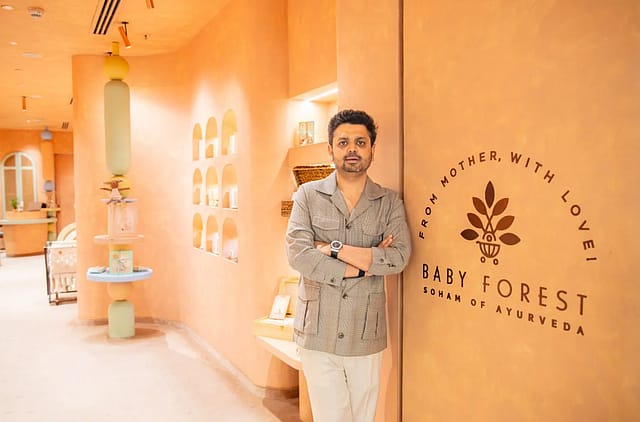
The corridor opens into a space that doesn’t quite feel like a hospital store.
The walls are washed in warm terracotta. Shelves are carved into the walls, holding rows of softly coloured bottles. Rounded tables carry neatly packed gift boxes. A crib sits in one corner, as if the store is already part of the life it is meant to enter.
An older woman walks in, adjusting the end of her saree. She has come to visit—but not empty-handed. Her eyes move across the shelves. She picks up a box, turns it over, reads the labels carefully. Oils. Kits. Bundles put together for newborns. Her hand pauses on one of the boxes. She turns it over, reads it twice, then doesn’t put it back.
It looks incidental.
A nurse leaving behind a potli. A visitor picking up a gift. A store tucked inside a hospital corridor. But none of it is accidental.
In categories like baby care, the decision doesn’t begin on a website. It begins earlier—at a moment of uncertainty, before preferences form, before comparisons begin, before the first product quietly sets the benchmark for everything that follows.
That is the window Baby Forest chose to enter: at the point of first use. Most brands build visibility first. They advertise, acquire, push for recall, hoping it converts into purchase later.
But Baby Forest took a different offline route. It entered before recall was even needed. Inside hospitals like Artemis in Gurugram and Motherhood in Greater Noida, the brand set up small retail spaces—not to drive footfall in the conventional sense, but to be present where decisions were already being made.
The drill is simple.
A sample becomes trial, a trial becomes familiarity and familiarity becomes trust. And trust, in this category, is hard to dislodge. Why? When the user is a newborn, the cost of getting it wrong feels too high to experiment again.
That’s how the loop closes. The first touchpoint is physical, the decision is emotional and the transaction moves elsewhere. What begins in the hospital doesn’t stay there. It shows up later—in search bars, in repeat orders, in quiet familiarity with a name that already feels known.
CELEBS AS A SECOND LAYER
For Baby Forest, that movement is structured.
The physical footprint is small but the ambition for that layer is larger. The company plans to build a network of nearly 100 kiosk-style stores inside premium maternity and paediatric hospitals, expanding presence in environments where the category’s first decisions are made and repeated.
The scale, however, sits elsewhere. Most of the business comes directly from its own website, supported by presence across marketplaces and quick-commerce platforms.
The sequence is clear. The first encounter happens offline. The purchase doesn’t have to. By the time a customer lands online, they’re not discovering the brand. They’re returning to it.
That shows up in the numbers.
From ₹2 crore in FY23, revenue moved to ₹9.54 crore in FY24. Then ₹19.96 crore in FY25, with FY26 expected to close at ₹26.61 crore. The growth has not come in bursts. It has built steadily—repeat orders, familiar users, decisions that didn’t have to be made again.
Profitability, however, is still evolving. The business has remained bootstrapped, continuing to invest in product and distribution. While it operated at a loss through much of this period, the company says it has begun turning profitable more recently, as the system starts to stabilise.
That changes what the website has to do. It doesn’t need to convince. It needs to complete. The brand has earned its visibility. By the time Baby Forest started to appear alongside familiar faces, the groundwork had already been laid. The product had found users, the system had begun to work, and the name had started to travel.
That’s when the next layer came in: Collaborations.
The first was with Mira Rajput Kapoor—closer to the audience the brand was speaking to: young, urban mothers navigating similar choices. Another followed with Masaba Gupta and Neena Gupta—a pairing that carried both cultural recall and generational trust.
For a new parent encountering the brand, the name didn’t feel entirely new anymore. But the sequence held. The first touchpoint remained inside hospitals. The celebrity came later.
For marketing and branding experts, the model is both precise and difficult to scale. “What Baby Forest has done is identify a very high-intent moment,” says Ashita Aggarwal, professor of marketing at SP Jain Institute of Management & Research. They started selling online, made a mark, and then entered the consumer’s journey in the offline world to cement trust.
That creates an advantage. “In categories like baby care, trust forms early. Once that trust is established, switching becomes less likely,” says Aggarwal.
But that advantage comes with its own limits. “The offline model depends heavily on controlled environments—hospitals, first-use moments and curated experiences,” she says. “The question is what happens when you move beyond that,” asks Aggarwal.
BUILT ON TRUST, TESTED BY SCALE
As the brand grows, the pressure shifts.
More visibility brings competition. More distribution introduces variability. And the conditions that made the model work—control, proximity, timing—become harder to hold together. “The opportunity is clear,” says Aggarwal. “They can build a strong, trust-led brand.”
But the challenge is consistency. Can the brand scale without diluting what made it credible in the first place? And then comes the harder question. Growth has to sustain itself. At some point, it has to start making money.
Meanwhile, for Gagan Agarwal, the approach did not begin as a marketing strategy. When the end user is a newborn, the cost of getting it wrong is very high. “Parents don’t experiment easily. The first product you use often becomes the one you stay with,” says the founder and CEO of Baby Forest Ayurveda.
That changed the starting point. Instead of asking how to acquire customers, the question became: where does the first decision happen?
The answer wasn’t a screen. It was a room, a hospital room. That insight shaped everything that followed. Though the brand began online, its offline strategy was clear: it didn’t need to be everywhere. It needed to be present at the right moment. “We realised it’s not about reach,” he says. “It’s about being there when the decision is made,” he adds.
That clarity came with a cost.
Profitability is still taking shape. The business has stayed in investment mode—product, distribution, controlled expansion—and that has kept it in the red: ₹1.20 crore in FY24, ₹4.07 crore in FY25, and ₹2.5 crore through most of FY26. The shift, Agarwal says, has only just begun, with the business turning profitable from January this year.
That transition will decide what holds. Growth has come from familiarity and repeat use. The next phase demands something less forgiving—discipline, margins, and the ability to convert trust into cash without breaking the system that created it.
The baby has arrived. Now it has to learn to earn its keep.