Riding Into a Man's World: Oben Electric’s Madhumita Agrawal
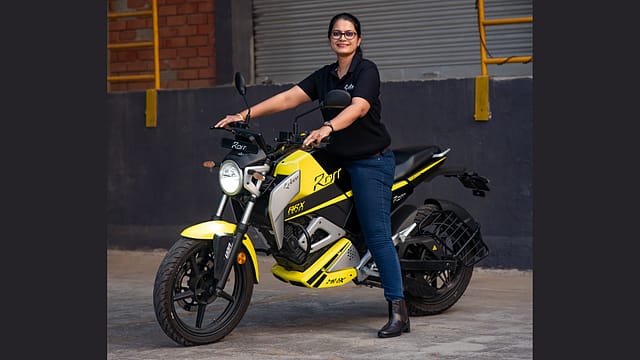
There is a particular kind of question that Madhumita Agrawal has heard many times over — usually phrased with a politeness that doesn't quite conceal the scepticism beneath it. Something about whether she'd found it difficult, being a woman in a space like this. Whether people had doubted her.
Her answer is characteristically direct. "The people who don't believe in your vision simply don't come along with you." She pauses for a beat. "The ones who trust your capabilities are the ones who stay."
It is a line that sounds almost serene, until you consider the terrain she's been navigating. Agrawal is the founder and CEO of Oben Electric, a Bengaluru-based startup building electric motorcycles — a category that has, for as long as anyone can remember, been designed by men, marketed to men, and largely run by men. She walked in anyway.
Rise of the Pivotal Power
18 Sep 2026 - Vol 05 | Issue 38
The BRICS declaration is a strategic victory for Modi
Oben Electric has raised ₹85 crore in a pre-Series B round, taking its total funding to ₹285 crore. Revenue from operations rose sharply from ₹1.45 crore in FY24 to ₹20.41 crore in FY25, while the net loss widened from ₹28.09 crore to ₹69.45 crore over the same period, as per regulatory filings accessed by business intelligence platform Tofler. The company is targeting EBITDA break-even by 2027 as it scales operations.
An Unlikely Route to the Road
Agrawal did not grow up dreaming of motorcycles. She grew up in a family of doctors — her father, aunts, several relatives — and for a long time assumed medicine was her trajectory too. "That white coat always looked fascinating," she says, with a laugh that suggests she's genuinely amused by her younger self.
But somewhere along the way, engineering caught her attention. She pivoted to biotechnology, at the time a frontier that fused both instincts, then pursued an MBA in Bangalore, then spent a few years inside a company watching how decisions got made. What she saw, it seems, was less a career path and more a set of constraints she didn't want.
"I wanted to build something of my own instead of working for someone else," she says. "It was a big U-turn."
The U-turn began around 2016–17, with a company offering R&D services to mid-sized firms that couldn't afford the kind of in-house research budgets that a Samsung or Apple could sustain. She started with two employees. Within a few years, she had close to a hundred, and a global client base. The milestone she still returns to: hiring their first employee from America. "It felt empowering," she says simply, "to build something that was creating opportunities globally."
Seven Years, One Conviction
The R&D company, IPExcel, operated across several technology domains — drones, petroleum, electric vehicles. It was through this work that Agrawal spent nearly seven years inside the EV ecosystem, learning its engineering language, its supply chains, its peculiar mix of promise and friction. By 2020, she had seen enough to want to stop advising and start building.
That instinct produced Oben Electric. And then came the choice that most founders in her position might have avoided: motorcycles. Not scooters — the gentler, more gender-neutral entry point that several EV startups had already staked out. Motorcycles. The category with the most entrenched culture, the most loyal (and almost exclusively male) consumer base, the deepest legacy of being somebody else's domain.
Why? Agrawal does not make it sound like a provocation. She makes it sound like a gap. And gaps, to her, are simply problems worth solving.
The Weight of the Question
Ask Agrawal directly about gender bias and she doesn't flinch, but she also doesn't reach for the expected narrative. She is not interested in cataloguing slights. What she's more interested in is execution — and in the idea that execution, done clearly and confidently, dissolves most doubts before they can harden into obstacles.
"As a CEO, my job is to perform," she says. "Whether I'm speaking to investors, suppliers, customers or employees — I focus on demonstrating value through data, clarity and execution. When you present your vision clearly and confidently, most doubts disappear."
It is worth noting what she is not saying. She is not saying the doubts were never there. She is not saying the room always felt welcoming. She is saying she found a more efficient response to it than resentment: proof.
Oben Electric is co-founded with her husband, a detail that tends to prompt its own set of assumptions. Agrawal addresses it with the same matter-of-factness she brings to everything else. Both ventures began with her vision; he joined the business later. What sustains it, she says, is clarity about respective strengths. "No founder knows everything. The key is to build the right team around you."
A Wonder Woman?
The work-life balance question, she says, is something of a false premise. "Most entrepreneurs will tell you there is no perfect balance. There is always a transaction cost." What she has built instead is a set of systems — meticulous ones, by her description — not just at the office but at home. Schedules for her child, arrangements for her parents, structures that allow her to be present in multiple places without being absent from any of them.
She makes an argument that feels quietly radical: that when women delegate domestic labour in order to build something larger, they are not shirking responsibility. They are creating employment. They are participating in an economy. "Women's participation in the workforce directly contributes to economic growth," she says. "In multiple ways."
She is also honest about the earlier years. Cooking her own food, commuting by bus, managing everything on a founder's budget. "Those phases are part of building something," she says. Not glamorised, not erased. Simply acknowledged.
The First Step
Agrawal's father had a mantra he repeated to her growing up: go and try. Even if you fail, you will learn something. It is, she says, a gift she is still spending — the permission to attempt things before the outcome is guaranteed.
She talks about women she has met across India — in cities, in small towns — building enterprises in their own registers, in their own languages. A woman running a poultry business who spoke neither English nor Hindi but knew, precisely, how her enterprise worked. Agrawal tells this story not as inspiration but as evidence. Evidence that the instinct to build is widely distributed. What is unevenly distributed is the permission.
Her advice to women who want to start something is not a list of strategies. It is a single sentence: "Dare to dream."
The moment you believe you want something, she says, you begin to find ways to reach it. Opportunities, people, solutions — they appear once you take that first step.
Madhumita Agrawal took hers years ago, in a room with two employees and a gap she thought she could fill. The motorcycles came later. So did the rest.