Meet Goofy Tails' Karan Gupta: The Dog’s Human
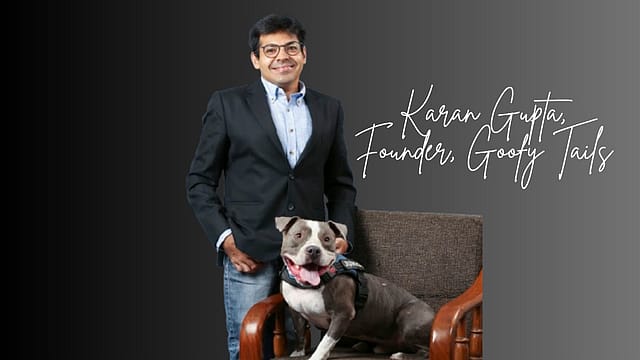
Karan Gupta's story could have easily been defined by setbacks. A childhood marked by illness. A year spent on a wheelchair. A near-fatal accident that left him hospitalised for months. Repeated personal losses that would have made most people withdraw.
And yet, when Gupta speaks, none of that sits heavily on the surface. What comes through instead is a certain lightness. A clarity. Almost a quiet joy. The kind that does not come from an easy life, but from having made sense of a difficult one.
His journey into building Goofy Tails did not begin with ambition. It began with a connection.
Gupta grew up in Hoshiarpur, in a family where business was a natural path. Born in 1982, his grandfather had migrated during Partition and rebuilt life from scratch. His father and uncles were entrepreneurs. But as a child, Gupta was drawn elsewhere.
Rise of the Pivotal Power
18 Sep 2026 - Vol 05 | Issue 38
The BRICS declaration is a strategic victory for Modi
"From a very early age, I felt more connected to animals than to people," he said.
It was not something he understood then. It was simply instinct. He would walk out of his home just to spend time with street dogs. His family was not comfortable with it. They worried about safety. But one of those dogs stayed. It became part of his everyday life, playing with him through the day and lingering outside the house at night.
That quiet companionship planted something early. But it was his own physical vulnerability that deepened it.
Illness and Brownie: A Bond That Defined Everything
As a child, Gupta began facing health issues that gradually worsened. A stint at boarding school had to be cut short. Eventually, his condition deteriorated to the point where he spent nearly a year on a wheelchair.
"I couldn't stand properly. There was constant pain," he recalled. "Even sleeping was difficult."
It was in this phase that a dog named Brownie became central to his life.
Brownie developed a routine that no one had taught him. Every night, he would sleep between Gupta's legs, almost as if he understood exactly how to protect him from further pain. He stayed there through the night, moving only when necessary.
"He would stay with me all the time," Gupta said. "Only getting up to eat and then coming back."
There is a way in which people often describe pets as companions. But what Gupta experienced felt deeper, almost protective.
One moment, in particular, stayed with him.
"One day, while coming to sit between my legs, he accidentally touched my injured leg. The pain was intense, and I reacted," he said. "That was the first time I saw tears in his eyes."
Brownie refused to eat for two days after that.
"That was the moment I truly realised that whatever love we think we give to dogs is nothing compared to what they feel for us."
There is no sentimentality in the way Gupta says this. It is matter of fact. Almost observational. But it carries weight.
That understanding would stay with him, even as life threw harder challenges his way.
The Accident and an Unexplainable Connection
A few years later, in 1998, Gupta met with a severe accident while travelling to Jaipur for his treatment. He suffered multiple fractures. His shoulder broke. His neck was injured. He was hospitalised for three months. His mother, who was with him, was also critically injured.
For those three months, Brownie was at home. And then something unexpected happened.
"He suddenly started showing signs of pain," Gupta said. "Doctors suspected a tumour. Some even suggested putting him down."
Gupta refused. There was no clarity, no definitive diagnosis. And then, just as suddenly as it had appeared, the problem disappeared.
"The day I came back home after three months, his pain just disappeared," he said. "It felt as if there was a deeper emotional connection there that we don't fully understand."
For Gupta, these were not isolated memories. They formed a worldview. One where animals were not passive dependents, but deeply feeling beings.
In 2001, Brownie passed away.
The loss left him hollow. He decided he would never get another dog.
But grief does not always behave in predictable ways. Within days, the emptiness began to grow.
"I realised that the emptiness wasn't going away. It was only increasing," he said.
In 2002, he brought home another puppy. There was no research, no structured system. Just a newspaper listing and a decision.
A veterinarian advised him to return the dog, warning of potential health issues.
"I said that once he had come into my home, he was family," Gupta said.
That dog died in a road accident in 2005.
Another followed. And then another. Each time, Gupta found himself confronting the same patterns. Health issues were common. Even dogs sold as "good breeds" were not immune.
The consequences were visible. Weak immunity. Skin issues. Bone problems.
For someone who had already seen animals at their most vulnerable, this was difficult to ignore. It was also, in retrospect, the first time a business problem began to take shape—though Gupta would not have called it that then.
Pet Club India: Building Information Where None Existed
At the same time, Gupta's own life remained physically constrained. In 2008, he underwent hip replacement surgery in both hips. He continued his education, eventually pursuing computer applications, but much of his work happened from home.
That is where the next phase began.
In 2009, he built a website called Pet Club India. It was not a business in the traditional sense. It was an attempt to organise information that did not exist.
"At that time, there was no structured information available about pets in India," he said.
He wrote everything himself. Breed guides. Care instructions. Health considerations. He built a directory of breeders, veterinarians, and pet shops. He even bought a database and manually uploaded it.
People began reaching out.
"If someone wanted to get a dog, I wouldn't just suggest a breed," he said. "I would first understand your lifestyle."
Time, space, family support, grooming capacity. Gupta would assess all of it before making a recommendation. And if something did not fit, he would say so.
Once a decision was made, he would connect people with breeders. But he introduced a step that was not common at the time. Every puppy had to be checked by a veterinarian before handover. It was a small intervention, but it brought some accountability into an otherwise opaque system.
The engagement did not end with the transaction.
"Even after people took the puppy home, they would call me daily," he said. "What to feed, how to train, what to do if the dog had loose motions."
He guided them through everything. He did not charge for it.
The platform eventually found its first commercial support in 2010, when Royal Canin—which had just entered India—sponsored the website, allowing Gupta to sustain and expand the effort. Around the same time, he began conversations with a veterinarian, Dr. Kunal, around e-commerce. They started listing products online, managing orders manually. As demand grew, so did the need for structure.
Goofy Tails: From Side Project to Business
That led to the creation of Goofy Tails.
In November 2011, Gupta formally launched the brand, starting with two physical pet stores in Delhi.
The early days were not glamorous. A small physical store. Online orders managed from a basement. At one point, nearly 150 orders a day were being handled from home.
But even as the business grew, Gupta's personal involvement with pet parents did not reduce. That consistency is telling. It suggests that the business was not built as a layer over his life. It grew out of it.
The next inflection point came from another personal challenge.
"My own dog developed severe allergies," Gupta said. "To chicken, rice, and pumpkin."
Most commercial foods contained at least one of these ingredients. Nothing worked. So Gupta began studying pet nutrition in earnest. He started cooking for his dog—carefully, deliberately. Within a few months, the results were visible. Coat health improved. Muscle tone returned. Veterinarians noticed. Requests came in to replicate the approach.
He spent over a year refining recipes, guided by one principle: "No matter how healthy food is, if the dog doesn't find it tasty, it's useless."
The company first launched fresh frozen meals, then moved to ready-to-eat formats using retort technology—making the food more accessible and scalable. Toys and accessories, once part of the offering, were quietly deprioritised. Designs were easy to copy. Price competition was intense. Nutrition offered a deeper, more defensible space. Goofy Tails began to position itself, deliberately, as a nutrition-first pet care company.
Building the Business: Scale, Science, and Review
Today, nearly 95% of Goofy Tails' revenue comes from food. The pivot was not incidental—it was earned through years of reformulation, consumer feedback, and scientific collaboration.
Revenue from operations rose 26.5% to ₹11.16 crore in FY25 from ₹8.82 crore in FY24, while net loss narrowed 27.3% to ₹1.76 crore from ₹2.42 crore, as per RoC filings accessed by Tofler.
Cat food, it turns out, is where the real complexity lives. Dogs are adaptable; cats are not. They require precise levels of taurine—an essential nutrient they cannot synthesise on their own—along with a carefully calibrated stack of vitamins. Early attempts at sourcing ready-made recipes fell short. "The quality wasn't great. It didn't feel right," Gupta said. The company eventually worked with an Australian pet nutritionist counted among the leading experts in her field globally, as Gupta highlighted. Her recipes, however, were designed for Australian conditions. Goofy Tails had to rebuild them for India—accounting for local raw material availability, price points, and taste preferences. The process took close to eighteen months.
The result is a portfolio roughly split between dog and cat food—with cats, as Gupta notes, being the more demanding audience. He tells the story of a three-star Amazon review where a customer wrote that she did not know what Goofy Tails was putting in its cat food, but her cat was addicted and refused everything else. She was still placing monthly orders. When the team called her, she explained that the three stars were because her cat would no longer eat any other brand. "That's how particular cats are," Gupta said. It was, in its own way, a testament.
The supplement line adds another dimension to the business. Currently distributed through over 200 veterinary doctors, it includes a canine recovery product designed for post-surgery patients, heatstroke cases, and general weakness. It delivers instant energy and hydration, and several vets use it alongside or in place of IV drips in specific situations. A focus on senior dogs is emerging as the next product frontier—with mobility supplements already launched and specialised recovery diets in development for distribution through veterinary channels.
Distribution itself is a deliberate mix. Around 20% of business comes through D2C channels—the company's own website and Amazon, where it maintains warehouse presence for faster fulfilment. The remainder flows through quick commerce platforms and trade partners. Veterinary channels, while traditionally hard to penetrate, are being prioritised as a strategic growth lever.
Goofy Tails has raised approximately ₹17 crore in funding to date, including a recent round from Wipro Consumer Care. The capital is being deployed primarily to scale the food business and deepen distribution reach.
On the product philosophy side, the company has stayed deliberate about what it will not sell. Certain high-margin categories have been set aside because they do not meet Goofy Tails' own bar for pet welfare. Technology is also in play: customer conversations are recorded and processed using AI to extract product feedback, which feeds directly into the R&D pipeline.
What Has Not Changed
In 2013, Gupta got married, but both he and his wife began facing health challenges, adding another layer of difficulty to his personal life.
But if there is one thread that runs through Gupta's journey, it is not strategy. It is perspective.
He has lived through physical pain, emotional loss, and repeated setbacks. But none of it shows up as bitterness. If anything, it has made him more certain about what he wants to build.
"And through all of this," he said, "one thing hasn't changed — I still continue to guide pet parents personally, free of cost, just like I did when I started."
It is a simple statement. But it explains the business better than any strategy ever could.