There is No Alpha in Following Someone Else’s Playbook: Aloke Bajpai
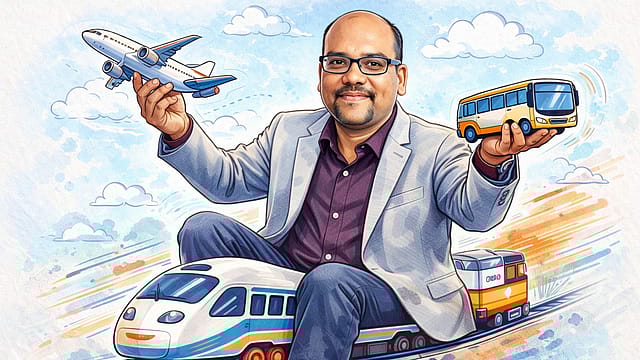
Last summer, at New Delhi railway station, Aloke Bajpai stopped watching trains.
He started watching people. They poured out in waves—families, solo travellers, groups—bags slung over shoulders, decisions already made. Not on screens or apps, but on instinct. Most were heading to Karol Bagh and Paharganj—crowded lanes and bylanes they trusted. Places where they could see a room before paying for it.
Bajpai asked a few of them a simple question: why not book online? They shrugged. The answer was unanimous. We don’t trust what we see.
That was the moment. The ‘aha’ didn’t arrive under a Bodhi tree. It arrived on a crowded platform. Bajpai realised hotels are not a demand problem. Nor a supply problem. They are a trust problem.
For a company that has built its business on getting Bharat to move—from trains to buses to flights—that answer carried heft. Why? Because ixigo isn’t competing with the MakeMyTrips of the world. It’s not—as tempting as it is to frame it—a David versus Goliath battle or a hotel war.
It’s a quieter fight. A harder one. It’s a fight to change behaviour, not with discounts or freebies, but with trust.
And behaviour, Bajpai knows, doesn’t change easily.
Months earlier, on IPO day, he had faced a different kind of uncertainty. “I remember when we rang the bell, we didn’t even look back at the screen… jo hoga dekha jayega,” he recounts. “Till that moment, we didn’t even know what we were worth,” he says.

Open Minds 2026
26 Jun 2026 - Vol 05 | Issue 26
The power of ideas and arguments in 50 portraits
In an ecosystem that obsesses over valuation, that restraint feels almost out of place. But it explains how ixigo has been built: By compounding trust.
From its early days as a meta-search platform to becoming a full-stack OTA across trains, buses and flights, the company has taken a slower route. It hasn’t relied on deep discounting. It hasn’t chased market share at any cost. And now, as it steps up its hotel play—a category where online penetration still struggles to cross even 20%—it is resisting the urge to scale too quickly.
Here’s why. The problem, Bajpai underlines, is bigger than competition. “It’s not a zero-sum game,” he says. “The real question isn’t where users book—it’s whether they book online at all.”
That shift—from share to behaviour—is what defines ixigo’s next chapter. And perhaps, its hardest test yet. Here are edited excerpts from a freewheeling interview with OPEN Digital.
Everyone wants to know—who should fear ixigo in hotels?
It’s not the right question. The bigger problem is that Indians are still not booking hotels online at scale. Out of an estimated 2 to 2.5 million room nights every day, OTAs together don’t even touch 3 lakh. That’s the real gap. The issue is trust—why people don’t come online to book.
That’s surprising, given this category has been around for two decades.
Exactly. If after 20 years penetration hasn’t crossed even 20%, then somewhere the approach needs to change. Inventory is not the problem. Hotels are everywhere. The problem is finding one that lives up to expectations at the price you’re willing to pay.
What have you learnt about this customer?
They’re not price-sensitive. They’re value-sensitive. Nobody chooses the cheapest car. Nobody chooses the cheapest anything. People want value for money—an AC that works, a clean room, basic things—but they don’t want to overpay.
And yet, they’re still booking offline. Why?
Because they don’t trust what they see online. They’ve tried it before—photos didn’t match, rooms disappointed, or they got a better deal by walking in and negotiating. That’s the behaviour we’re trying to change.
So, this isn’t really about competing with other OTAs?
No. It’s not a zero-sum game. The real competition is offline. If behaviour shifts, the market itself expands.
What gives ixigo the right to take this on?
Our audience. We already have users booking trains and buses with us. They trust us for bookings, refunds, support. That trust translated into flights. Now the question is whether we can extend that into hotels.
But hotels are a very different problem.
Exactly. In trains or flights, the product is standardised. In hotels, it’s experiential. We don’t control what happens on the ground. So trust has to flow all the way—from platform to supply.
You’ve avoided the discount playbook so far. Why?
We’ve never built the business on losses. Discounts can drive transactions, but they don’t solve the underlying problem. If the experience isn’t right, users won’t come back.
Then what actually drives growth?
How you treat your customer every day. That’s make or break. Marketing can amplify growth, but it can’t fix a broken experience.
ixigo has a reputation for doing things differently—almost reinventing the wheel.
We’ve developed a bias to build our own playbooks. There is no alpha in following someone else’s playbook. If you’re copying, it becomes a race to the bottom.”
What does that look like in practice?
It starts with thinking from first principles. As a customer, what would I want? For example, in flights, why should prices change at the last step? We spent years reducing that. Or web check-in—why should I wake up at 2 am to get a seat? We automated it.
These sound like small fixes.
They look small. But they create ‘aha moments.’ That builds trust, reduces acquisition cost and increases stickiness.
Where do these ideas come from?
Empathy. When you develop enough empathy, the obvious things become visible. You start seeing problems others ignore.
Empathy is a big word. How do you operationalise it?
We tell our product managers—read one-star reviews every day. Listen to angry customer calls. Talk to users who don’t use you. That’s where the real insight is.
And this is embedded in the culture?
Yes. In our induction, we spend time on empathy. If you can feel a problem the way the user feels it, you will know what the right thing to do is.
That sounds idealistic. Does it hold in tough moments?
It has to. During COVID, we refunded money from our own pockets. We didn’t fire people. Culture isn’t what you write on posters. It’s what you do when it’s hard.
Coming back to hotels—what’s the hardest part?
We don’t run these hotels. We can’t control every touchpoint. Ratings are gamed. Photos can be misleading. So, the challenge is to identify which hotels actually deliver—and stand behind them.
How do you solve that?
Part of the answer lies in curation. Part in building stronger relationships with hotel owners. And part in using crowd-sourced information—learning from users who’ve actually stayed there.
This sounds like a long road.
It is. We don’t have a magic wand. We didn’t solve trains or flights in a day either. First, you understand the problem. Then you build. Then you scale.
You’ve called this a ‘non-obvious path.’ Why take it?
“Because the obvious path is crowded. The non-obvious path is harder, more painful—but that’s where the opportunity is.”
Does that uncertainty ever worry you?
It’s part of the journey. On IPO day, we didn’t even know what we were worth. But that’s okay. You focus on building, not on the noise.
What does success look like in hotels?
If we solve the trust problem, the rest will follow. Numbers will come. But that may take time—quarters, maybe years.