Licious, Lickicious & Other Cheeky Name Twins: Why Do Brands Sound Alike?
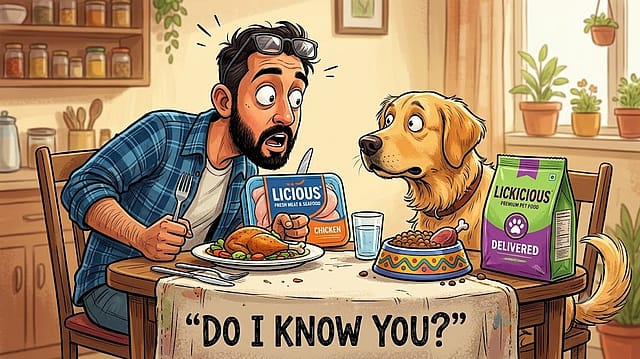
Your dinner has a near-namesake. It is feeding your dog.
Licious sells meat and seafood. Lickicious sells pet food. One prepares for your appetite; the other caters to the fellow who believes everything on your plate is a sharing platter. Licious, Lickicious
Say the two names aloud: Licious. Lickicious.
Somewhere between the kitchen counter and the dog bowl, the branding department appears to have found a rhyme.
The pet nutrition brand has reportedly raised ₹19 crore through equity and institutional debt, with Prath Ventures leading the institutional investment. Investors will examine what the money can build. Anyone who has ordered chicken from Licious might first examine the spelling.
There is an obvious possible explanation: “lick” and “delicious” make perfectly plausible companions in a pet-food name. That is a reading of the word, not a verified account of its creation. The resemblance itself establishes neither copying nor a corporate connection.
The Modi Years
02 Oct 2026 - Vol 05 | Issue 40
A Nation Rebuilt
It does, however, open the door to a magnificent gathering of brand humshakals.
Some share a name. Others share a sound. A few have shared so much that lawyers had to arrange separate accommodation.
Welcome to the naming party. Please check whose badge you are wearing.
Marketing and branding experts reckon that a name begins working before the advertising does. It gives consumers clues about the category, the personality and sometimes the company behind a product. "A familiar-sounding name can make that introduction easier," says Ashita Aggarwal, professor of marketing at SP Jain Institute of Management & Research. But familiarity is useful only if the association leads back to you. "If people remember another brand first, you may have attracted attention without establishing an identity,” she adds.
The question, then, is whose name the customer takes home.
Dove has managed to send the same name into the bathroom and the chocolate drawer.
Unilever’s Dove sells personal-care products. Mars’s DOVE sells chocolate; Mars acquired that business in 1986. The two have separate owners and entirely different uses for a bar. One promises a more agreeable shower. The other makes a persuasive case for postponing the diet. Both can talk about smoothness. Both can sell indulgence. Both can look quite at home in an advertisement featuring someone closing their eyes in satisfaction.
At this point, the product shot becomes rather important.
The supermarket does much of the explaining. The aisle, wrapper, imagery and product format give those four letters their context. A shopper can encounter two Doves without needing to convene a meeting about the corporate structure.
That's why calling every matching name a copycat is lazy
Sometimes a word has two perfectly serviceable careers.
Magnum has taken that arrangement somewhere more adventurous. There is Magnum ice cream. There are also Trojan Magnum condoms. The ice-cream brand dates its launch to 1989; Trojan sells a Magnum range in large and XL sizes. One belongs in the freezer. The other would make an unexpected addition to the freezer.
Here, too, the advertising vocabulary could get interesting. Pleasure. Anticipation. Indulgence. A close-up of somebody unwrapping something. Two creative teams could get surprisingly far into a presentation before discovering they had booked the wrong client.
The coincidence is funny because the products are easy to distinguish. The customer supplies the context; the copywriter supplies the raised eyebrow.
But a sound can also travel straight from a joke to a legal letter.
Ask Mike Rowe. In 2004, the 17-year-old Canadian became embroiled in a dispute with Microsoft over his website, MikeRoweSoft.com.
Go on. Say it. The eventual settlement reportedly included help with the cost of moving the site, Microsoft training and an Xbox. A Microsoft spokesman conceded that its original approach had been “admittedly maybe impersonal”. Other teenagers negotiated with their parents for a gaming console. Mike negotiated with the software company.
For the branding industry, the episode offers a deliciously awkward split screen. On one side, an organisation protecting its name. On the other, a teenager whose pun has become everybody’s entertainment.
A legal department and an audience can read the same situation very differently. The first sees a mark to defend. The second sees a powerful company that could perhaps afford a sense of humour.
A famous name comes with recognition. It also comes with an audience watching how you behave.
Apple’s naming problem required a larger fruit bowl
There was Apple, the technology company. There was Apple Corps, the Beatles’ company. In February 2007, they announced an agreement replacing their 1991 arrangement. Apple Inc. would own the Apple-related trademarks covered by the deal and license certain marks back to Apple Corps. Their ongoing trademark lawsuit ended.
Even an apple, it turns out, can require a licensing agreement.
The broader naming headache is that businesses refuse to sit quietly in the categories assigned to them. Computers become music players. Technology companies become music distributors. A name that once appeared to occupy another neighbourhood can suddenly turn up at your door.
Aggarwal draws out that problem. “Founders often assess a name against what the business sells today," she underlines. They also need to ask where it might go tomorrow. Products change, distribution changes and companies enter adjacent categories. The identity has to travel with them. "A name that needs constant explanation can become a burden, particularly when each expansion brings a fresh question about who owns the brand,” she adds.
And sometimes, even staying in entirely different businesses fails to keep the peace.
Consider the unlikely wrestling match between a wildlife organisation and a company famous for putting people in headlocks. Both used WWF.
In May 2002, the World Wrestling Federation announced that it would become World Wrestling Entertainment. The change followed a UK court ruling in favour of the wildlife organisation restricting specified uses of the initials and wrestling logo. The wrestling company acknowledged the ruling in its announcement.
The panda had helped take the 'F' out of wrestling
For an industry built on spectacular confrontations, it was an unusual opponent. The response was a small masterclass in making a compulsory wardrobe change look like an entrance. The company’s announcement carried the headline “World Wrestling Federation Entertainment drops the ‘F’!” It emphasised the entertainment business behind the new E.
The lawyers had supplied a problem. The marketing team found a line.
Beer, naturally, made the naming party more complicated.
Budweiser Budvar, the Czech brewery founded in 1895, is based in České Budějovice, historically called Budweis in German. Its name has been the subject of a long-running confrontation with the American Budweiser business. According to the Czech brewery, it created Czechvar for North America in 2000 because an earlier trademark agreement prevented the use of its traditional names there. Then, in 2007, Anheuser-Busch announced an alliance to distribute the Czech brewer’s Czechvar in the United States.
Imagine that conversation: we have difficulties with your name; we see possibilities in your beer.
Brand rivalry had acquired a distribution arrangement. The label could remain a point of contention while the bottles found a commercial route. There are evidently several ways to settle things over a beer.
Starbucks versus SardarBuksh
India’s contribution to the guest list comes with caffeine.
After Starbucks brought proceedings against SardarBuksh, the Indian coffee business agreed in 2018 to change its name to Sardarji-Bakhsh. The dispute involved the broader branding as well as the name.
A local twist can make a name instantly memorable. It can also make another company instantly attentive.
That is the tension running through this entire identity parade. A name can earn a smile, trigger an association, attract a customer or summon a lawyer. Sometimes it performs several of those duties before breakfast.
For a young brand, the most seductive outcome is instant recognition. Building familiarity from scratch takes work. A name that already rings a bell appears to have completed the first assignment.
Except the bell might be ringing next door.
“Being noticed and being correctly remembered are different outcomes,” says Aggarwal. The useful test is to hear a name once and then ask people what they think it sells, who they believe makes it and what they remember later. A brand should want its packaging, communication and product experience to reinforce the same identity. "Otherwise, it can spend money becoming familiar while leaving the ownership of that familiarity unresolved,” she reckons.
This brings us back to Lickicious.
A hypothetical shopper could hear the name and wonder whether Licious has entered pet food. That would be an assumption about the company, even if the shopper understood the product perfectly. No consumer research presented here establishes that this happens. It is the question the resemblance invites.
Lickicious’s website gives the name a distinctly animal world: dog and cat food, treats and supplements. Those products, their packaging and the way customers encounter them will help determine what the name comes to mean.
The ambition should be for “Lickicious” to summon its own pack, its own promise and the pet waiting for its own dinner.
Dove can live with a double. Magnum can survive a cheeky association. Mike Rowe discovered the price of a pun, and wrestling discovered the importance of its last letter. For a growing brand, the harder achievement is to make the audience stop thinking about the resemblance altogether.
The dog will know who filled the bowl. Will the customer?