Jhalmuri Had Its Viral Moment. But Can It Become India’s Next Big Food Brand?
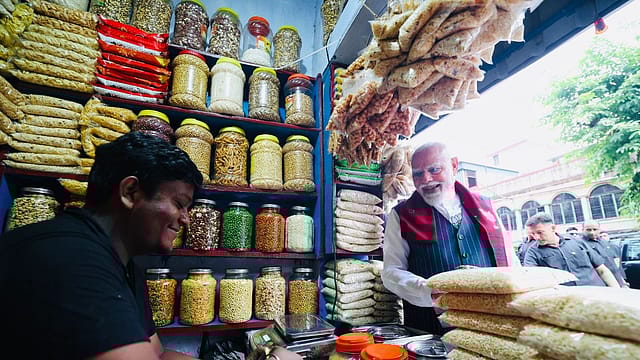
On April 19, in Jhargram, Narendra Modi stopped at a roadside shop and bought jhalmuri.
It was the kind of political moment that is designed to travel. A familiar snack. A local setting. A quick pause in the middle of an election campaign. The video went up and the line “Jhalmuri break in Jhargram!” did the rest.
For a few days, jhalmuri was everywhere. Not on streets, because it has always been there, but in feeds and conversations.
The question is whether this kind of attention changes anything. Does it push a category forward or does it simply borrow from something that is already culturally strong and leave it as it is?
To answer that, it helps to step back from jhalmuri and look at muri itself.
In eastern India, muri is not one thing. It is a base that adapts to time, place and appetite.
There is muri with ghugni, a broth of spiced yellow peas finished with mustard oil and green chillies. It is filling, affordable and widely consumed as a quick breakfast across Kolkata.

Open Minds 2026
26 Jun 2026 - Vol 05 | Issue 26
The power of ideas and arguments in 50 portraits
There is muri with batasha, a crunchy sweet combination that mirrors the texture logic of muesli or cornflakes, even if the cultural context is very different.
In parts of Jharkhand, muri is eaten with water. It is light, hydrating and often used as a simple way to settle the stomach.
Then there is muri with chop, where deep-fried pakodas sit alongside puffed rice. It is heavy, oily and indulgent, with the blandness of muri balancing the intensity of the fried elements.
Jhalmuri emerges from this ecosystem as the most mobile version. It is quick to assemble, easy to customise and fits into almost any time of day. That is what makes it visible. That is also what makes it interesting from a business lens.
Because at the street level, the economics are already strong.
A jhalmuri vendor in an East Delhi locality put it simply. “I sell 100 plus packets in one day. Each pack is freshly churned and sold for ₹50.” That brings his daily turnover to around ₹5,000.
The more revealing number is the margin. “I usually keep ₹20 per packet for myself, so that’s about ₹2,000 per day of take-home,” he said.
There is no formal real estate cost. The setup is mobile. A tin, a few containers, basic ingredients and a small patch of space are enough to run the business.
It is efficient, low-risk and repeatable at a small scale.
Which is also why it has not translated into a large-scale category.
Food businesses that scale usually rely on standardisation. The product needs to travel. It needs to remain consistent across locations and over time.
That is how the samosa moved into frozen formats and large supply chains. That is how butter chicken became a menu staple across restaurants globally.
Jhalmuri does not lend itself easily to that shift.
It is assembled in the moment. The order of ingredients matters. The timing matters. Freshness matters most. Within minutes, the puffed rice starts losing its crunch. The texture changes and the experience is no longer the same.
This makes it difficult to package and difficult to distribute at scale.
There have been attempts to work around this. Brands like Haldiram's offer bhel-style mixes that replicate some of the flavour profile in a shelf-stable format. These products travel well and have built large businesses. However, they do not fully replace jhalmuri.
Similarly, Paper Boat has shown that nostalgia can be turned into a product. It built a brand by packaging familiar flavours and memories for a modern consumer.
Jhalmuri presents a different challenge because it is already accessible in its original form. It is fresh, inexpensive and widely available. A packaged version has to compete not just on taste but on the experience of watching it being made and eating it immediately.
There is some early movement. Masala kits and DIY versions are being sold online, especially to diaspora consumers. However, this remains a small and fragmented opportunity.
At this point, Harish Bijoor, a brand consultant sees both the opportunity and the limitation. “Jhalmuri is certainly in the national spotlight after what happened in Jhargram, with Prime Minister Narendra Modi stopping by. In parts of the country, its place in everyday food habits is very strong. To an extent, it is a piece of food culture.
Can this turn it into a big, mainstream food category? Possibly, at least for a while. "There are already large brands offering make-it-yourself kits, and jhalmuri has had, and will continue to have, its moment in the sun,” Bijoor added.
He also points to a broader shift underway. “Expect a wide range of snack players to start offering desi options like jhalmuri. Over time, there will be a shift in consumer preference, where people move away from Western snacks like potato chips and gravitate towards local foods that feel more exciting and relevant to their palate.”
If jhalmuri scales, it is more likely to do so through format rather than packaging. Branded carts or kiosks could bring some consistency while retaining the live assembly that defines the product.
That transition has not happened yet.
Which brings the focus back to the Jhargram moment.
When political figures engage with everyday food, the intent is rarely about the food itself. It is about signalling familiarity and connection. In this case, jhalmuri already carried enough cultural meaning to make the moment work.
What the moment did was amplify that meaning at a national level.
But amplification alone does not create a category.
For jhalmuri to become a larger business, it would need a scalable format, some level of standardisation and a way to preserve its core experience. It would need to move from individual vendors to organised systems.
At the moment, it remains where it has always been. Local, immediate and dependent on the person making it.
The vendor in Jhargram is likely back at his cart, making the same cones in the same way. The numbers still work for him. The demand has not changed.
Only the attention has.
And unless something else changes with it, that attention will pass, leaving jhalmuri exactly where it began.