Meet Juicy Lucy—the burger. And Mr. Juicy Lucy—the man
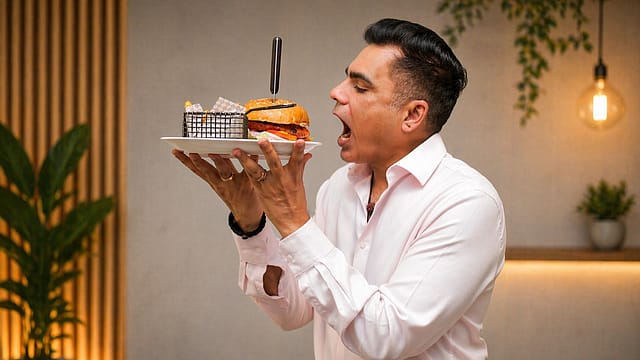
Hema Malhotra leans in. Takes a bite.
For a moment, everything feels normal. Soft bun, warm meat and a burger doing what burgers usually do.
And then—something shifts. The centre collapses. Cheese rushes out. Not politely or in a neat layer. It spills. Hot, sudden and slightly chaotic. The kind that makes you pull back for a second, just to process.
Then comes the rest. Mutton—rich and heavy. Jalapeños—sharp, and unapologetic. Gherkins—cutting through like they’ve got somewhere to be. Butter, quietly holding it all together.
Malhotra pauses. She looks at the burger, then at the mess and then smiles. The second bite is different. Slower. Slightly cautious. Like she knows this thing has a personality now.
The Modi Years
02 Oct 2026 - Vol 05 | Issue 40
A Nation Rebuilt
Around her, people are watching. Not in a creepy way. In a they’ve-seen-this-before way. Phones come out. Someone says, “Careful.” Someone else says, “Too late.”
It usually is. Only then does the name make sense: Juicy Lucy.
Rewind to 2011. That’s when the story began.
Burgers, at the time, were everywhere. And mostly predictable. All of them were quick, efficient and built to be eaten, not remembered. If you wanted indulgence, you didn’t look at a burger. You looked at a menu with linen napkins and prices that made you sit straighter. There wasn’t much in between.
That’s when things got interesting—someone decided to build for that space.
Inside Cafe Delhi Heights, the brief wasn’t ‘add a burger.’
It was closer to—if we’re doing this, it better be worth it.
The burger didn’t need to be bigger for the sake of it. It didn’t need to shout for attention. Just something you’d remember on the drive back. “We wanted to create a big, indulgent gourmet burger with a surprise element inside,” recounts Vikrant Batra, who cofounded Cafe Delhi Heights with his brother Sharad in 2011.
It was a simple sentence but annoyingly hard to execute. Why? Because the ‘surprise’ wasn’t a topping or a sauce. It wasn’t something you could just stack and send out.
The idea was slightly mischievous: Put the cheese inside the patty. Not on top, not between layers…inside.
It sounds neat but refused to behave. Seal it wrong, the cheese leaked out before it reached the table. And if you cook it too fast, the centre stayed cold. But if you take your time, the meat would lose its bite.
For a while, the burger did everything except what it was supposed to. “It took nearly a month of trials to get it right,” recounts Vikrant.
The kitchen kept at it. Mutton mince came first—richer, less forgiving. Then fat, carefully calibrated. Enough to hold moisture, not enough to fall apart. Jalapeños for heat. Gherkins for bite. Cheddar for that molten moment everyone was chasing.
But everything hinged on one thing: the seal. Two patties. One centre. Edges pressed shut like a secret. If that broke, the whole idea fell apart.
And then, one day, it didn’t. The knife went in. The burger opened. The cheese did exactly what it was supposed to do—spill, stretch and take over the moment.
There was no explanation required. The experience of biting into it, explains Vikrant, and finding molten cheese within made it stand apart from typical burgers in the market.
The name, interestingly, came later.
In fact, it arrived casually and then refused to leave. During trials, someone took a bite and said what everyone was already thinking—it’s too juicy.
Too juicy. And so came the name: Juicy Lucy. It stuck. Because it sounded like the burger felt—slightly indulgent, slightly over the top, and very hard to ignore.
Vikrant remains candid about the ‘naming ceremony.’ There was no brainstorm or brand workshop. “It was just a name that behaved like the product,” he says. By the time it hit the menu, the idea was clear: This wasn’t going to be another burger. It was going to be that burger.
Now came the slightly uncomfortable part. Conviction had to meet pricing, which was ₹695 for one burger. And remember there was no combo, no smaller version hiding somewhere on the menu and no ‘regular’ and ‘large’ to soften the blow. It was just one for ₹695.
In a country where burgers had already found their lane—and it was comfortably under ₹200--think about ₹695 for a second.
While McDonald's had built scale on affordability, KFC on familiarity, and
Burger King on aggressive pricing and expansion, here was a burger that refused to join the conversation. So, no price war, no entry-level bait and no attempt to ‘fit in.’ Just a quiet, slightly audacious stance: this is what it costs.
Vikrant explains the ‘method’ behind the madness. It was meant to be a burger that feels premium, heavier, and more satisfying. “It was meant to be something you remember even after the meal is over,” he says.
This sounds nice. Until you realise what it demands.
Pricing like that does two things immediately. First, it narrows your audience. Second, it raises expectations.
You don’t get casual trials. You don’t get impulse orders. But you definitely get scrutiny. Every bite has to justify itself.
And then there was the second decision, which was arguably riskier. Juicy Lucy didn’t have any variants. Just one burger, sitting there, year after year, like it had made up its mind early and wasn’t interested in revisiting it. In a category that thrives on options, this felt stubborn.
Or was it clear-headed? Why so? Because most menus grow by adding more. This one grew by repeating. The same product. The same experience. Over and over again. No distractions, no dilution, just quiet confidence that if the core idea is strong enough, it doesn’t need help.
And that’s the thing about bets like this. They look bold in a presentation but they are risky on a menu.
And slowly, almost quietly, it began to add up. For all the personality in that first bite, the real story sits elsewhere: In repetition.
Over the years, the burger has crossed 8.5 lakh orders. There was no one viral spike or it didn’t happen because of any discount push. The numbers kept adding up, steadily. It was 3 lakh by 2019. Then it jumped to 5 lakh by 2022. And then it keeps going. There was no big moment you can point to and say that’s when it took off. It didn’t take off. It just compounded. Even now, across outlets, it clocks 200 to 250 burgers a day. Every day.
“It is no longer something you try. It has become something you order, almost automatically,” says Vikrant, who now carries a nickname—Mr. Juicy Lucy.
The burger market, globally and in India, runs on a few simple rules:
Quick, consistent and affordable.
Juicy Lucy doesn’t tick any of those boxes neatly. It’s not the fastest thing on the table. It’s definitely not the cheapest. And it doesn’t try to be identical across formats in the way fast food chains do.
This raises the obvious question: Where does it fit?
Vikrant’s answer is disarmingly simple: “We do not consider anyone as competition because of the distinct nature and experience of our burger.”
At first glance, that sounds like classic founder optimism. Until you look at how the product behaves.
Burgers are built for convenience. But Juicy Lucy is built for experience, reckon marketing and branding experts. For years, the assumption has been that Indian consumers, especially in categories like burgers, will default to value, lower price, faster service and more options. “What this burger quietly suggests is something else. That there’s room—real, repeatable room—for indulgence,” says Ashita Aggarwal, professor of marketing at SP Jain Institute of Management & Research. Not everyone will opt in. But it doesn’t need everyone. “It just needs enough people who care about the experience. And keep coming back for it,” she adds.
Step back, and the picture gets clearer. Juicy Lucy is one of the blockbusters that has shaped the identity of Cafe Delhi Heights. From a revenue of ₹151 crore in FY24, Cafe Delhi Heights is likely to cross Rs 200-crore mark in FY26. It’s still bootstrapped, and it is still profitable.
There’s another layer to this. Most brands, when they find a hit, try to stretch it by rolling out more versions, more formats and more ways to make it accessible. Vikrant stayed away from this mindset.
That’s why, from a marketing lens, this is slightly uncomfortable. Why? The safer play is always to blend in just enough to scale. The tried-and-tested playbook is stay familiar, stay comparable and stay easy to choose.
Aggarwal sees it differently. “Staying different was the whole point,” she reckons. No lookalike burgers. No chasing price wars. No attempt to sit next to the usual suspects and compete on their terms. “The idea wasn’t to be everywhere. It was to be remembered,” she says. Once that happens, discovery happens on its own.
In a market that rewards speed, scale and sharp pricing, this story moves differently. One product and one idea held steady for over a decade. There is no rush to expand it, no pressure to dilute it and no urge to chase what everyone else was already doing.
When Juicy met Lucy, Vikrant didn’t stand a chance—Mr. Juicy Lucy took over.