“It’s Like Riding a Lion”: Inside Akshaya Patra CEO Shridhar Venkat’s Playbook
Fifteen days. That’s the financial runway of one of India’s largest food operations. No reserves. No margin for pause. And every morning, over 22 lakh meals still have to be served across the country.
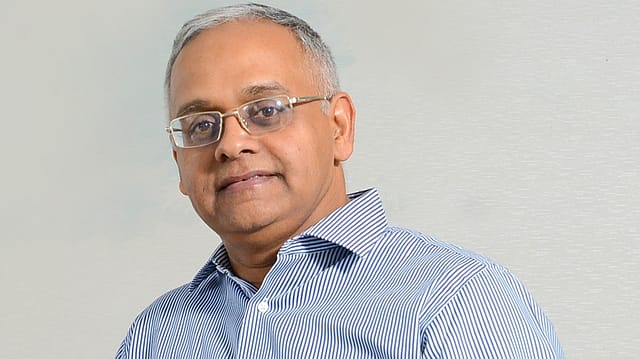
At the centre of this system is Shridhar Venkat, CEO of The Akshaya Patra Foundation—a man who insists his real job is service. In this free-wheeling conversation, he talks about running a zero-profit operation at scale, the pressure of sustaining it, and why, sometimes, it feels like ‘riding a lion.’ Excerpts:
You might be one of the few CEOs who doesn’t deal with profit. What does that title mean here?
CEO is just a title. I would call myself a Chief Service Officer. I am here to serve our employees—our hunger warriors—and the children who deserve to be served. We don’t even call our Bangalore office a head office. It’s a central office. Because leadership, for me, is about service.
You talk a lot about service. Where does that philosophy come from?
I strongly believe all of us are looking for happiness. The children we serve are looking for happiness. Our employees are looking for happiness. The best way to be happy is by serving others. Whether you like it or not, we are always serving.

The Liberation of Bengal
05 Jun 2026 - Vol 04 | Issue 74
A silent revolution ends the reign of fear
What keeps a non-profit CEO awake at night?
We are feeding over 2.3 million children every day. The most important thing is to ensure that the child in the remotest place we serve has access to a hot, safe, nutritious meal when she comes to school. That is the responsibility.
You operate with barely a few weeks of financial buffer. How do you deal with that pressure?
We run with a 15-day kind of reserve. The challenge is to ensure that those 15 days never become 10. We don’t have big reserves. We are a zero-debt organisation. So, sustaining this system day after day is the biggest challenge.
Is running a non-profit harder than running a business?
Absolutely, yes. In a business, you can pause. You can delay. You can recalibrate. Here, you cannot stop. Meals have to be delivered every day.
You talk about purpose and service as your guiding principles. But no leader arrives at that alone. Who shaped your thinking at Akshaya Patra?
Madhu Pandit Dasa, Founder and Chairman of The Akshaya Patra Foundation (TAPF), and Chanchalapathi Dasa, Co-Founder/Vice Chairman of TAPF, have truly guided me and shaped my thinking. They have been a guiding force throughout my tenure at Akshaya Patra. I look up to them deeply. Whatever I have become as a leader here, a large part of that is because of them.
A non-profit CEO is also a fundraiser. How much of your time goes into that?
Earlier, a lot of my time went into fundraising. Now, we have built a strong, purpose-driven team. So, I spend about 30–40% of my time on it. The key is to build people who are not just working for salaries but are connected to the purpose.
What does a typical day look like for you?
I spend a lot of time with my people. That gives me the maximum kick. Meeting teams, solving problems, visiting kitchens, schools, donors—and ensuring we are heading in the right direction strategically.
How do you think about efficiency in a non-profit?
If I save one paisa on the cost of a meal, it is food for 4,000 children for one whole year without raising any additional funds. So, efficiency is not about margins. It is about impact.
What are the hardest decisions you’ve had to take as a CEO?
The toughest decisions are when there is a breach of integrity. Even if someone has contributed immensely, if they violate our values, we have to let them go. These are very difficult calls. But if you compromise on integrity, you weaken the foundation of the organisation.
In a compassion-driven organisation, why do you place integrity above compassion?
Because there is no point in being compassionate without integrity. If the foundation is weak, the entire organisation becomes hollow.
What would surprise a Fortune 500 CEO the most here?
The people who lead operations are monks. They live very simply, but they are extremely committed. You have professionals, monks, and mission-driven people working together. Navigating this culture would be the biggest shock.
How do you describe the pressure of running this system every day?
It is like riding a lion. You can’t get down. Once you are on it, you have to keep moving.
What can NGOs learn from corporates—and vice versa?
NGOs should learn efficiency, governance, systems, and scale from corporates. Corporates can learn purpose, frugality, and how to stay motivated even when things don’t go as planned.
Have you ever failed as a leader?
Many times. If I go back 20 years, I would have built financial sustainability much earlier. That is something I would change.
What made you choose this life?
Someone once asked me, “Why are you building empires for others? Build for these children.” That stayed with me.
How do you rate yourself as a CEO?
I don’t want to rate myself. I want children, teachers, and stakeholders to rate my service. If God considers me his humble servant, that is my biggest success.
At least you sleep peacefully?
(laughs)...Not only sleep peacefully, I snore nicely.