Inside India’s Search Bar: A Country Learning to Slow Down, Even as It Speeds Up
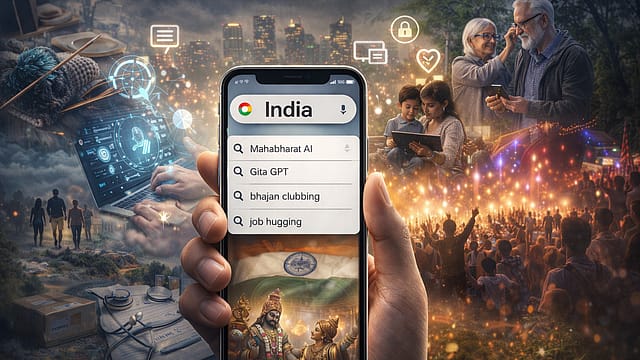
India’s search bar is beginning to look less like a tool for information and more like a mirror of its contradictions.
According to Kantar’s India in Search 2026 report, the country’s digital queries—spanning everything from “Mahabharat AI” to “job hugging”—suggest a population that is not just consuming more, but recalibrating how it lives, works, and believes. Based on Google search data from January to December 2025, the report attempts to map cultural and consumption shifts through what it calls one of the “most honest signals” of consumer intent.
At a surface level, the numbers point to acceleration. Artificial intelligence continues to surge, with average monthly searches touching 235 million, up 154% year-on-year. Quick delivery services, too, have seen a 61% jump, reinforcing the growing appeal of convenience-led consumption.
But beneath that growth lies a quieter shift—one that is less about speed and more about control.
Zeroing In on ECI
09 Oct 2026 - Vol 05 | Issue 41
Constitutional legitimacy versus political opportunism
Across categories, search behaviour indicates a move away from impulse toward intent. Beauty queries, for instance, are increasingly centred around science-backed ingredients, while financial searches reflect a more cautious consumer checking eligibility, creditworthiness, and risk before spending. Even health-related searches reveal a duality: a rise in personalised wellness practices alongside what the report describes as “optimization fatigue.”
This tension—between doing more and doing it carefully—runs through much of the report’s findings.
Nowhere is this more visible than in how Indians are engaging with faith. Once largely institutional and collective, religion is being reshaped into a more individual, tech-enabled experience. Searches for AI-powered religious tools such as “Mahabharat AI” and “Gita GPT,” alongside trends like “bhajan clubbing,” point to a reimagining of spirituality that blends tradition with personalisation and digital access.
A similar recalibration is visible in how younger generations are growing up. The report highlights a rise in what it describes as “digitally supervised childhoods,” where access to content is accompanied by increasing parental oversight. Searches for parental control tools and safe search filters have risen sharply, suggesting that digital exposure is being actively managed rather than freely explored.
At the other end of the age spectrum, ageing itself is being reframed. Rather than focusing on decline, search trends point to a growing emphasis on longevity, independence, and capability. Queries around strength training, perimenopause, and senior-friendly technology indicate that Indians in their 40s and beyond are approaching ageing as something to optimise rather than manage.
Yet, even as digital tools and efficiency continue to shape everyday life, there are signs of a countercurrent.
Searches for activities such as knitting, Lego building, and homemade pet care reflect what Kantar terms a return to “slow joy”—tactile, effort-driven pursuits that offer a break from algorithmic, always-on environments. In parallel, there is a noticeable shift toward offline experiences, with rising interest in live events, hiking trails, and immersive social activities suggesting that consumers are increasingly seeking presence over passive consumption.
Work, too, is being renegotiated. Terms like “micro-retirement,” “job hugging,” and “occupational burnout” are gaining traction, pointing to a workforce that is reassessing the trade-offs between stability, ambition, and well-being. While upskilling—particularly in AI and emerging technologies—remains a priority, it is increasingly being balanced against a desire for flexibility and control.
Taken together, these shifts suggest that India’s consumption story is becoming less linear. Growth persists, but it is layered with caution. Aspiration remains strong, but is tempered by anxiety. Digital adoption continues to rise, even as there is a simultaneous pull toward physical, slower, and more grounded experiences.
Kantar frames this as a move toward “deliberate living,” where decisions across categories—from finance to food to faith—are shaped by a need for greater agency in an increasingly complex environment.
For brands, the implication is less about tapping into a single trend and more about navigating these overlaps. The same consumer who orders groceries in minutes is also searching for ways to disconnect. The user experimenting with AI tools is also looking for safeguards against digital risk. And the individual exploring new identities is doing so outside traditional structures, but not without a search for belonging.
In that sense, India’s search trends are not just signalling what people want next. They are revealing how a country is learning to balance speed with stillness—often within the same query.