India’s $2 Billion Sports Economy Emerges Built Largely on Cricket: WPP Media
India’s sports industry has crossed a symbolic and structural turning point.
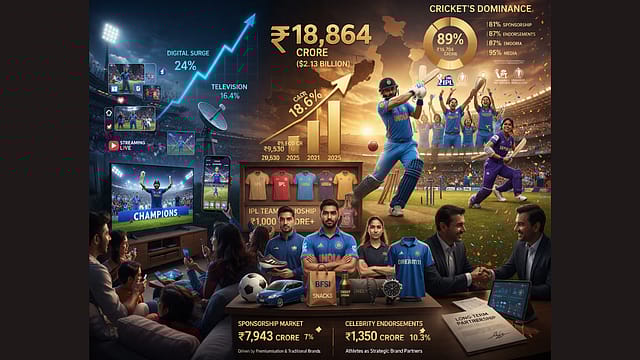
In 2025, the country’s sports economy touched ₹18,864 crore ($2.13 billion) for the first time, growing 13.4% year-on-year, according to WPP Media’s latest Sporting Nation report. But beyond the headline number, the story that emerged was not just one of growth—it was one of concentration, evolving monetisation, and a deeper integration of sports into India’s cultural and commercial fabric.
Over the last four years, the industry has nearly doubled from ₹9,530 crore in 2021, clocking an approximate CAGR of 18.6%. That pace of expansion signals more than just rising interest—it reflects a maturing ecosystem where media rights, sponsorships, and athlete-led branding are beginning to operate with institutional scale.
Zeroing In on ECI
09 Oct 2026 - Vol 05 | Issue 41
Constitutional legitimacy versus political opportunism
Yet, for all its progress, the Indian sports economy in 2025 remained anchored—overwhelmingly—by one sport.
Cricket’s Expanding Dominance
Cricket contributed ₹16,704 crore in 2025, accounting for 89% of the total sports economy, up from 85% a year earlier. In effect, cricket alone generated more revenue than the entire Indian sports industry did in 2024.
Its dominance extended across every major revenue stream—81% of sponsorship spends, 87% of endorsements, and 95% of media investments flowed into cricket.
This wasn’t accidental. The year saw a strong international calendar, including India’s Champions Trophy win and the women’s team lifting the ODI World Cup, alongside the continued rise of the Women’s Premier League. Together, these moments expanded cricket’s cultural footprint while reinforcing its commercial appeal.
At the centre of this ecosystem remained the Indian Premier League (IPL), which continued to function as the industry’s most bankable property—both as a media asset and a sponsorship magnet.
Media Becomes the Growth Engine
If cricket was the backbone, media was the engine.
Media spends emerged as the largest contributor to the sports economy in 2025, accounting for 51% of total industry value at ₹9,571 crore. Advertising investments alone grew nearly 20% year-on-year, underlining how central sports content has become to brand strategy.
What stood out, however, was the shift in consumption patterns.
Television remained strong at ₹5,117 crore, growing 16.4%, but digital surged ahead with 24% growth to reach ₹4,449 crore. The gap between linear and digital is narrowing, and for advertisers, the appeal lies in sharper targeting, younger audiences, and measurable engagement.
For viewers, this shift reflects a deeper behavioural change—sports is no longer just watched; it is streamed, clipped, shared, and consumed in fragments across platforms.
Premiumisation Over Expansion
Sponsorships, the second-largest pillar, grew at a slower but steady 7% to reach ₹7,943 crore, contributing 42% to the overall market.
But the nature of growth here is what stood out.
Rather than a surge in new inventory, the increase was driven by premiumisation—higher pricing, deeper integrations, and better monetisation of existing assets. IPL team sponsorships alone crossed the ₹1,000 crore mark for the first time, signalling rising confidence in franchise-led models.
Even a potential disruption—the pullback of real-money gaming (RMG) companies, once major advertisers—failed to dent the market.
Instead, traditional sectors like BFSI, auto, and FMCG stepped in, often at higher deal values, effectively upgrading the quality of advertisers in the ecosystem.
The result: the pie didn’t shrink; it became more stable.
Athletes as Businesses, Not Just Endorsers
Celebrity endorsements in sports reached ₹1,350 crore in 2025, growing 10.3% year-on-year. But the real shift was structural.
Athletes, particularly cricketers, are no longer just faces of brands—they are becoming strategic partners.
The report pointed to the rise of equity-linked partnerships and deeper integration with teams and tournaments. This reflects a broader transition towards data-driven, long-term brand collaborations rather than one-off endorsement deals.
In simpler terms, athletes are evolving into businesses.
A Market Still Searching for Balance
While the headline numbers suggest a booming industry, the underlying imbalance remains stark.
Non-cricket sports continue to struggle with continuity, visibility, and consistent sponsorship inflows. The absence of leagues like the Indian Super League during parts of the cycle impacted overall sponsorship momentum outside cricket.
The challenge is structural: without regular media visibility and stable league calendars, other sports find it difficult to build long-term commercial ecosystems.
From Growth to Consolidation
For industry leaders, the $2 billion milestone is less about arrival and more about transition.
Ashwin Padmanabhan, Chief Operating Officer, WPP Media South Asia, said, “The Indian sports economy crossing the $2 billion milestone marks a significant moment in its evolution, reflecting sustained growth and increasing structural maturity, led by the success of the Indian Premier League. While cricket continues to anchor the ecosystem, we are also seeing encouraging momentum across other segments of the sports landscape. The opportunity ahead lies in building on this foundation to create a more diverse and scalable multi-sport ecosystem.”
At the same time, the role of brands within sports is also shifting.
Vinit Karnik, Managing Director – Content, Sports & Entertainment, WPP Media South Asia, added, “Sport today sits at the intersection of culture and commerce, and brands are increasingly becoming part of the narrative rather than just sponsors. The evolution of leagues like the Indian Premier League has shown how deeply integrated partnerships can drive both fan engagement and commercial impact. We are seeing a shift from visibility-led associations to more immersive, story-driven collaborations.”
The Next Phase
As India’s sports economy scales further, its future will likely be shaped by three converging forces—media innovation, deeper fan engagement, and sustained brand investment.
But the larger question remains unresolved.
Can India build a truly multi-sport economy, or will it continue to grow on the back of cricket alone?
For now, the numbers offer a clear answer.
India has built a $2 billion sports industry.
But it is still, fundamentally, a cricket-first economy.