From Food to Rides, Why Everyday Convenience is Getting Pricier
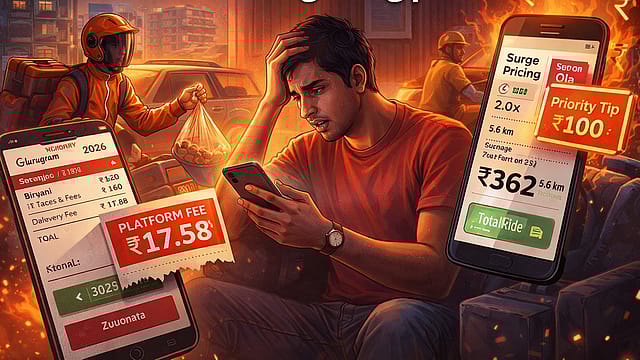
In the narrow lanes of Gurugram’s Sector 25, where middle-class flats stack like shipping containers, Prashant Kumar, a 25-year-old corporate employee, opens Zomato on a humid March evening in 2026. A ₹320 biryani order balloons to ₹512 by checkout. There it sits, the new villain on the bill: ₹17.58 platform fee. Not delivery, not GST, not packaging—just the app’s cut for ‘operating and maintaining the platform.’ Prashant swears under his breath. Three years ago it was ₹2. Now it is almost nine times that, and neither Zomato nor Swiggy blinks. This is not a glitch. It is the new business model.
The numbers tell a story of calculated, incremental greed. Zomato introduced the platform fee in August 2023 at ₹2 per order—an experiment so small it barely registered. By late 2024 it had crept to ₹10. September 2025 brought it to ₹12.50. Then, on 20 March 2026, the company quietly hiked it 19% to ₹14.90 (pre-GST), landing at ₹17.58 with tax. Swiggy, never one to be left behind, matched within days, raising its own fee from ₹14.99 to the same ₹17.58—a 17 % jump. Analysts estimate each rupee increase adds roughly ₹85 crore annually to Zomato’s coffers and ₹63 crore to Swiggy’s, based on current order volumes. This is not inflation hedging. This is pure-margin engineering. Fuel costs from the West Asia conflict are cited as the official reason, along with “delivery partner incentives.” But the hikes are pan-India, applied even on non-surge days, and they stick because order volumes barely flinch. The customer has been trained to accept the boil.

Global By Design
29 May 2026 - Vol 04 | Issue 73
Is the future of fashion Indian?
The platforms defend it as necessary for “unit economics.” In investor calls and internal memos, executives describe the fee as one of the “cleanest levers”—zero extra cost, 100% margin, applied to every single transaction. Restaurants, meanwhile, already surrender 18-28% commission plus GST on that commission. Many small eateries have inflated menu prices on the apps by 15-30% just to stay afloat. The result: a ₹300 restaurant meal routinely costs the customer ₹500-650. The platforms’ Q1 FY26 numbers show the strategy working. Revenue is soaring, profitability is the new religion, and the platform fee line item has become a quiet profit engine.
Now look at the roads. The same logic—make the rider pay more to get served—has infected mobility. In July 2025 the Union government’s Motor Vehicle Aggregator Guidelines (MVAG 2025) handed Uber, Ola and Rapido a gift: surge pricing capped at twice the base fare during peak hours, up from 1.5 times. Non-peak fares cannot dip below 50% of base. The stated reason? Balance supply and demand, protect driver earnings amid rising fuel costs. In practice, it means your evening commute can double in price without warning. But that is only the visible layer.
Beneath it lies a subtler extraction: the “add more money” game to guarantee acceptance. Ola’s “Priority To” feature lets riders pay a small premium for higher driver commitment and lower cancellation risk. Drivers receive extra incentives or priority dispatch. More widespread is advance tipping. On Uber, Ola and especially Rapido, riders who tip upfront—₹20, ₹50, even ₹100—see dramatically faster acceptance rates during rush hour. Drivers openly admit they filter for tipped rides; the algorithm may even nudge them higher. The platforms insist tips are voluntary. In reality, they have become mandatory for reliable service. The customer who cannot—or will not—pay extra waits longer, or watches the ride disappear. It is dynamic pricing by another name, only now the rider is bidding against himself.
Both ecosystems share the same DNA. Gig workers—delivery partners and drivers—are squeezed on one end by commissions and algorithm-driven incentives; customers are squeezed on the other by fees, surges and priority premiums. Regulators have been complicit. There is no cap on platform fees for food delivery. Surge pricing was relaxed rather than tightened. Consumer courts occasionally rap knuckles over hidden charges, but enforcement is toothless. The apps disclose the fees, after all. They just keep raising them.
The deeper truth is structural. In a winner-takes-all digital economy, scale is everything and profitability is non-negotiable for listed companies. Zomato turned profitable two years ago; Swiggy is still chasing it. Investors reward margin expansion. The middle-class customer—neither poor enough for subsidies nor rich enough for subscriptions—pays the price. Prashant Kumar in Gurugram is not an outlier. He is the archetype: the salaried Indian who once saw these apps as liberation from traffic and cooking, now sees them as another monthly tax.
The boiling-frog strategy has worked brilliantly. Small hikes, tested on festive days, quietly made permanent. No single jump shocks the system. Yet cumulatively they have transformed convenience into a luxury good. The apps will tell you this is market economics. The customer, staring at the checkout screen, knows it is something simpler: extraction, dressed up as service. And until volumes finally drop or the regulator wakes up, the meter will keep running.