Brand Messi: How Lionel Messi Won Argentina’s Heart and Became a Marketing Masterclass in Belonging
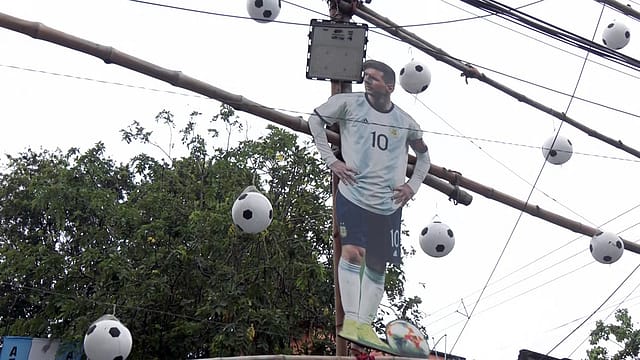
Lionel Messi had already won four Ballon d’Or awards before Argentina truly knew what to do with him.
Barcelona adored him. Advertisers pursued him. Defenders feared him. Children across continents wore his No. 10 shirt. He could sell boots, beverages, video games and streaming subscriptions without saying very much at all.
Yet his most important market remained unconvinced. Argentina knew Messi was brilliant. It questioned whether he was sufficiently Argentinian.
He had left Rosario for Barcelona at 13. He spoke softly. He did not perform patriotism for the cameras. He sometimes stood silently during the national anthem. When he wore Barcelona colours, the goals arrived in torrents. When he pulled on the blue-and-white shirt, major trophies remained absent.

Zeroing In on ECI
09 Oct 2026 - Vol 05 | Issue 41
Constitutional legitimacy versus political opportunism
Worst of all, he followed Diego Maradona.
Maradona was footballer, street fighter, political provocation and national theatre. He had grown up in poverty, played in Argentina and delivered the 1986 World Cup with rebellion pouring from every pore. Messi was an emigrant shaped by Barcelona’s academy and packaged as a global sporting superstar.
Argentina did not merely want Messi to win. It wanted him to become another man.
He never did.
On August 31, the 39-year-old retired from international football after 207 appearances, 125 goals, two Copa América titles and the 2022 World Cup. The boy once treated as Barcelona’s genius rather than Argentina’s son leaves as the most beloved Argentinian footballer of his generation.
It is one of sport’s great redemption stories. It is also one of marketing’s most unusual case studies.
Messi changed how an entire country felt about him without significantly changing the personality he presented to the world. There was no patriotic makeover, confessional documentary or dramatic personal rebrand. The transformation was built from repetition, failure, vulnerability and, finally, delivery.
Brand Messi won Argentina through evidence.
Fame is Not Belonging
Marketers frequently confuse recognition with affection and affection with ownership.
Messi possessed almost universal awareness. A study of his commercial appeal published in the International Journal of Business Ecosystem & Strategy observed that his associations with brands including Adidas and Pepsi worked because qualities such as excellence, perseverance and global reach aligned naturally with his public image.
The commercial proposition was easy to understand. Messi was the best footballer in the world. A brand could borrow some of that brilliance.
Argentina presented a more complicated problem. It did not need to be told that Messi was great. It wanted proof that his greatness belonged to the country. This is the difference between a famous brand and a culturally embedded one. Consumers may recognise a name, admire its product and still regard it as foreign to their lives. A brand becomes culturally powerful when people begin to see part of themselves inside it.
Messi’s extraordinary performances for Barcelona may even have deepened Argentina’s frustration. Every club hat-trick generated another question about the national team. Why could he produce miracles in Catalonia and not in Buenos Aires? Success in one market was being used as evidence against him in another.
The Curse of the Existing Archetype
Messi also inherited an impossible positioning problem. Argentina already possessed the perfect footballing brand: Maradona.
Maradona represented the barrio, defiance, imperfection and revenge. His two goals against England in the 1986 World Cup quarterfinal entered national mythology only four years after the Falklands War. One was an act of deception. The other was an act of genius. Together, they created a character no advertising agency could have invented.
Messi represented something else: precision, discipline, privacy and sustained excellence. An academic study comparing the two men argued that sporting mythology depends heavily on cultural context and cannot be explained by performance alone. Maradona’s hold over Argentina came from what he represented beyond the pitch. Messi could score more goals, win more club titles and collect more individual awards. He could not relive Maradona’s childhood, politics or 1986.
Brands often make the mistake Argentina initially made with Messi. They identify a successful rival and attempt to reproduce its tone, personality and mythology. The result is usually an imitation stripped of the history that made the original powerful.
Messi’s eventual triumph came from refusing that imitation. He did not try to become louder than Maradona. He made quietness formidable. He did not claim to speak for Argentina’s working class. He kept returning to play for Argentina. He allowed consistency to become his declaration of loyalty.
The country eventually stopped asking for another Maradona. It learned how to love the first Messi.
The Product Kept Failing
The temptation is to turn this into a sentimental sermon on authenticity. Messi’s story is tougher than that.
For years, the product failed at the decisive moment. Argentina lost the 2014 World Cup final to Germany. Chile defeated it in the 2015 Copa América final. Chile did it again in 2016, when Messi missed his penalty in the shootout. He retired from international football afterwards.
“The national team is over for me,” he said. “I’ve done all I can.”
This was not a carefully choreographed exercise in vulnerability. It was collapse. Messi had lost three major finals in three years and had become the vessel into which a country poured its anger.
Then something crucial happened. Argentina asked him to return. Supporters gathered with signs saying, “No te vayas, Lio.” Do not go, Leo. Children wrote letters. Public figures appealed to him. The audience that had repeatedly judged Messi suddenly feared losing him.
The relationship changed. The consumer became a participant in the brand story. Messi returned, but the happy ending did not arrive immediately. Argentina crashed out of the 2018 World Cup against France and lost to Brazil in the 2019 Copa América semifinal.
No slogan could repair this. No campaign could declare the redemption complete. The product still had to deliver.
Repetition Rewrote the Reputation
A campaign can alter awareness quickly. Behaviour changes belief slowly.
Messi’s repeated returns accumulated meaning. Each one countered the accusation that he did not care enough. He continued appearing for the country that hurt him, carrying the comparison that diminished him and entering tournaments that could produce another public humiliation.
He did not answer Argentina’s doubts with interviews. He answered them with exposure to further pain. The 2021 Copa América finally converted that accumulated investment into victory. Argentina beat Brazil at the Maracanã to win its first major senior title in 28 years. Messi fell to the ground at the final whistle. His teammates buried him beneath their bodies.
For most of his international career, Argentina had demanded that Messi carry the team. At the Maracanã, the team carried Messi.
Sergio Agüero later described the victory as an event that changed his friend’s life. It removed the central accusation against him. Messi had delivered a trophy. Argentina could begin enjoying him without treating every match as a referendum on his identity.
But conversion was not yet devotion. That required Qatar.
Qatar Was the Conversion Event
The 2022 World Cup gave Brand Messi everything it had previously lacked: jeopardy, leadership, vulnerability, conflict and delivery.
Argentina lost its opening match to Saudi Arabia. Messi responded with a critical goal against Mexico. He scored against Australia, the Netherlands, Croatia and twice against France in the final. He argued with opponents, confronted referees and displayed an anger the public had once believed he lacked.
ESPN described the tournament as the emergence of a more forceful and expressive Messi. Yet this was not an artificial personality transplant. Pressure had revealed more of the man already there.
When Gonzalo Montiel converted the winning penalty against France, Messi acquired the World Cup and Argentina acquired the ending it had demanded from him for nearly two decades.
The trophy functioned as the ultimate product demonstration. Messi later described winning over Argentina as a personal triumph. “Today 95% or 100% of Argentines love me,” he told ESPN in 2023. “And that’s a beautiful feeling.”
One of history’s most successful footballers considered emotional acceptance by his own country a victory distinct from every medal. That is the power of belonging.
Messi’s talent initially created distance. His failures closed it. Consumers can admire perfection without feeling affection for it. Perfection becomes relatable when people see the cost of maintaining it.
Argentina saw Messi miss a penalty. It saw him retire in despair. It watched him lose finals, return and expose himself to fresh failure. It saw him collapse at the Maracanã and cry after winning in Qatar. These moments added emotional texture to a brand previously defined largely by performance.
This does not mean brands should manufacture vulnerability. Audiences have become highly skilled at detecting scripted intimacy. Confessions conceived in a strategy meeting usually sound like confessions conceived in a strategy meeting. Messi’s vulnerability worked because it arrived as a consequence of the journey. It was not content. It was evidence.
Quiet Can Become a Brand Language
Messi’s commercial image has long offered a counterpoint to Cristiano Ronaldo’s more theatrical personal brand.
Ronaldo turned visibility, physical perfection, ambition and self-belief into a global commercial system. Messi’s brand was built around a quieter set of codes: talent, family, humility, the ball and the game.
Neither model is inherently superior. Each works because the personality and the presentation broadly agree.
Messi’s great advantage was consistency. The shy teenager from Rosario and the World Cup-winning captain remained recognisably the same person. The scale changed. The codes did not.
That continuity created trust. Brands frequently panic when a louder competitor dominates attention. They change voices, chase trends and borrow cultural mannerisms that do not belong to them. Messi demonstrates that quietness is not the absence of a personality. Used consistently, it becomes one.
But quietness alone would not have conquered Argentina. The silence acquired power because Messi kept producing.
The Audience Owns the Ending
By the time Argentina won the World Cup, Messi’s story no longer belonged only to Messi.
The supporters who had criticised him, defended him, pleaded for his return and endured every defeat had become co-authors of the redemption. The World Cup victory released decades of shared frustration.
That is when a brand becomes larger than its owner. Its milestones enter personal memory. Consumers remember where they were when it won, failed or returned. The brand becomes a vessel for their own longing.
Argentina’s celebration after Qatar was therefore about more than a football trophy. It was the resolution of a national argument. Millions of people were celebrating Messi, the country and their younger selves who had waited for this ending.
Advertising can invite participation. It cannot manufacture that degree of emotional ownership overnight. It must accumulate.
There is an important warning in the Messi story.
Affection remains market-specific and reversible. A YouGov survey conducted after the 2026 World Cup found Messi’s favourability had fallen sharply among British respondents, even though football followers still chose him as the game’s greatest player by a wide margin. Argentina’s love did not immunise him from criticism elsewhere.
This distinction matters. Brand equity is not one enormous global reservoir. It is a series of relationships shaped by local history, behaviour and expectation.
Messi could be Barcelona’s masterpiece, Argentina’s disputed son, America’s football evangelist and an opponent resented elsewhere at the same time. There is no single Brand Messi. There are overlapping Messis, interpreted by different markets.
Rebranding Without Messi 2.0
When companies attempt to repair perception, they usually announce change before proving it. There is a new logo. A new purpose. A launch film. A manifesto filled with declarations about listening, learning and transformation.
Messi announced nothing. He came back. He played. He lost. He came back again. He led. He won. The market changed its mind because the evidence eventually became overwhelming.
That may be the finest marketing lesson in his life. The strongest rebranding does not always look like rebranding. Sometimes the identity remains intact while behaviour supplies a new meaning.
On August 31, Messi returned Argentina’s shirt after 21 years. Above its crest now sits the World Cup star he helped place there. He never became Maradona. He achieved something harder. He made Argentina fall in love with Messi.