ACKO Takes the Stairs. Policybazaar Sends Yamraj: Two Ways to Scare India into Buying Health Insurance
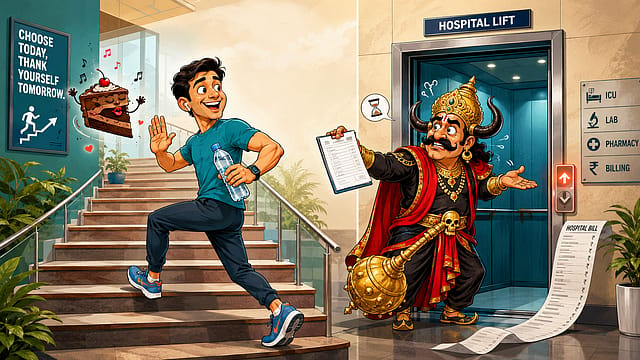
A slice of cake begins singing to its intended victim.
“Baahon mein chale aao…”
The temptation is creamy, musical and sitting dangerously close to the keyboard. But the woman refuses. Elsewhere, an office lift tries to seduce a man who chooses the stairs. An energy drink makes its move. Water wins.
This is ACKO Health Insurance advertising a policy without admitting anybody to hospital. No anxious spouse. No unpaid medical bill. No doctor removing spectacles before delivering bad news. No Yamraj waiting outside reception.
ACKO’s new campaign, For People Who Don’t Compromise, celebrates small acts of health discipline that nobody posts on Instagram: leaving the cake untouched, climbing instead of riding and choosing water over sugar.
The Modi Years
02 Oct 2026 - Vol 05 | Issue 40
A Nation Rebuilt
Policybazaar has traditionally taken another route. It does not ask temptation to sing. It asks death to speak. Akshay Kumar has appeared as Yamraj, confronting people who keep postponing insurance. Gulshan Grover and Shakti Kapoor have warned men not to become their families’ villains. Pankaj Tripathi has delivered darkly comic messages about the “ghor paap” of leaving dependants financially exposed.
ACKO takes the stairs. Policybazaar sends Yamraj
Welcome to the two schools of Indian insurance advertising. One says: “You are responsible. Your insurance should respect that.” The other says: “You have been irresponsible. Kindly purchase a policy before the god of death loses patience.”
At first glance, ACKO appears to have rejected fear advertising altogether.
Its films are bright, playful and built around an old romantic song. The protagonists are alive, healthy and capable of making sensible choices. Insurance appears as a reward for discipline rather than a response to catastrophe.
Policybazaar’s universe is much noisier. Death interrupts conversations. Medical emergencies drain savings. Procrastinating husbands become villains. The consumer is not congratulated. He is shaken by the collar.
Yet the two campaigns are not complete opposites. Both begin with fear. Policybazaar displays it. ACKO refrigerates it.
ACKO never shows the hospital because the audience already knows it exists. The untouched cake and avoided lift acquire meaning only because consumers associate poor daily choices with future illness. Its advertising replaces immediate terror with preventive anxiety.
Policybazaar says the emergency could come tomorrow. ACKO says tomorrow is being quietly manufactured by what you do today.
Marketing and advertising experts reckon that the emotional machinery is similar, although the creative treatment is very different. “Policybazaar externalises fear through death, disease and financial loss. ACKO internalises it through personal discipline," says Ashita Aggarwal, professor of marketing at SP Jain Institute of Management & Research. While one frightens the consumer about consequences, the other flatters the consumer for making better choices.
The consumer is still being reminded of mortality. And ACKO merely lets mortality hum a Lata Mangeshkar song.
Why Yamraj Keeps Getting Work
Fear enjoys unusually stable employment in Indian public communication.
Insurance companies use hospitals and grieving families. Traffic police recruit Yamraj to stop helmetless riders. Anti-tobacco films show diseased organs before movies. Road-safety campaigns display wrecked vehicles, funerals and bloodied roads.
In Gurugram, Guntur, Ambala, Rewa and several other cities, actors dressed as Yamraj have stopped motorists and warned them about helmets and seat belts. Mumbai Traffic Police once used Raavan to remind riders that he had ten heads while they had only one. India does not merely use fear as a message. It gives fear mythological casting.
The reason is brutally practical. Insurance, helmets and preventive healthcare ask people to spend money or accept inconvenience today to avoid something that may never visibly happen. If the helmet works, there is no head injury. If insurance works, the family does not collapse financially. If prevention works, the medical crisis may never arrive.
The benefit is, therefore, invisible. Advertising must make the avoided disaster visible enough to compete with today’s expense.
Fear also attacks procrastination. People can understand medical inflation, road fatalities and family responsibility and still postpone action. Tomorrow feels distant. The premium feels immediate. Yamraj closes that distance. He turns an abstract possibility into a man standing beside your hospital bed.
Policybazaar says its Yamraj campaign more than doubled enquiries and sales for term insurance after release. Whatever one thinks of the creative temperature, death apparently generated leads. Policybazaar’s campaign account
The Product Explains the Advertising
The difference between the two brands also reflects what they sell and how they sell it.
Policybazaar is a marketplace. Its commercial task is to make consumers stop postponing, visit the platform, compare policies and complete a purchase. Urgency is strategically useful. The consumer must be moved from “I should buy insurance someday” to “Let me compare plans now.” Its villains and Yamraj operate as conversion officers.
ACKO is an insurer building a direct consumer relationship. It needs to sell not only a policy but also an idea of the customer it wants to attract: digitally comfortable, health-aware, impatient with complexity and unwilling to compromise on quality.
The new campaign, therefore, performs a flattering act of segmentation. You take the stairs. You reject the cake. You choose water. Surely you are not the sort of person who would buy ordinary health insurance.
ACKO turns self-control into a consumer identity and then positions its policy as the natural accessory. Policybazaar speaks to the procrastinator. ACKO speaks to the protagonist. One says, “Do not become the villain.” The other says, “You are already the hero.”
Insurance Advertising Without a Funeral
Globally, insurers have spent decades trying to make unpleasant possibilities entertaining.
American supplemental-insurance brand Aflac turned an inexplicably loud duck into one of advertising’s most recognisable insurance mascots. The duck did not explain medical underwriting. It simply made an invisible, complicated category impossible to forget.
Oscar Health launched in the US with friendly illustrations, plain language and lines designed to make health insurance behave less like a government form. It attempted to replace intimidation with navigability.
Germany’s Signal Iduna reportedly used quirky mishaps to sell supplementary dental cover under the proposition “Better to have than need”. The accidents supplied risk, but absurdity prevented the films from feeling like public-service punishment.
Brazilian healthcare company INLAB reportedly went further with Not the End of the World, using exaggerated humour to tell uninsured consumers that lacking a health plan was serious without treating every medical need as an approaching apocalypse.
And American life-insurance company Ladder reportedly produced a gloriously dark film in which a man’s family repeatedly tries to kill him because his cover is so attractive. Axes, explosives and arrows arrive. The insured man appears impressed. The line: “Life insurance so good, they’re gonna want you dead.”
The international lesson is not that fear must disappear. Risk is the product’s reason for existing. The creative decision is whether fear appears as tragedy, absurdity, a mascot, a behavioural nudge or a god carrying a mace.
Does Fear Work?
Yes, until it works too hard.
Fear can seize attention, make consequences concrete and destroy the comforting fiction that disaster happens only to other families. It is particularly effective when the danger is credible and the consumer is shown a clear action: wear the helmet, stop smoking, buy adequate cover.
But excessive fear can produce avoidance rather than action. The viewer changes the channel, rejects the message or becomes angry at the advertiser. Policybazaar experienced this danger in 2025 when a term-insurance commercial featuring a widow criticising her late husband attracted accusations of insensitivity. The fear had stopped being a warning and begun to resemble posthumous humiliation.
There is also a moral problem with making financial vulnerability look like personal failure. A family may remain underinsured because of low income, confusing exclusions, distrust of claims, limited awareness or unaffordable premiums. Calling the uninsured breadwinner a villain may create urgency, but it can also convert a structural protection gap into an individual character defect.
ACKO avoids that aggression. Nobody is scolded. The consumer is admired.
Its danger lies elsewhere. Healthy habits do not prevent every illness. People who take stairs, avoid cake and drink water may still develop cancer, suffer accidents or require expensive treatment. Insurance cannot be presented as an elite medal awarded to the disciplined. Health is not always a performance appraisal.
The Real Contest
ACKO’s campaign is more elegant. Policybazaar’s advertising is more bluntly Indian.
ACKO understands the urban consumer who wants encouragement rather than a lecture. Policybazaar understands the mass-market consumer who can postpone a necessary financial decision for years unless somebody makes tomorrow frighteningly present.
The crucial test is not which film viewers prefer. It is which behaviour changes. Does ACKO’s protagonist make consumers inspect the cover, exclusions, waiting periods and claims process? Does Policybazaar’s Yamraj produce a considered purchase or merely a frightened click? Does either brand make health insurance easier to understand after making it difficult to ignore?
“Fear may open the door, but trust must complete the sale,” says Aggarwal. “Insurance is a promise whose quality is discovered during a crisis. Memorable advertising can bring the consumer to the brand. Product clarity, service and claim experience determine whether the relationship survives.”
ACKO has made insurance look like a continuation of self-respect. Policybazaar has made it look like an escape from regret. One seduces the careful. The other terrifies the careless. Both understand the category’s most inconvenient truth: nobody wakes up excited to buy health insurance. Advertising must, therefore, introduce a more persuasive companion.
ACKO brings aspiration. Policybazaar brings Yamraj. And Yamraj, unlike the office lift, is apparently not taking no for an answer.