Would You Like a Burger With Those Fries? McCain Steps onto McDonald’s Turf
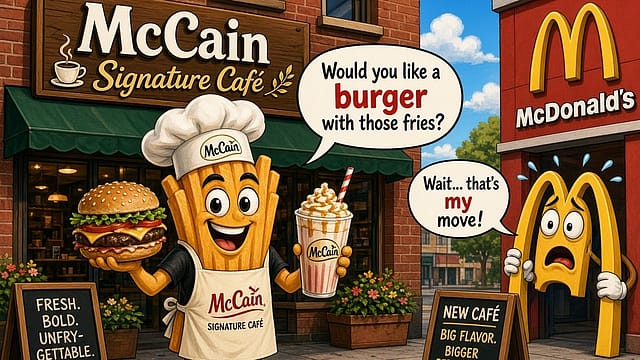
The fries supplier has brought a burger.
Also a milkshake. A sundae. And its own name above the counter.
At Max Mall in Noida’s Sector 129, McCain’s first Indian Signature Café serves a menu that makes a routine outlet launch considerably more interesting. The company that supplies fries to McDonald’s in India is now offering consumers a place to order a meal under the McCain name.
Would you like a restaurant with those fries?
There is a delicious change of roles here. A supplier helps make another brand’s meal worth buying. A restaurant asks the customer to choose its own name before the meal begins. McCain’s café crosses that boundary, however modestly, with burgers, loaded fries, frankies, shakes and desserts.

Losing Memory
16 Oct 2026 - Vol 05 | Issue 42
The making of a medical and social emergency
The move puts it in territory occupied by its restaurant customers. McDonald’s gives that overlap its sharpest expression: a familiar name on the storefront now has a familiar supplier experimenting with a storefront of its own.
One café cannot establish a national contest. It can reveal a rather good branding question. How much of the customer’s appetite belongs to the company making the food, and how much belongs to the name selling the experience?
THE SUPPLIER CROSSES THE COUNTER
The McDonald’s connection is documented by the restaurant brand itself. Its official India West & South blog traces its fries from farms in Idar, Gujarat, through McCain’s plant in Mehsana and into McDonald’s kitchens. That establishes the supplier relationship; it does not establish exclusive supply across India or identical products at the two counters.
Supplying the fries is one thing. Getting diners to choose your restaurant is a much bigger order. McCain’s café puts that ambition on the menu. Someone can enjoy an ingredient without consciously choosing its manufacturer. The restaurant receives the recommendation, the meal gets the photograph, and the supplier remains several steps away from the affection generated by its contribution.
McCain already has a recognised consumer identity through its frozen-food packs. Its café therefore starts with something useful: a name that customers may associate with snacks they have prepared at home.
Now that familiarity has a new job. It must help answer where to eat.
A consumer can enjoy your product repeatedly without ever making a conscious choice of your brand. "The opportunity is to connect that enjoyment to your name, so that it influences the next purchase,” says Ashita Aggarwal, professor of marketing at SP Jain Institute of Management & Research.
At a café, the next purchase can include the entire order. The fries are no longer waiting for somebody else’s burger to secure the visit.
THE MENU IS THE MESSAGE
The announced menu reportedly includes Mexi-Crunch and Korean Veggie Crunch burgers, hot dogs, frankies, loaded fries, quick bites, milkshakes, ice creams and sundaes. The range is what makes the competitive reading plausible.
A counter serving different preparations of fries could remain a narrowly focused product demonstration. Burgers, drinks and desserts let a customer assemble a broader eating occasion. The menu gives McCain permission to be considered alongside places already associated with a quick meal or an indulgent snack. Calling the outlet a café does not determine which alternatives a hungry customer considers.
That decision happens somewhere more practical: between the available time, the appetite, the companions and the bill.
McCain has a credible starting point in potato products and an opportunity to give them more attention than a conventional side order receives. Loaded preparations and different formats could make that specialisation useful to a diner.
The harder task is establishing a distinctive reason to choose the whole experience. A large menu can communicate versatility while making a new outlet look familiar enough to disappear among other snack counters.
McCain needs the customer to remember what was particularly McCain about the visit. Otherwise, the supplier has acquired a restaurant’s operating responsibilities without acquiring a restaurant brand’s pull.
TORONTO HAS ALREADY ORDERED
There is a useful complication for anyone preparing to announce a global restaurant revolution.
McCain has done a café before. In Toronto, its Happy Frydays Café ran from October 30 to November 24, 2024. The Canadian company’s announcement described a temporary venue at 119 Strachan Avenue, with communal dining, merchandise and a menu built around its products.
There were sliders using McCain Smiles, loaded potato bites, a salted-caramel milkshake served with fries, and elaborate topped fries. The exterior featured 25-foot fries. Subtlety evidently had another booking.
The stated purpose included inspiring consumers to recreate McCain food experiences at home.
That precedent matters. It shows how a café can serve the packaged-food business: demonstrate versatility, generate attention and send customers back to the freezer aisle with fresh ideas.
Toronto’s pop-up also means Noida should be described precisely as McCain’s first Signature Café in India. The Indian announcement says the company plans to explore other strategic locations, but supplies neither a firm rollout scale nor the outlet’s tenure.
Those facts leave room for several ambitions. Noida might help sell more McCain products through other channels. It might help the company learn which recipes travel beyond a serving suggestion. It could also become the beginning of a more substantial dining proposition.
The opening alone cannot tell us which ambition will dominate. A supplier’s café can promote the food its business customers buy while simultaneously testing a role those customers already occupy. A product showcase can come with a competitive side effect.
THE CUSTOMER WHO IS ALSO A CUSTOMER
This is where the McDonald’s relationship becomes more interesting than a simple challenger-versus-incumbent poster.
McCain has business customers who need its products. Its café seeks consumers who need somewhere to eat. Those relationships can coexist.
A restaurant operator might find value in seeing fresh applications for a supplier’s products. A successful preparation could encourage new menu ideas or greater interest in an ingredient. McCain could benefit even when the eventual sale happens at somebody else’s counter.
Yet expansion could alter the balance. If a supplier builds enough outlets to compete for the same visits, locations and spending occasions as its customers, the relationship acquires another dimension.
That is a strategic possibility, not evidence that McDonald’s objects to this café. There is no documented dispute or competitive response in the material announcing the launch.
Nor should the argument assume that every café sale is a meal stolen from McDonald’s. Consumers choose among numerous alternatives, and novelty can produce a visit without displacing a settled habit.
The meaningful question is whether McCain can become a repeat choice.
McDonald’s offers a formidable benchmark because the dining proposition extends well beyond an ingredient. The customer encounters a menu, service process, location, price and familiar expectation of the visit. Replicating one contribution to that experience cannot reproduce the whole.
McCain’s opportunity is to build a reason of its own. Its supplier credentials can make the proposition credible. Its expertise needs to become something the diner can identify on the plate and want again.
SUPPLYING CRISPNESS, SERVING EXPECTATIONS
A café puts the brand in charge of more things that can go wrong.
At home, the consumer handles the cooking. At a restaurant customer’s outlet, another business handles preparation and service. Under McCain’s own sign, those final moments become part of the McCain promise.
A long wait belongs to the brand. So does an indifferent burger, a disappointing shake or fries that arrive after their best moment.
The packet has cooking instructions. The customer at the counter has expectations.
This is why the menu’s breadth creates both opportunity and risk. Burgers and beverages can make the outlet useful for more occasions. They also invite judgement on products and skills beyond the potato expertise that drew attention in the first place.
The café must make those additions feel like a coherent meal rather than supporting paperwork for a portion of fries.
“The extension should make the brand’s expertise easier to experience,” says Aggarwal. But curiosity only gets you the first visit or the first purchase. "The real test is whether consumers can name a reason to come back,” she adds.
A successful showroom and a successful restaurant also require different evidence. A showcase could justify itself through product discovery and useful learning. A dining business must eventually sustain repeat visits and workable outlet economics.
The launch material supplies no basis for declaring either result. What it supplies is a place where McCain can attempt the conversion from familiar food brand to chosen destination.
THE SIDE DISH WANTS THE INVITATION
McCain’s most interesting move is the change in the sentence it hopes consumers might say.
“Buy McCain” already makes sense in the freezer aisle. “Let’s go to McCain” asks considerably more of the brand. It asks people to entrust it with an occasion: a snack after shopping, a quick meal, time with friends. It gives the company a chance to earn credit for the complete experience, along with responsibility for delivering it.
The Toronto precedent keeps the interpretation honest. McCain knows that a café can be marketing people can eat. Noida’s broader menu gives that marketing a place in the same consideration set as established quick-service restaurants.
McDonald’s need not lose a single order for the shift to be worth examining. The supplier is exploring how much consumer preference its own name can carry.
“The opportunity is to turn product expertise into a reason to choose the destination,” says Aggarwal. The brand needs to be clear about what it wants the café to achieve, because showcasing a portfolio and building a repeat dining habit demand different kinds of success.
The side dish has asked for top billing. Now it has to earn the invitation.