Some Like It Hot: Why Sprite’s Truth & Spice Wants Summer to Last All Year
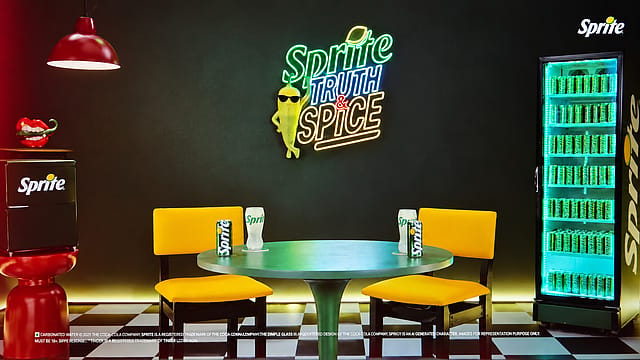
A celebrity has two options: surrender a little dignity through a confession, or surrender a little composure to something spicy. Somewhere in this arrangement, a soft-drink company would like to become indispensable.
Welcome to Sprite’s Truth & Spice, where a food challenge doubles as a fairly serious business proposition. The guests supply the chemistry. The food supplies the jeopardy. Sprite would like to supply the habit.
The eight-episode digital series pairs personalities from comedy, cricket and creator culture for spicy dishes, challenges and conversations. Among the pairings are Aaditya Kulshreshth and Larissa D’sa, and Arshdeep Singh and Samreen Kaur. Two episodes involve Tinder, adding the possibility of a different kind of heat.
On the surface, this is a brand joining the entertainment business. Underneath, it is a brand trying to get the weather out of its business plan. Summer is useful. Lunch is more dependable.

Losing Memory
16 Oct 2026 - Vol 05 | Issue 42
The making of a medical and social emergency
The forecast is spicy
There is unusually direct evidence for this reading. Ogilvy India’s Kyoorius Marketing Awards entry for Sprite’s earlier food platform identifies three business challenges: weakening relevance among Gen Z, the need for more consumption occasions and a substantial non-summer sales decline. Its answer was to attach Sprite to spicy meals through “Spicy ko de Sprite ka Tadka”.
That is the commercial backstory to the chilli-powered entertainment. Truth & Spice extends a strategy already trying to move the brand from a seasonal refreshment cue towards an everyday eating occasion.
The awards entry claims growth in off-season sales from the earlier work. It provides no figures on the public page. That claim cannot be borrowed as evidence that the new show has worked. What the entry establishes is the problem the wider platform was designed to solve.
Think of the difference between waiting for a consumer to feel hot and teaching that consumer to think of your drink when ordering something hot. The first depends partly on conditions outside the brand’s control. The second gives the brand a recurring point of entry into a decision already being made.
Marketing and branding experts reckon that the meal does not have to be invented. The accompaniment has to be claimed.
“If a brand can become associated with a recurring meal, it creates more opportunities to be remembered than a seasonal promise alone can provide,” says Ashita Aggarwal, professor of marketing at SP Jain Institute of Management & Research.
The strategic appeal is easy to see. A new flavour requires a consumer to consider something new. A familiar drink beside a familiar dish can make a smaller demand: next time you eat that, remember this.
There is also something enjoyably audacious about the proposition. A company selling a cold beverage is placing a wager on heat. The chilli becomes an unpaid member of the sales team.
Seedhi baat. How many new lines?
Sprite, of course, once made a virtue of needing very little explanation.
Its Indian advertising history contains at least ten documented lines or platforms. These include “Bujhaaye Only Pyaas, Baaki Sab Bakwaas” at its 1999 launch; “Dikhawa Hai Waste, Trust Only Taste” in 2001; “All Taste, No Gyaan” in 2002; “No Gyaan, Only Pyaas” in 2004; and “Seedhi Baat, No Bakwaas” in 2008.
Then came University of Freshology in 2011, “Rasta Clear Hai” in 2012 and “Chalo Apni Chaal” in 2013. “Thand Rakh” arrived in 2022, followed by the spicy-food platform in 2025.
That is a record of changing advertising language, not proof of ten complete repositionings. Several expressions shared a family resemblance: irreverence, clarity, resourcefulness and refreshment. A new execution, a new slogan and a new reason to buy are different things.
Nor was every change a rescue operation. In March 2011, Ogilvy’s Ajay Gahlaut reportedly explained that the earlier Indian positioning was working; the change followed a global decision to align the brand’s positioning.
The spicy-food push, meanwhile, has not simply erased the summer proposition. Coca-Cola was still promoting “Sprite Gatak. Thand Rakh.” in 2026. Food gives the brand another consumption trigger alongside that refreshment message.
Even so, there is a legitimate memory question. A consumer does not attend the brand’s strategy presentations. If the lines keep changing, what is supposed to remain?
The older Sprite had a readily recognisable temperament. It punctured pretension. It also took on Pepsi’s advertising through spoof. Its promise was almost aggressively uncomplicated: stop the nonsense and have a drink.
Now the brand that once dismissed the performance has commissioned eight episodes of it.
That is a fascinating contradiction, although entertainment itself is hardly new territory: Sprite backed Comedy Konkout with Culture Machine in 2016. The issue is whether the entertainment retains a recognisable Sprite point of view.
There is no recall evidence here to establish that consumers have forgotten the newer lines. But constant novelty places a burden on the brand. Each campaign must leave something behind that the next one can use.
A tagline can change without the brand losing its character. The risk arrives when every new line asks consumers to meet the brand all over again.
A confession with your order?
The game-show format gives the food association a social life. A conventional pairing commercial demonstrates a combination. A recurring programme gives the audience people to follow, questions to anticipate and moments to share.
That is a plausible reason to spend longer with a brand. The audience arrives for a personality or an uncomfortable question; the drink gets repeated opportunities to sit inside the experience.
The trick is making the product necessary to the remembered idea. A celebrity can dominate a clip so completely that the advertiser ends up paying for an excellent piece of celebrity promotion. The audience remembers the confession and forgets who bought lunch.
For Sprite, the question is therefore more demanding than whether the show produces entertaining footage. Does the food-and-drink relationship survive when an episode is chopped into smaller pieces? Is Sprite still part of the joke, the ritual or the choice? Or has it become the green object on the table?
Branded entertainment has to create two memories at once: why the content was enjoyable and why this particular brand belonged in it. “If only the first survives, the entertainment has done better than the advertising,” says Aggarwal.
Tinder introduces an interesting complication. Its participation makes intuitive sense in a programme trading on chemistry and candour. It also stretches “spicy” from a property of food into a description of social interaction.
The metaphor gets bigger. The commercial association could get weaker.
A brand trying to own a food occasion must decide how far it can travel into flirtation, gossip and confessional entertainment before the meal becomes a prop. Selling spicy conversation and selling a drink with spicy food are different jobs. One should help the other.
The world has eaten this format before
The obvious international reference is First We Feast’s Hot Ones universe, especially Hot Ones Versus. Its format asks guests to answer honestly or face a hot-sauce penalty. The resemblance is in the machinery: food heat produces conversational pressure.
That comparison is useful without turning it into an accusation of imitation. Truth-or-dare has no shortage of descendants. The sharper question is what a familiar entertainment mechanism does for this particular advertiser.
In Sprite’s case, the desired commercial destination is a repeatable beverage occasion. The heat is valuable because it can connect the on-screen game to something viewers do away from the screen.
Pepsi offers a closer business comparison. In April 2024, it announced Talking Sabor, an eight-episode Hulu series with chef Aarón Sánchez and COCINA. The programme visited Hispanic-owned restaurants across four American cities, paired food with Pepsi and sat within its wider food-pairing marketing.
The two programmes have different cultural settings and creative structures. Together, they illustrate a straightforward ambition: put the beverage inside an experience people already care about, then keep it there long enough to become an expected companion.
The competitive prize is a place in the order. Sprite is asking diners to associate a particular kind of food with its particular green bottle. Every alternative drink at the table has reason to contest that association.
Entertainment can make the suggestion feel sociable rather than transactional. It still ends at a transaction.
The chilli cannot close the sale alone
The strongest defence of Sprite’s move is that the brand has a coherent role. Food, refreshment and friends are compatible ingredients. The show does not need an elaborate social cause to explain why a can has entered the room.
It can also build repetition without simply repeating an identical commercial. Different guests provide variety while the underlying association remains available for reinforcement.
But ordinary meals are less theatrical than celebrity challenges. Most people are not choosing lunch for its potential to extract a confession. If the association only works at the extremes of a spicy-food stunt, its usefulness may narrow precisely where the brand needs it to broaden.
The real opportunity lies in unremarkable occasions: an order placed with friends, a quick meal, a snack chosen without ceremony. Those moments offer fewer spectacular reactions and more chances to become a habit.
“People may enjoy watching a food challenge without changing what they order with their next meal,” says Aggarwal.
That is where availability, menu visibility and a memorable pairing must do their work. Views can show that people encountered the entertainment. They cannot, by themselves, establish that the programme changed the contents of an order.
Ultimately, Truth & Spice gives a defined commercial ambition an entertaining shape. The celebrities may help people watch; the food association must help people choose.
For a brand with so many lines behind it, the most valuable outcome may be a very short sentence at the counter: add a Sprite. Summer comes once a year. The next meal is already on its way.