Why Donald Trump’s AI Jesus Post and Attack on Pope Leo XIV Are Sparking Global Debate
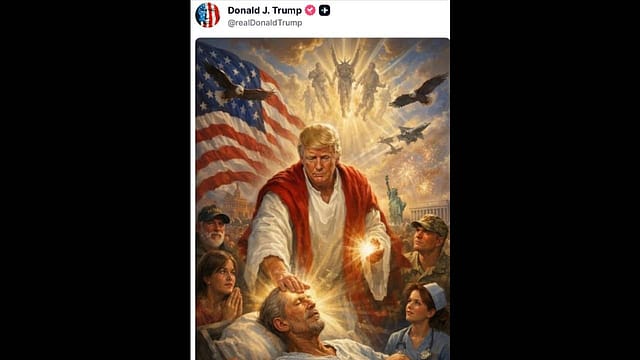
US President Donald Trump found himself at the centre of controversy after sharing—and then deleting—an AI-generated image depicting himself as Jesus Christ on his platform, Truth Social.
The now-deleted post, uploaded without any caption, showed Trump dressed in a white robe and red sash, performing a healing on a man. The imagery evoked the biblical miracle of raising Lazarus from the dead, surrounded by symbolic elements such as eagles, the US flag, soldiers, and even fighter jets ascending toward a celestial light.
The combination of religious iconography and nationalist imagery sparked immediate backlash online, with critics accusing the President of blasphemy and inappropriate self-deification. Despite the uproar, no formal explanation was issued for the deletion.
How does this tie into Trump’s attacks on Pope Leo XIV?
The controversy did not emerge in isolation. It happened while Trump launched a sharp and personal attack on Pope Leo XIV, the first American-born pontiff, escalating tensions between Washington and the Vatican.
The Identity Project
11 Sep 2026 - Vol 05 | Issue 37
Amit Shah leads the mission for a national demographic correction
In a lengthy Truth Social post, Trump directly criticised the Pope’s leadership and policy views: "Pope Leo is WEAK on Crime, and terrible for Foreign Policy. He talks about 'fear' of the Trump Administration, but doesn't mention the FEAR that the Catholic Church, and all other Christian Organizations, had during COVID."
He went on further, accusing the Pope of being lenient on Iran and criticising his stance on US military actions: "Focus on being a Great Pope, not a Politician."
Trump also made a striking personal comparison:
"Louis is all MAGA. He gets it, and Leo doesn't!"
Speaking later to reporters, Trump doubled down: "I don't think he's doing a very good job. He likes crime, I guess... I am not a fan of Pope Leo."
How has Pope Leo XIV responded to the criticism?
Despite the sharp rhetoric, Pope Leo XIV has chosen a restrained and conciliatory tone, avoiding direct confrontation with the US President.
Responding to questions during his flight to Algeria, he said: "I think that the people who read will be able to draw their own conclusions: I am not a politician, I have no intention of entering into a debate with Donald Trump."
He emphasised his broader mission: "Rather, let us always seek peace and put an end to wars. I am not afraid of the Trump administration."
The Pope also cautioned against the politicisation of religion, warning that the Gospel should not be "abused" for political purposes. His remarks underscore a deliberate effort to maintain moral authority while steering clear of political escalation.
What has been the reaction from the Catholic Church?
The backlash has not been limited to social media. The United States Conference of Catholic Bishops (USCCB) also criticised Trump’s remarks.
Archbishop Paul S. Coakley described the comments as inappropriate and divisive, stressing that the Pope is the "Vicar of Christ" and should not be treated as a political adversary.
This institutional pushback reflects growing discomfort within the religious community over the tone and substance of Trump’s statements.
What does this mean for US-Vatican relations?
The episode marks a rare and significant strain in relations between the White House and the Vatican. While political disagreements between US administrations and the Holy See are not new, the public and personal nature of this exchange is unusual.
Even as Trump frames the Pope as politically aligned against his administration, Pope Leo XIV continues to focus on global diplomacy, interfaith dialogue, and humanitarian issues. His ongoing visit to North Africa, described as "truly a blessing," highlights his emphasis on reconciliation and bridge-building.
The contrast is stark: escalating rhetoric from Washington versus calls for peace, dialogue, and restraint from the Vatican.
(With inputs from ANI)