Voyager 1 About to Be a Full Day Away at the Speed of Light
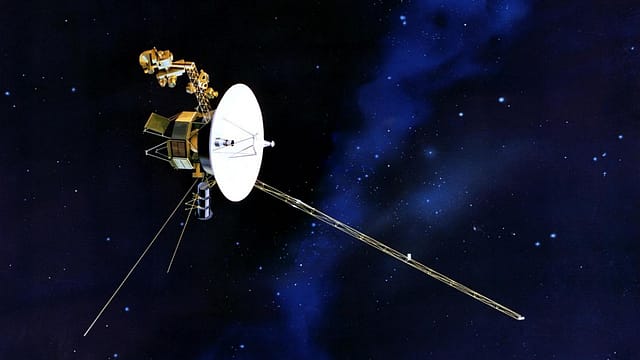
NASA’s Voyager 1 is about to reach a distance that light covers in 24 hours and the spacecraft has taken more than 49 years to travel. On Wednesday, November 18, it is expected to become the first human-made object to reach one light-day from Earth, about 26 billion kilometres or 16 billion miles away.
NASA puts the crossing at 5:16:07 am US Eastern time, or 3:46:07 pm IST. Voyager 1, launched in 1977 to explore the outer planets, is already farther from Earth than any other spacecraft. It crossed into interstellar space in 2012 and continues to send data back as it travels at about 61,000 kilometres per hour.

The Wealth Issue 2026
06 Nov 2026 - Vol 05 | Issue 45
Portraits of Dreamers and Doers under 35
A message takes 24 hours each way
A light-day measures distance. Light travels at about 300,000 kilometres per second, which means a radio signal from Voyager 1 will take a full day to reach Earth at the milestone. A command sent from Earth would take another day to reach the spacecraft. Even an immediate reply would leave the mission team waiting roughly 48 hours from the time it sent the command.
By comparison, sunlight takes about eight minutes and 20 seconds to cross the roughly 150 million kilometres between the Sun and Earth. Light takes about four hours and 10 minutes to travel between Earth and Neptune, the most distant planet. At one light-day, Voyager 1 will be almost six times as far away as that comparison with Neptune.
Voyager 2 is nearly a decade behind
Voyager 2 also launched in 1977, following a different route through the outer solar system that took it past Uranus and Neptune. NASA expects it to reach one light-day from Earth in November 2035, nine years after its twin.
Voyager 1 is travelling in the direction of Gliese 445, a star more than 17 light-years from Earth in the constellation Ursa Minor. NASA expects the spacecraft to pass within about 1.7 light-years of the star in roughly 40,000 years.
With inputs from ANI