In Nvidia story, follow the money, not the spy story, warn experts
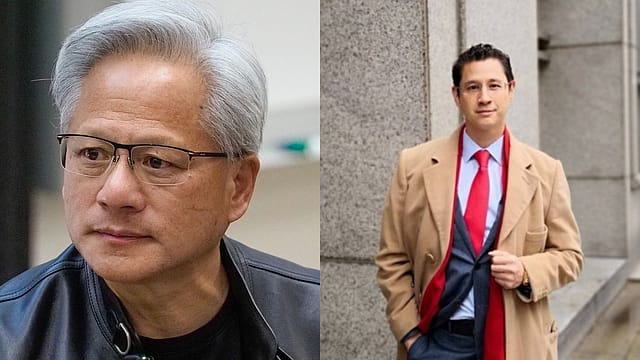
With a section of American legacy media calling Singapore-based Chinese-origin businesswoman Alice Huang a “Chinese spy,” quoting anonymous intel sources and claiming she honey-trapped Taiwan-born Nvidia founder Jensen Huang, contrarian opinions have emerged from across journalists, analysts and market watchers who insist on “chasing the money” rather than sensationalism.
Independent investigative journalist Ben Norton of Geopolitical Economy Report goes to the extent of alleging a conspiracy, saying, “It is now obvious that US intelligence agencies carried out another coup, but not against a foreign head of state this time, but rather against Nvidia CEO Jensen Huang.” He adds in a post on his X handle, “First, US spies and China hawks spread the unsubstantiated rumour that the Chinese businesswoman with whom he had an affair, Alice Huang, was a spy. Next, they forced him to resign. Now, US spies are acknowledging that there is no evidence that she is a spy. But they don’t care, because they accomplished their goal: removing Jensen Huang.”
He asks the billion-dollar question and answers it: “Who benefits? China hawks and Silicon Valley monopolists.”
Norton isn’t the only one sensing conspiracies.
In a show hosted by Mario Nawfal, a highly successful podcast host, Simon Dixon, who is also an entrepreneur, noted investor and market analyst, said the scandal that followed Jensen Huang’s own confessions of an affair and reports of other relationships, including with his former vice-president Kimberly Powell, was mostly a corporate regime change made possible because of the Nvidia founder’s weak voting powers—in which the American military-industrial complex battered the financial and technical industrial complexes, suggesting the involvement of various powerful politicians with their individual interests.

The Wealth Issue 2026
06 Nov 2026 - Vol 05 | Issue 45
Portraits of Dreamers and Doers under 35
Now, speaking to Open, Shaun Rein, US-born founder and managing director of the China Market Research Group, who advises Fortune 500 and leading Chinese companies, argues that Jensen Huang didn’t need anyone to goad him into doing business with China even after restrictions were put in place by the US government on selling extremely high-quality chips that his company makes to China amidst the ongoing chip war. “It’s very clear that Jensen Huang wanted to sell chips, even inferior chips, to the Chinese. He has said that he is losing 18 billion US dollars a year of sales to the China market. As a businessman, he wants to make money,” says Rein, a Harvard University alumnus.
Rein’s scepticism about charges of Chinese espionage stems from other reasons, too. The Shanghai-based consultant adds, “Second, he is not a fear-mongering businessman like many China hawks are, and he doesn’t necessarily view China as a competitor or evil. So, it’s in his best interests to sell chips to the Chinese.” Nvidia had developed a downgraded GPU called H20 (a modified version of H100) specifically for the Chinese market to beat export restrictions.
Rein adds, however, that the Chinese government actually doesn’t want to rely on Nvidia chips anymore, because it feels that even if it can buy them now, at some point, Donald Trump or another president can weaponise technology again and ban the export of Nvidia chips to Chinese companies. “So China is pushing hard to focus on indigenous innovation and the use of Chinese competitors like Cambricon Technologies (dubbed China’s Nvidia), Hua Hong Semiconductor, SMIC (Semiconductor Manufacturing International Corporation), the largest contract semiconductor manufacturer (foundry) in mainland China, Moore Threads Technology Co. Ltd (a Chinese company that specialises in graphics processing unit (GPU) design) and so on,” Rein explains.
He, however, hastens to add that it is quite plausible that many Chinese companies that are profit-driven and are not looking at national security have a very different view from Beijing on whether or not they want to use Nvidia chips. “And so it is very possible that large Chinese companies like an Alibaba would be willing to rent the use of Nvidia chips in data centres that are housed in Malaysia or in Singapore. Some might also even be willing to smuggle chips into mainland China to put into their own data centres on the mainland.”
Which is why, along the lines of several independent journalists and technology analysts, he feels that it is important to differentiate between the motives and wants of for-profit private Chinese companies that are publicly traded and the Chinese government. Rein says he wants to underscore that even the United States is saying that it doesn’t have proof that she was a spy—as news reports from CNN and other news outlets suggest. In fact, amidst sensationalised reporting, US Attorney General Todd Blanche said the Department of Justice was yet to determine whether Huang was a Chinese spy.
“To me, it’s highly unlikely that Alice is a spy. When you look at her background, she fits more of a Chinese businesswoman who is desperate and clawing her way to riches. These are the types of people who in the old days would have smuggled baby formula into China or iPhones into China to make a quick buck,” Rein says, emphasising that “she could make money buying massive amounts of chips from Nvidia and then renting them to Chinese companies or potentially smuggling them into China.” He says it is highly possible and perhaps likely that she did smuggle. He also alleges that some of the reporters who broke the story had a reputation for running stories at the behest of their political masters in the US something which Open couldn’t independently verify.