Trump, Putin and Xi Control 11,000 Nuclear Warheads. Can They Build New Guardrails?
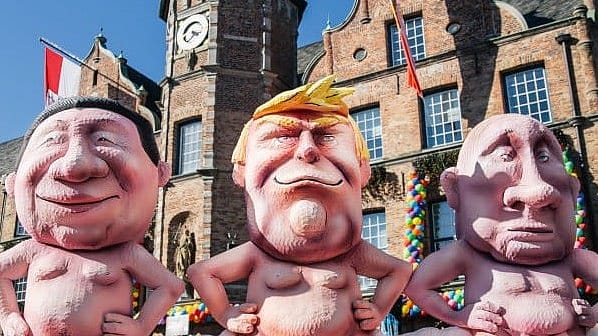
Donald Trump, Vladimir Putin and Xi Jinping are expected to sit down together in Shenzhen on Thursday with approximately 11,000 nuclear warheads in their combined national inventories.
No previous meeting has placed the leaders of the United States, Russia and China around one table. No binding agreement currently limits the strategic arsenals of Washington and Moscow. No formal nuclear-arms negotiation has ever included Beijing.
The photograph will, therefore, carry its own historical weight before anybody speaks.
The White House says the meeting will take place on the sidelines of the Asia-Pacific Economic Cooperation summit and that Trump intends to discuss reducing nuclear weapons. Iran may enter the conversation. Ukraine, according to American officials, will not.

The Wealth Issue 2026
06 Nov 2026 - Vol 05 | Issue 45
Portraits of Dreamers and Doers under 35
No agreement is expected. A senior US official has described the gathering as an entry point and the first leader-level conversation among the three countries on the subject.
That modest expectation is appropriate. The three leaders agree that nuclear war would be catastrophic, but they disagree over almost everything that might prevent one. Their arsenals differ radically in size and readiness. Their military doctrines respond to different enemies. Each country believes the others are developing technologies that could weaken its ability to retaliate.
Trump is attempting to replace a nuclear order designed for two adversaries with one capable of managing three. Shenzhen may demonstrate why the transition is necessary. It may also demonstrate why it has not happened.
The treaty expired before its replacement existed
New START expired on February 5, 2026.
The treaty had limited the United States and Russia to 1,550 deployed strategic warheads, 700 deployed intercontinental ballistic missiles, submarine-launched ballistic missiles and nuclear-capable heavy bombers, and 800 deployed and non-deployed launchers and bombers.
Its verification system was as important as its numerical ceilings. Inspections, notifications, data exchanges and a bilateral consultative mechanism gave each government information about the other’s strategic forces. Arms control did not require trust. It supplied tools for managing distrust.
That machinery had deteriorated before the treaty formally ended. Russia stopped facilitating American inspections and suspended several implementation obligations after its invasion of Ukraine. The United States concluded that it could no longer certify Russian compliance, although it assessed that Moscow was probably not exceeding the treaty’s deployed-warhead limit.
When New START expired, the UN secretary-general called it a “grave moment”. For the first time in more than half a century, the two countries holding the overwhelming majority of nuclear weapons faced no binding limits on their strategic arsenals.
Russia and the United States have not immediately rushed beyond the old ceilings. Moscow has indicated that it will observe them informally if Washington does the same. Informal restraint, however, lacks inspections, legal obligation and an agreed mechanism for resolving disputes.
The world is depending on two rivals continuing to exercise voluntary restraint while their political relationship remains hostile.
Trump rejected a simple continuation of the old bilateral arrangement. He has called for a “new, improved and modernized” agreement that includes China. The strategic logic is understandable. The negotiating arithmetic is brutal.
Three leaders, vastly unequal arsenals
The Stockholm International Peace Research Institute estimates that Russia possessed 5,420 nuclear warheads at the beginning of 2026 and the United States 5,042. China held approximately 620.
The figures include retired American and Russian weapons awaiting dismantlement, and not every weapon is deployed or immediately available for use. The scale of the imbalance remains unmistakable.
Russia and the United States together hold almost 86 per cent of the world’s estimated nuclear inventory. China has expanded more rapidly than any other nuclear-armed country, but its total remains approximately one-eighth of either larger arsenal.
Washington sees China’s direction of travel. Beijing sees the distance that still separates it from Washington and Moscow.
The United States argues that another purely bilateral treaty would constrain the two largest powers while allowing the fastest-growing arsenal to remain outside the system. China argues that entering numerical disarmament talks now would legitimise the much larger American and Russian stockpiles and preserve its own inferiority.
Beijing has stated that asking it to join trilateral disarmament negotiations at this stage would be “neither fair, reasonable nor realistic”. It says the two largest possessors must first reduce their forces substantially through verifiable and legally binding measures.
The disagreement is not merely about a final number. It concerns the baseline from which fairness should be measured.
If all three accepted the same ceiling, China could potentially expand while Washington and Moscow dismantled thousands of weapons. If they accepted proportional reductions, the existing imbalance could become permanent. If the United States and Russia negotiated first, China could continue growing outside formal limits.
Every elegant formulation creates a strategic objection for somebody in the room.
Trump has tried this before
The Shenzhen proposal is not a spontaneous response to New START’s expiry.
Trump directed his administration during his first term to pursue what officials called “21st-century arms control”. Washington sought an agreement that would capture a wider range of Russian weapons and bring China into nuclear negotiations for the first time.
China refused. Russia resisted American suggestions that Moscow should pressure Beijing and argued that any genuinely multilateral framework might also need to include the nuclear forces of Britain and France.
The initiative stalled. The United States and Russia eventually extended New START for five years in 2021, carrying the treaty to the legal limit of its life.
The underlying American concern has since grown stronger. China has constructed large missile-silo fields, diversified its land, sea and air delivery systems and increased the readiness of parts of its force. SIPRI estimates that its inventory reached 620 warheads by January 2026. The Pentagon has projected that it could exceed 1,000 by 2030.
China still professes a no-first-use policy and maintains that its arsenal exists at the minimum level required for national security. American planners worry that greater numbers, more launchers and higher readiness could alter how that doctrine functions during a crisis.
The US nuclear problem has consequently become triangular. Washington must deter Russia and China simultaneously, while each rival plans against American conventional weapons, missile defences, space assets, cyber capabilities and nuclear forces.
A treaty counting warheads alone would leave much of that competition untouched.
What Xi gains without surrendering a warhead
Xi does not need an arms-reduction agreement to benefit from the meeting.
Hosting Trump and Putin allows him to place China beside the two Cold War nuclear powers as an equal participant in global strategic management. Shenzhen can display the international status Beijing has sought while avoiding commitments that might limit its military modernisation.
China can also redirect the conversation away from numerical parity and towards principles it prefers. It has long promoted a mutual no-first-use commitment among nuclear powers. It could support hotlines, advance notification of missile launches, greater transparency over exercises, agreements governing artificial intelligence in nuclear command systems or declarations aimed at preventing accidental escalation.
Those measures would fall far short of a treaty, but they could reduce risk without requiring China to accept the same numerical obligations as the United States and Russia.
Beijing’s caution is visible in its public messaging. The White House has announced the trilateral meeting. Chinese state media has confirmed Xi’s expected bilateral activity around APEC but, at the time of writing, had not issued an equally detailed announcement of the three-way session. Earlier, China acknowledged that discussions were under way.
The distinction matters. A meeting can be historic and still remain vulnerable to agenda disputes, diplomatic conditions or last-minute changes.
Putin arrives with another war in mind
Putin’s incentives are different.
The meeting places him alongside the American and Chinese presidents despite Russia’s continuing war in Ukraine. The staging itself weakens efforts to portray Moscow as internationally isolated and allows Putin to present Russia as one of three indispensable global powers.
Russian officials have also argued that future arms control cannot ignore British and French nuclear forces, American missile defences and US nuclear weapons deployed in Europe. Expanding the number of participants and weapon categories may reflect legitimate strategic concerns. It also makes an agreement slower and more difficult.
Putin has reportedly wanted Ukraine discussed in Shenzhen. The White House says it will remain outside the formal agenda because Kyiv and Moscow are engaged through a separate American-led track and China is not part of it.
That assurance may not settle the matter.
Three leaders can discuss sanctions, territorial principles, European security or relations with Moscow without placing “Ukraine” on an official list. Ukrainian President Volodymyr Zelensky has reason to fear that decisions affecting his country could emerge from a room in which it has no seat.
The symbolism resembles an older model of great-power diplomacy, in which the strongest states discuss the security of regions and countries absent from the table.
Iran enters the room
The White House expects Iran to be discussed.
The choice reflects an issue on which all three powers possess influence but sharply different interests. The United States has used force against Iranian nuclear facilities. Russia has deepened its military and diplomatic partnership with Tehran. China depends on stability across the Gulf, buys Iranian energy and presents itself as an alternative diplomatic power in the region.
Iran also connects nuclear arms control with nuclear proliferation. American officials can argue that restraint among the largest powers strengthens their authority to prevent additional states from acquiring weapons. Critics can respond that attacks on a non-nuclear state’s facilities demonstrate the vulnerability of countries that remain outside the nuclear club.
SIPRI has warned that the attacks on Iran’s nuclear infrastructure weakened monitoring and damaged the broader non-proliferation regime.
Trump’s agenda, therefore, combines two related but distinct ambitions: controlling weapons already held by nuclear powers and preventing Iran from approaching that status.
One meeting cannot solve either problem. It may reveal whether Washington, Moscow and Beijing can agree on the problem’s definition.
The attainable agreement is much smaller
The phrase “denuclearisation” overstates what Shenzhen can deliver.
None of the three governments is preparing to eliminate its nuclear force. All are modernising weapons, delivery systems or supporting infrastructure. Russia and the United States continue replacing ageing systems. China continues expanding from a much smaller base.
The first achievable outcome is dialogue itself.
A regular three-way strategic-stability channel could allow officials to explain doctrines, identify dangerous misunderstandings and begin separating issues suitable for bilateral negotiation from those requiring all three powers. Washington and Moscow could restore verifiable limits on their forces while creating a parallel risk-reduction track with Beijing.
More immediate commitments could include preserving the old New START ceilings temporarily, restoring data exchanges, notifying one another of major exercises and missile launches, strengthening crisis hotlines or agreeing that humans must remain responsible for nuclear-launch decisions.
Experts expect modest risk-reduction measures at best. Even those would require sustained technical negotiations after the leaders leave Shenzhen.
The alternative is an accelerating cycle in which each country cites the others to justify expansion. The United States responds to China’s buildup. Russia responds to American deployments and alliances. China points to the much larger American and Russian arsenals. The result is three modernisation programmes feeding one another without common rules.
India will not be at the table, but it is inside the equation
India holds an estimated 190 nuclear warheads, compared with China’s 620 and Pakistan’s 170.
Those arsenals cannot be understood as three isolated national totals.
China’s build-up is driven primarily by its rivalry with the United States. Indian planners must still decide what the expansion means for the survivability and credibility of India’s deterrent. Pakistan then measures its requirements against India.
An American decision affects China. A Chinese response affects India. An Indian adjustment affects Pakistan.
India and Pakistan also carry their own history of crises, territorial disputes and doctrinal differences. China’s relationship with Pakistan adds another layer to New Delhi’s calculations. Analysts describe these relationships as linked nuclear dyads rather than a single stable balance.
A US-Russia-China agreement that restrained Chinese growth, increased transparency or reduced the risk of high-alert deployment could benefit India. A framework that simply recognised the three countries as the permanent managers of nuclear order could leave New Delhi reacting to rules it did not help write.
India’s absence also exposes the limits of describing a trilateral agreement as globally comprehensive. Britain, France, India, Pakistan, Israel and North Korea would remain outside it. Each possesses a different arsenal, doctrine and regional threat environment.
The three largest-power conversation is necessary. It cannot be the final architecture.
History’s photograph, followed by history’s work
Trump, Putin and Xi will enter the Shenzhen meeting with different measures of success.
Trump wants the beginning of a grand agreement and the political image of convening it. Putin wants strategic recognition and room to advance Russia’s security agenda. Xi wants the prestige of equality without accepting obligations built around arsenals many times larger than China’s.
Those motives are not automatically incompatible. They are too divergent to produce a treaty in one sitting.
The most responsible outcome would be an admission that the old structure has ended and that the replacement will require several layers: renewed US-Russia limits, a new strategic dialogue with China, regional risk reduction and eventual participation by other nuclear powers.
The meeting can begin that process. It can also become a performance in which three leaders praise peace, repeat established positions and depart without authorising the officials who must negotiate verification, definitions and numbers.
The combined nuclear inventories behind the three men will ensure the photograph is remembered.
Whether Shenzhen makes the world safer will depend on what happens after the cameras leave.