US Strikes 3,000 Targets in Iran as Trump Demands ‘Unconditional Surrender’
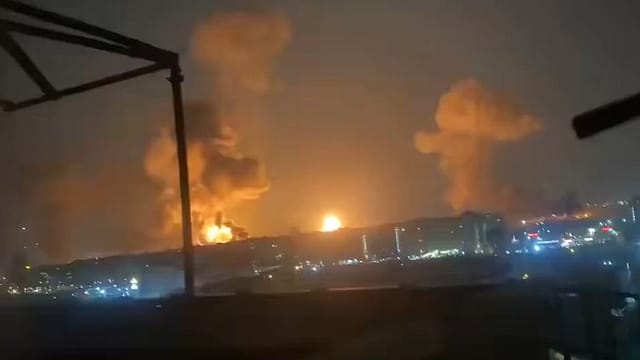
The United States intensified its military campaign against Iran, with thousands of strikes conducted over the past week and fresh attacks reported in Tehran early Saturday.
In a statement released on X, the US Central Command confirmed that its mission, designated as "Operation Epic Fury", has already struck thousands of targets inside Iran.
Why did Donald Trump demand Iran’s “unconditional surrender” before any deal?
Parallel to the military escalation, US President Donald Trump declared that any agreement with Tehran would only come after its unconditional surrender.

Zeroing In on ECI
09 Oct 2026 - Vol 05 | Issue 41
Constitutional legitimacy versus political opportunism
In a post on Truth Social, Trump said there would be "no deal with Iran except unconditional surrender."
He emphasised that the United States and its allies, particularly Israel, would only consider negotiations after Iran's leadership capitulates and is replaced by leaders acceptable to Washington and its partners.
"There will be no deal with Iran except UNCONDITIONAL SURRENDER! After that, and the selection of a GREAT & ACCEPTABLE Leader(s), we, and many of our wonderful and very brave allies and partners, will work tirelessly to bring Iran back from the brink of destruction, making it economically bigger, better, and stronger than ever before. IRAN WILL HAVE A GREAT FUTURE. 'MAKE IRAN GREAT AGAIN (MIGA!),'" Trump wrote.
Airstrikes hit the Iranian capital in the early hours of Saturday, according to Iranian state media.
A video circulating on social media and geolocated by CNN showed Tehran's Mehrabad Airport on fire following the strikes, with large plumes of smoke and flames rising from the facility, one of the capital's primary aviation hubs.
Iran's state broadcaster reported explosions and smoke in the eastern and western parts of Tehran.
How did Iran respond to Israeli attacks on Tehran?
The reports came shortly after the Israeli military announced it was carrying out a new wave of attacks on Tehran targeting regime infrastructure.
Meanwhile, Iran launched retaliatory strikes at Tel Aviv, according to Fars News. A CNN team in Tel Aviv witnessed explosions in the sky as Israeli air defences intercepted incoming fire.
The exchange of attacks follows a week of intense military operations that have heightened risks for civilians and infrastructure across the region.
Saudi Arabian air defences also intercepted a new wave of aerial attacks targeting the strategic Shaybah oil field early Saturday, according to Arab News citing the Ministry of Defence.
In updates posted on X, ministry spokesperson Major General Turki Al-Maliki said that 16 drones launched in four separate waves were intercepted and destroyed over the Empty Quarter while heading toward the energy facility.
Al-Maliki also confirmed the "interception and destruction" of a ballistic missile and a cruise missile aimed at Prince Sultan Air Base in Al-Kharj.
Another drone was downed east of Riyadh. Arab News reported that this marked the third consecutive day of attempted strikes on Al-Kharj, a major industrial hub located about 80 kilometres from the capital.
Why is Saudi Arabia’s Shaybah oil field important in the escalating Iran conflict?
The attempt on the Shaybah field was the first since February 28 following the launch of a large-scale US-Israeli air campaign against Iran.
The escalation has prompted retaliatory strikes from Tehran against various Gulf targets including critical industrial and oil infrastructure.
Situated deep within the Rub' al-Khali, or the Empty Quarter, Shaybah is regarded as one of Saudi Arabia's "super-giant" fields.
It plays a central role in the Kingdom's gas strategy through a high-tech recovery plant that supplies natural gas liquids to the petrochemical industry.
The surge in hostilities has also led to a dramatic rise in aerial threats across the region. Arab News reported that within the past 24 hours the United Arab Emirates intercepted more than 125 drones and six ballistic missiles.
On Friday alone Saudi defences intercepted five missiles headed for Prince Sultan Air Base and multiple drones across Riyadh and Al-Kharj.
What did the Arab League and OIC say about the escalating Iran conflict?
The attacks have drawn condemnation from international organisations including the Arab League and the Organisation of Islamic Cooperation.
During a ministerial meeting in Riyadh on March 1, the Gulf Cooperation Council affirmed the collective right of member states to defend their territories against what it described as "treacherous Iranian aggression."
Following a Cabinet meeting led by Crown Prince Mohammed bin Salman on March 3, Saudi Arabia declared that it reserves the "full right" to respond.
Arab News reported that the Cabinet said the Kingdom would take all necessary measures to protect its territory, citizens and residents from ongoing hostilities.
Amid the turmoil, Trump has expressed a desire to be personally involved in selecting Iran's next Supreme Leader following Khamenei's death.
Why did Donald Trump oppose Mojtaba Khamenei as Iran’s next Supreme Leader?
In an interview with Axios, Trump said he wanted a role in the appointment process and criticised the potential succession of Mojtaba Khamenei, the son of the late Supreme Leader.
"They are wasting their time. Khamenei's son is a lightweight. I have to be involved in the appointment, like with Delcy [Rodriguez] in Venezuela," Trump said.
Trump described Mojtaba Khamenei as "unacceptable" and said he would prefer a leader capable of bringing "harmony and peace" to Iran.
He warned that continuation of the policies of the late Supreme Leader could lead to renewed conflict with the United States.
Reports suggest Mojtaba Khamenei, a 56-year-old cleric with close ties to the Islamic Revolutionary Guard Corps, is among the leading contenders to succeed his father. However, Iranian authorities have rejected these claims.
Through the Consulate General in Mumbai, the Iranian government said reports about possible candidates have no official source and are officially denied.
According to Axios, Trump remains firm that the United States should not accept any new Iranian leader who would pursue policies similar to those of the late Khamenei.
(With inputs from ANI)