US Deploys Second Aircraft Carrier USS Gerald R. Ford To West Asia Amid Iran Tensions
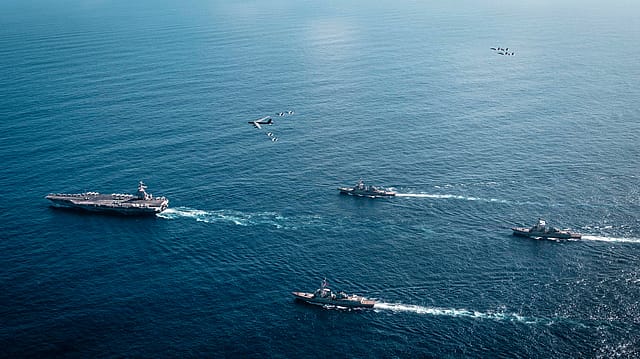
The United States is deploying a second aircraft carrier, the USS Gerald R. Ford, along with its escort ships from the Caribbean to West Asia, according to a report by The New York Times that cited four US officials speaking on condition of anonymity.
The vessels are not expected to return to their home ports until late April or early May and will join the USS Abraham Lincoln carrier strike group already operating in the region, including in the Persian Gulf and Arabian Sea.
The Lincoln and several guided missile destroyers had arrived in West Asia more than two weeks ago.
The deployment comes as US President Donald Trump weighs military action against Iran while indirect talks continue between Washington and Tehran over Iran’s nuclear programme.

The Modi Years
02 Oct 2026 - Vol 05 | Issue 40
A Nation Rebuilt
Trump has said the United States must make a deal with Iran and suggested an agreement could be struck within the next month, warning that failure to do so would be “very traumatic.”
Earlier in the week, he had indicated he was considering sending a second aircraft carrier if a deal was not reached.
The Ford’s deployment marks a significant increase in American firepower in the region and a rapid turnaround for the ship, which began its extraordinary deployment on June 24 when it left Norfolk, Virginia.
The cruise was originally planned for Europe but was redirected to the Caribbean as part of the administration’s pressure campaign on Venezuela.
The strike group’s warplanes reportedly participated in a January 3 attack on Caracas that led to the capture of Venezuelan President Nicolas Maduro.
The deployment has already been extended once and sailors had expected to return home in early March, which would make the crew’s mission approach eight months.
The move comes amid heightened tensions and stalled diplomacy. Negotiations did not materialise even as one of Tehran’s top security officials visited Oman and Qatar this week to exchange messages with US intermediaries.
What Did Iran Say About Nuclear Enrichment And Potential US Military Action?
Iranian official Ali Larijani, in an interview with Al Jazeera, said indirect negotiations with Washington are ongoing in Oman and that no specific proposal has yet been received from the United States.
He added that Washington’s engagement in talks suggested a move toward a “rational path” and rejected any discussion of “zero enrichment,” asserting that Iran requires enrichment for energy and medical purposes.
He also warned that if the United States attacks, Iran would target US military bases in the region, according to a report carried by the IRNA.
Trump, after meeting Israeli Prime Minister Benjamin Netanyahu, said Iran had previously been struck under “Midnight Hammer” when it failed to reach a deal and expressed hope that Tehran would act in a more responsible manner this time.
On June 21 and 22, 2025, under Operation Midnight Hammer, the United States conducted strikes against Iranian nuclear infrastructure at Fordow, Natanz and Isfahan, an action Iran condemned as a violation of international law and the UN Charter.
How Could The USS Gerald R. Ford Deployment Escalate Regional Conflict Amid Israel-Gaza War Fears?
Netanyahu is also urging Washington to press Tehran to scale back its ballistic missile programme and end its support for militant groups such as Hamas and Hezbollah as part of any future agreement.
Gulf Arab nations have warned that any attack on Iran could spiral into a broader regional conflict in a Middle East still reeling from the Israel-Gaza war.
The Ford’s redeployment also appears to contrast with Trump’s national security strategy, which had emphasised the western hemisphere over other regions.
At home, Iran faces mounting internal pressure following a violent crackdown on nationwide protests last month.
Iranians have begun holding traditional 40 day mourning ceremonies for those killed, with online videos showing gatherings across the country where mourners sang the patriotic song “Ey Iran.”
The US based Human Rights Activists News Agency has put the death toll from the crackdown at at least 7,005 people, including 214 government forces, while Iran’s government said on January 21 that 3,117 people were killed.
The dual carrier presence underscores Washington’s effort to coerce Tehran into a nuclear deal while keeping military options on the table as indirect diplomacy continues.
(With inputs from ANI)