The Strait of Hormuz and the Goods That Flow Through It
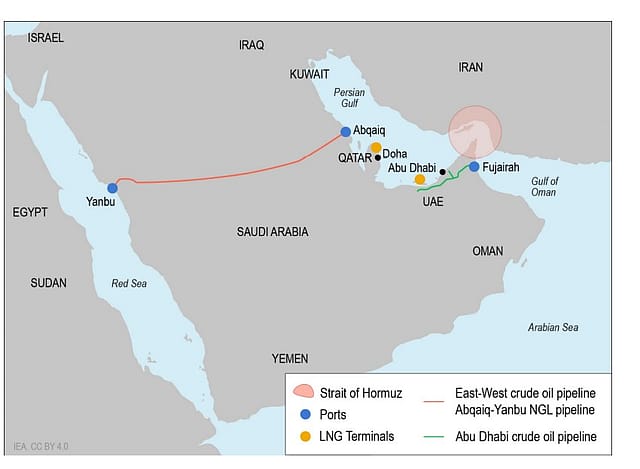
A 21-nautical-mile passage between Iran and Oman has rattled energy markets before as well. But nothing compares to what is unfolding now.
Following US-Israeli strikes on Iran on February 28, Iranian forces shut the strait to all shipping, Brent crude briefly touched 119 dollars a barrel, and the IRGC warned of 200-dollar oil. The world is now scrambling to reckon with exactly how much flows through this corridor.
Here is a detailed breakdown.
What Makes the Strait of Hormuz So Indispensable?
The strait is the sole maritime exit from the Persian Gulf to the open ocean. Seven of the world's largest energy producers, including Saudi Arabia, Iraq, Qatar, and the UAE, depend on it as their only export route.
According to the US Energy Information Administration, roughly 20 million barrels of oil per day transited the Strait of Hormuz in 2025, about 20% of global seaborne oil trade.

Zeroing In on ECI
09 Oct 2026 - Vol 05 | Issue 41
Constitutional legitimacy versus political opportunism
How Much Crude Oil Passes Through It Daily?
Kpler tanker tracking data puts average crude transit at over 14 million barrels per day through the strait in 2025. That is roughly a third of the world's total seaborne crude exports. Saudi Arabia leads, followed by Iraq and the UAE. Together, these three account for nearly three-quarters of all crude flows through this global oil chokepoint.
What Share of Global LNG Flows Through Hormuz?
LNG exports through Hormuz represent nearly 20% of all global LNG trade, the IEA notes. About 93% of Qatar's and 96% of the UAE's LNG exports transit the strait. Unlike crude, there are no pipeline workarounds. A sustained closure would pull over 300 million cubic metres per day off the global market, making this the most acute vulnerability in the current Hormuz shipping disruption.
What Non-Energy Goods Transit the Strait?
Beyond oil and gas, Strait of Hormuz trade includes fertilisers, aluminium, industrial chemicals, and helium. The Gulf region accounts for 16 to 18% of global seaborne fertiliser exports, and Saudi Arabia alone ships close to 14 million tonnes annually from its eastern ports.
Qatar supplies roughly 33-38% of the world's helium, almost all produced at Ras Laffan and exported by sea through the strait. With Ras Laffan now offline, global helium supply has been cut by a third overnight, sending spot prices up 35 to 50%.
The Global Impact of the Helium Supply Shock
Helium is irreplaceable in semiconductor fabrication, MRI scanners, and fibre-optic manufacturing, where it is used for cooling, leak detection, and precision processing. A sudden drop in supply therefore threatens chip production, hospital equipment, and advanced manufacturing worldwide.
With a third of global helium effectively removed from the market overnight, the disruption risks cascading into a broader technology and healthcare supply crisis.
Which Countries Are Most Exposed?
About 84% of crude shipments through this global oil chokepoint in 2024 were headed to Asian markets, IEA data shows. China, India, Japan, and South Korea absorb the vast majority of Hormuz crude flows. Bangladesh, India, and Pakistan collectively imported nearly two-thirds of their LNG through the strait. Japan has already begun drawing on emergency stockpiles.
Are There Any Workable Bypass Routes?
Saudi Arabia and the UAE together hold an estimated 3.5 to 5.5 million barrels per day of pipeline bypass capacity. Iraq, Kuwait, Qatar, and Bahrain have no bypass routes at all. For LNG exports through Hormuz, there is simply no alternative. Every cargo goes through the strait or it does not go at all.
What Has the Crisis Done to Energy Prices?
Brent crude surged past 100 dollars a barrel on March 8, briefly hitting 119.50 dollars, the first time since Russia invaded Ukraine, CNBC reported. The IEA authorised a release of 400 million barrels from emergency reserves, the largest in its history. Allianz Research has warned, a prolonged Hormuz shipping disruption could push Brent above 130 dollars. The IRGC has threatened 200-dollar oil if shipping attempts continue.
What Does a Prolonged Closure Mean for the World?
This is not a standard oil shock. It is a food, energy, and industrial crisis squeezed into 21 nautical miles. The full range of Strait of Hormuz goods, from crude and gas to fertilisers and chemicals, is now off the market, hitting Asia hardest.
As former IEA oil head Neil Atkinson told CNBC, what the world is witnessing is something energy markets had never seen before. Every day the strait stays shut, that assessment gets harder to argue with.
(With inputs from yMedia)