Strait of Hormuz Crisis: First India-Bound Crude Shipment Reaches Mumbai
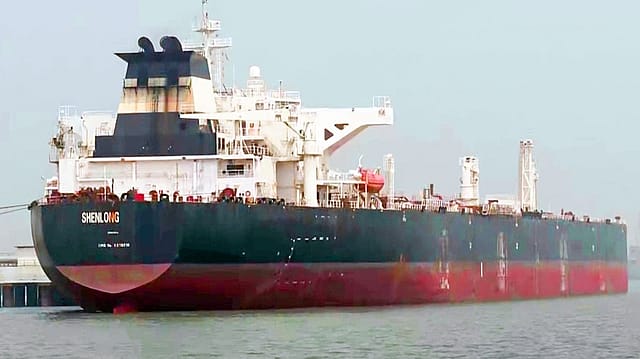
A Liberia-flagged tanker, Shenlong Suezmax, carrying Saudi crude has reached Mumbai Port, becoming the first India-bound vessel to pass through the strategically vital Strait of Hormuz since the start of the Iran–US conflict.
The tanker transported 1,35,335 metric tonnes of crude oil and docked at the port on Wednesday afternoon, offering reassurance that India’s energy supply lines remain operational despite heightened regional risks.
What makes the Shenlong Suezmax voyage significant?
The Liberia-flagged Shenlong Suezmax loaded crude oil from Ras Tanura Port on March 1 and departed on March 3.
Maritime tracking data showed the vessel entering the Strait of Hormuz on March 8 before it temporarily disappeared from tracking systems. The ship reportedly switched off its Automatic Identification System (AIS) transponder while navigating the high-risk stretch of the strait and reappeared on tracking systems the following day.

Flood and Fury
04 Sep 2026 - Vol 05 | Issue 36
Devighat, Nepal, August 29, 2026
The AIS transponder is a mandatory maritime VHF radio system that automatically broadcasts a ship’s identity, position, speed and course to nearby vessels and shore stations to prevent collisions and improve navigation.
The tanker eventually docked at Mumbai Port at 1 pm on Wednesday and was berthed at Jawahar Dweep at 6:06 pm.
The vessel is carrying 1,35,335 metric tonnes of crude oil that will be supplied to refineries in Mahul in eastern Mumbai. The crude discharge process is expected to take around 36 hours.
Who owns the tanker and who is on board?
The tanker is owned by Shenlong Shipping Ltd and managed by Dynacom Tanker Management Ltd.
The ship has 29 crew members on board, including Indian, Pakistani and Filipino nationals, and is captained by an Indian.
What warning has Iran issued to ships crossing the Strait?
Earlier, the commander of Islamic Revolutionary Guard Corps Naval Force warned that ships must seek Tehran’s approval before attempting to cross the strait.
Rear Admiral Alireza Tangsiri said that two ships that ignored Iranian warnings had been targeted.
"Were the ships assured of safe passage through the Strait of Hormuz? This should be asked of the crews of the vessels Express Rome and Mayuree Naree, who today, trusting in empty promises, ignored the warnings and intended to cross the Strait, but were caught. Any vessel intending to pass must obtain permission from Iran," the Iranian general said in a post on X.
According to Iranian state media, Iran has intensified restrictions on ships moving through the strait. Tehran has said vessels that are not serving the interests of the United States and Israel will be allowed to sail through safely.
Why is the Strait of Hormuz so crucial for global energy markets?
The Strait of Hormuz is one of the world’s most critical energy chokepoints.
More than 20 million barrels of crude oil pass through the narrow channel every day. That volume represents roughly a fifth of global oil consumption and nearly a quarter of all seaborne oil trade.
A significant share of the world’s liquefied natural gas also moves through the same passage, meaning any disruption can quickly affect financial markets, supply chains and household fuel prices around the world.
How many Indian vessels are currently in the Persian Gulf region?
India’s Shipping Ministry said that 28 Indian-flagged vessels are currently operating in the Persian Gulf region.
Of these, 24 vessels are located west of the Strait of Hormuz carrying 677 Indian seafarers, while four vessels are east of the strait with 101 Indian seafarers on board.
Authorities said their safety and security are being actively monitored.
A 24-hour control room has been operational at the ministry and the Directorate General of Shipping since February 28 to monitor developments and coordinate assistance.
Officials said authorities, ship managers and recruitment agencies are coordinating closely with Indian embassies and local authorities to ensure safety and provide assistance to Indian seafarers wherever required.
(With inputs from ANI)