Is war in the Middle East Inevitable?
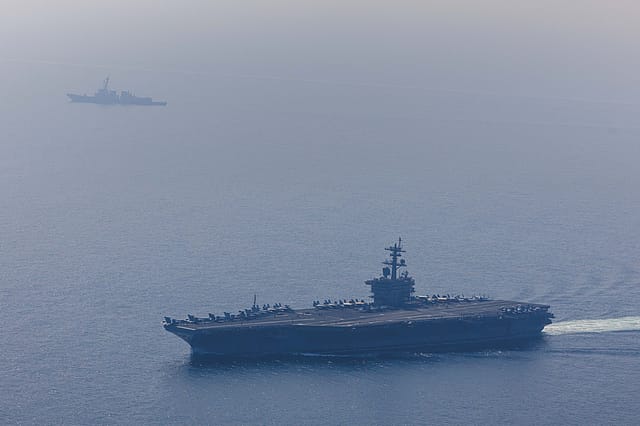
On Saturday February 8, after an uneventful round of talks in Muscat a day earlier, Trump's top negotiators Steve Witkoff and Jared Kuchner flew to the aircraft carrier USS Abraham Lincoln in the Arabian Sea. The two negotiators and US Centcom Chief Admiral Brad Cooper were humiliated during those negotiations a day earlier. Firstly, the Iranians refused to accept the presence of Admiral Cooper in the talks and team leader Witkoff complied with this demand. Secondly, the Iranians led by Foreign Minister Abbas Aragchi refused to sit in the same room across the table from the Americans. Instead, the Omani Foreign Minister Badr bin Hamad Al Busaidi shuttled between different rooms, writing instructions, and carrying them back and forth. Iran refused every American demand and the talks were adjourned to another date. Less than 24 hours later, these same three men stood on the deck of the US$13 billion nuclear-powered aircraft carrier.
But what was scary was that while the three Americans were engaged in a photo op on board the ship, Aragchi gave an interview published the same day and he said something that changes everything. He said, “We hope talks resume soon, but make no mistake, our red lines remain firm.”

The Modi Years
02 Oct 2026 - Vol 05 | Issue 40
A Nation Rebuilt
Trump is in a choke-hold. Israeli Prime Minister Benjamin Netanyahu arrived in Washington yesterday February 11. Before he emplaned for the US, Netanyahu's office released a statement saying all negotiations must include limiting ballistic missiles.
Translation: if Trump comes back from talks without missile restrictions, Netanyahu will view the entire negotiation as a failure. And we know what happens next when Israel decides diplomacy has failed.
But here's where the carrier visit becomes critical. Trump sent his negotiators to the Abraham Lincoln for one reason: to show Iran and show Netanyahu that military options remain on the table.
Markets already know that. Bitcoin crashed to $66,000. Gold and silver are volatile. Stock indexes are nervous. Energy futures show elevated risk premiums. All because investors understand the timeline and see where it's heading.
When American negotiators visit aircraft carriers between diplomatic rounds, that's not confidence. That's contingency planning. When Israel's prime minister flies to Washington demanding specific concessions that Iran has already rejected, that's not optimism about peace. That's preparation for alternatives. When former Pentagon officials start warning publicly about carrier vulnerability and Chinese support for Iranian defense, that's not speculation. That's professionals seeing indicators that concern them deeply.
Here's what is creating uncertainty about Netanyahu's current US visit and why it creates a fait accompli for Trump. Netanyahu isn't there to discuss options. He's there to deliver an ultimatum. Iranian ballistic missiles must be restricted to a maximum range of 300 km. That's the distance from Iran to Israel. Anything beyond that range threatens Israeli territory.
How extreme is that demand?
Kheibar Shekan missiles, Iran's most advanced ballistic systems, have a 1,500 km range. Iran has deployed around 2,000 of these weapons in underground facilities throughout the country. Iran produces hundreds of new missiles every month. And Netanyahu wants Trump to negotiate reducing missile range to 300 km. That's an 80% reduction in capability. That's Iran voluntarily dismantling its primary deterrent against Israeli and American power.
The Kheibar Shekan (also spelled Khaybar Shikan or Kheibar Shekan, meaning "Breaker of Khaybar") is a third-generation, long-range, solid-fuel ballistic missile operated by the Islamic Revolutionary Guard Corps (IRGC) Aerospace Force. Unveiled in February 2022, it is designed for precision strikes and high mobility, capable of hitting targets within a range of 1,450 kilometres (approximately 900 miles), placing much of the Middle East, including Israel, within its reach.
Why would Iran ever agree to that?
That's the impossible position Trump faces with Netanyahu. If he tells Netanyahu, that Iran won't negotiate missiles, then Netanyahu will sanction Israeli strikes on Iranian missile facilities without US approval. And when Iran retaliates against those strikes, they'll hit US bases throughout the region because those bases supported Israeli operations logistically. Trump gets dragged into a regional conflict he didn't authorize.
What are Trump’s options?
He can tell Iran: The USS Abraham Lincoln is parked in the Arabian Sea with 6,000 sailors and 75 aircraft. It's parked in your maritime approaches. We can use it.
To Netanyahu Trump can say: We're serious about military options if diplomacy fails. Don't feel like you need to act unilaterally. We're positioned and ready.
To American military commanders Trump can say: Diplomatic failure is increasingly likely. Prepare for scenarios where political decisions require military responses.
To global markets Trump’s message could be: Negotiations continue, but we're managing all contingencies, including kinetic options.
That's sophisticated messaging. One carrier visit; multiple meanings, depending on who's watching.
However, if Trump authorizes strikes using the USS Abraham Lincoln, and if China has indeed provided Iran with advanced anti-ship missiles and real-time targeting intelligence, then that ship faces genuine risk. Not theoretical risk—actual operational danger. Sinking an American aircraft carrier would kill thousands. It would represent the single worst American military loss since World War II. And it would trigger automatic escalation to levels nobody currently wants to contemplate. Therefore, using the Lincoln battle group may not give the US any strategic gain against the Iranians.

Meanwhile, Netanyahu is telling him to use the Lincoln or he will launch strikes anyway and Trump will face the consequences regardless. And Iran is telling him to try using the Lincoln and watch what happens to his 6,000 sailors.
So, here's a scenario till the end of February:
Netanyahu meets Trump in Washington D.C.. He presents evidence of Iranian missile production rates, deployment locations, and threat assessments. They prepare satellite imagery of underground facilities. They prepare arguments for why waiting only makes the problem worse. Netanyahu demands action. He warns that Israel cannot wait while Iran builds more missiles every month. He reminds Trump that Israeli voters elected governments that promise security; that means eliminating the Iranian missile threat permanently.
Trump will listen. He'll nod. He'll say he understands Israeli concerns. But he won't commit to strikes because his NSA Marco Rubio has told him carrier-based operations against Iran carry unacceptable risk. Therefore, Netanyahu leaves Washington without the commitment he came for. Thereafter, diplomatic teams prepare for the next round of talks in Muscat. The US drafts proposals that include missile restrictions. Iran drafts counterproposals that explicitly exclude missile discussions. Both sides know before meeting that positions are incompatible.
Assume the talks resume in Muscat. The same shuttle diplomacy through Omani mediators, the same unbridgeable gaps, the same public statements afterward about constructive discussions that accomplished nothing concrete. Except this time, Netanyahu has already met Trump. This time, Israel knows America won't force Iranian concessions. This time, Israeli military planners start final preparations for unilateral operations.
Late February: Israeli fighter jets strike Iranian missile facilities. Maybe multiple sites simultaneously, maybe limited strikes on specific targets, but definitely military action that Iran cannot ignore. Iran retaliates within hours. Ballistic missiles target US bases in Qatar, Bahrain, Kuwait, and Iraq. The stated reason is that US logistics and intelligence supported Israeli aggression. The result is that US forces take casualties; possibly dozens, scores, depending on how many missiles penetrate defences and which facilities get hit.
Trump faces an immediate decision: allow US casualties to go unanswered, or authorize counter strikes that escalate regional conflict further. Assuming he chooses the latter. He authorizes limited strikes. F-35s from the USS Abraham Lincoln launch against Iranian missile sites; the same sites that just hit US bases. Tit-for-tat escalation takes place that both sides claim is defensive.
Globally, markets collapse. Oil prices double overnight as the Strait of Hormuz becomes a combat zone. Global recession begins within weeks as energy costs spike and supply chains break.
Witkoff and Kushner’s carrier visit wasn't signaling confidence in diplomacy. It was positioning pieces for the conflict Trump sees coming but can't stop, because he can't satisfy Netanyahu without attacking Iran, and he can't attack Iran without risking catastrophic casualties, and he can't allow Israeli unilateral action without getting pulled into regional conflict anyway.
Perchance if Witkoff and Kushner visit the Lincoln again for a second trip after Netanyahu leaves Washington D.C., that's a final operational briefing before authorization to escalate kinetic attacks.
Undeniably, the timeline is compressing. The satellite images of the port of Bandar Abbas in southern Iran shown to Trump revealed three unmarked cargo vessels. They were of Chinese registry, but with no official manifests. Analysts at the GSIA (National Geospatial Intelligence Agency) watched in real time as massive containers were offloaded under the cover of darkness. Containers that thermal imaging revealed were climate controlled, precisely the kind used for sensitive military hardware. These disappeared within 72 hours, into fortified mountain facilities near Fordow. And then the Pentagon received a classified briefing that changed everything. The shipments were not just weapons. They were delivery systems; missile technology, the kind that could reach the continental US. This was not an arms deal. This was a declaration and it takes courage to understand what it means.
Behind the headlines, something much more sinister is brewing. For months, maybe years, China has been quietly feeding Iran's missile program with components, guidance systems, and propulsion technology that Beijing officially claimed it would never export. The US had been watching the wrong threat. While it obsessed over Russia's alliance with Tehran, China was building something more dangerous; a shadow supply chain that bypassed every sanction, every watchdog, every treaty. And now, the CIA estimates that Iran possesses the capability to strike targets over 7,000 miles away. That is not just Israel. That is not just Europe. That is Guam. That is Alaska. That is the continental US.
This is where it gets darker. This is not a mistake. This is not rogue actors or black-market smuggling. This is state policy. The Chinese Ministry of Foreign Affairs denies everything of course, but US NRO (National Reconnaissance Organization) intercepted communications between Chinese advisers attached to Iran's Islamic Revolutionary Guard Corps. These intercepts tell a different story. Technical advisers, joint testing facilities, shared satellite data. China is not just selling weapons to Iran. It is integrating Tehran into its strategic architecture.
On Wall Street, fear dominates. Markets are precariously poised. Oil futures spiked 6% in a month. Défense stocks have soared. Lockheed Martin, Raytheon, and Northrop Grumman’s stock prices have all hit record highs. Investors know what this means. A new arms race. Billions in contracts for missile defence systems, satellite tracking networks, hypersonic countermeasures.
Let us also for a moment review events on 28 December 2025, when Iran conducted what it called a space launch from Russia’s Vostochny Cosmodrome. The world was told that a Russian Soyuz rocket ostensibly carrying a payload of 3 Iranian satellites the Zafar-2, Paya, and Kowsar was launched. But Mossad and the CIA saw something else. The trajectory, the payload capacity, the telemetry data of the rocket was actually a thinly veiled demonstration of a new Iranian rocket not the Soyuz. Iran was showing the world it had intercontinental ballistic missile technology.
And the components, the rocket motors, the guidance processors, the heat-resistant nose cone materials, all bore the fingerprints of Chinese engineering. Military analysts at the Pentagon were blunt in their assessments. Iran's missile program had just leapt forward by a decade.
CIA tracked payments made through cryptocurrency and Chinese digital yuan to evade financial tracking. And at the centre of it all, a unit within China's strategic support force, the PLA's information warfare, and intelligence branch, coordinated every transaction. This was not just arms trafficking. This was a state-run covert operation designed to fundamentally alter the balance of power in the Middle East and beyond. It is proxy warfare by other means. If Iran becomes embroiled in conflict with the US or Israel, China can claim plausible deniability. They are just a supplier, not a combatant. But the effect is the same.
US military resources get tied down in the Middle East, stretched thin and distracted. And while Washington is focused on Tehran, Beijing moves in the South China Sea, tightens its grip on Taiwan, expands its influence across Africa and Latin America; its strategic genius wrapped in diplomatic denial. And here is where it gets truly complex. China is not doing this to start World War III. Beijing's calculus is more sophisticated. They are building what strategists call strategic ambiguity. By arming Iran, China creates a credible threat to US interests without directly confronting US forces.
Which brings us to the question everyone is avoiding. What happens next?
Intelligence assessments offer three scenarios.
Scenario one: containment. The US and its allies successfully deter Iran through a combination of missile defence, cyber operations, and credible threats of overwhelming retaliation. Iran keeps its missiles, but never uses them. Cold war style deterrence holds. It is possible, but it requires perfect execution and no miscalculations.
Scenario two: pre-emption. Israel, with or without US support, conducts a large-scale strike on Iranian missile facilities before they become fully operational. This likely triggers a regional war. Hezbollah rains rockets on Israeli cities. Iran closes the Strait of Hormuz. Oil markets panic. The global economy teeters. Thousands die, maybe tens of thousands.
Scenario three: escalation. A miscalculation, an accident, or a deliberate provocation leads to direct conflict between Iran and the US. The latter’s Middle East bases are struck. US forces retaliate and suddenly China is faced with a choice. Abandon its partner or risk confrontation with a nuclear armed superpower. That is the scenario that keeps Pentagon planners awake at night.
But there is a fourth possibility that few are discussing publicly. Normalization. The world adapts to an Iran with intercontinental strike capability the same way it adapted to Israel, North Korea, Pakistan, and India. Sanctions continue. Rhetoric remains heated, but no one goes to war. Instead, we enter a new era of managed hostility where everyone has enough weapons to annihilate each other, so no one does. It is the Cold War model, but in a more fragmented, less predictable world. And the dark truth is that might be the best-case scenario. Because all the alternatives involve body counts that make current conflicts look minor by comparison.
While China is subtly accelerating the global arms race and positioning itself as the dominant global military power through strategic ambiguity, in India, political elites are fighting over a former army officer’s book that exposes this very strategic ambiguity as applied to India. It is time for India’s political class to take heed and assess whether we vacated Chabahar because of US sanctions or whether we were outmanoeuvred there by China. Today, Chabahar port is in the hands of the PLA Navy and in Chabahar proper, PLA Rocket Force advisers are helping operationalise the Iranian Space Agency’s new heavy liquid fuel launch vehicle site. This is the corollary of this month’s Indo-US Trade Deal. Fight amongst yourselves while the world moves on.