NEPAL FLOODS | 1,356 Dead, Nearly 5,000 Missing as India-Nepal Team Pushes Deeper into Chilime Tunnel
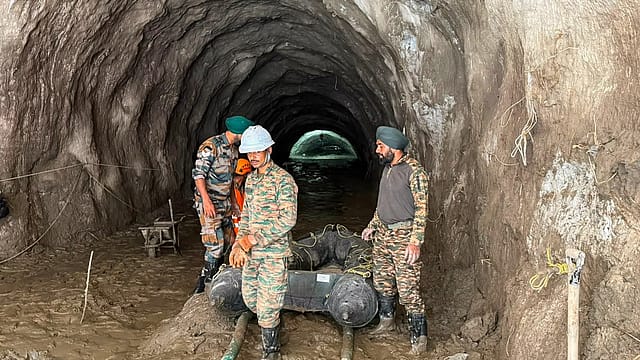
The search for survivors in Nepal has moved underground.
An India-Nepal technical team has established safety-rope connectivity inside the mud-choked Chilime tunnel, allowing rescuers and equipment to enter one of the most difficult sites created by the August 26 floods.
A large mud pump and generator have been transported to the tunnel to remove slush, while controlled rock blasting is being used to build a temporary access road for heavy machinery.
Above ground, the scale of the disaster continues to expand.
The death toll has reached 1,356, according to Nepal’s National Disaster Risk Reduction and Management Authority. Nearly 5,000 people remain missing, including 587 foreign nationals and approximately 100 security personnel and government officials.
More than 13,000 people have been rescued.

Losing Memory
16 Oct 2026 - Vol 05 | Issue 42
The making of a medical and social emergency
Nepal observed a day of national mourning on Monday, with flags lowered at government offices and diplomatic missions. But in Chilime and across the flood-ravaged districts, mourning remains suspended between identification and hope.
Thousands of families still do not know whether they are waiting for a survivor or a body.
What Is Happening Inside the Chilime Tunnel?
Indian Ambassador to Nepal Naveen Srivastava said the joint technical team was making steady progress despite challenging conditions.
“Safety rope connectivity to induct the team into the tunnel was successfully achieved,” he said in a social-media update. “A large mud pump and a generator were brought in to clear slush and mud from the tunnel.”
Rescuers are also constructing an approach road through controlled blasting, enabling larger equipment to reach the site.
The safety rope is crucial because the flooded tunnel presents several simultaneous risks. Rescuers must move through mud and debris with limited visibility while guarding against unstable surfaces, water accumulation, falling material and further movement in the surrounding landscape.
The authorities have not disclosed how many people may be trapped inside the tunnel or how far rescue teams have penetrated. The operation should therefore not be interpreted as confirmation that survivors or bodies have been located.
At this stage, progress means access. Every metre cleared gives the teams another place to search.
Why Has the Rescue Become So Difficult?
The floods did not create a single, clearly defined disaster site.
They damaged roads, bridges, settlements, hydropower installations and other infrastructure across several districts. Search teams are operating along river systems, inside tunnels and beneath enormous deposits of mud and debris.
Australian tunnelling expert Arnold Dix, who helped advise rescuers during the 2023 Silkyara tunnel operation in Uttarakhand, described the Nepal emergency as unlike anything he had previously encountered.
“Not one rescue, but multiple potential rescues, unfolding at the same time, in different places, each with its own dangers, uncertainties and lives that may still be saved,” Dix wrote from the field.
The Silkyara operation involved 41 workers trapped inside a defined tunnel space. Nepal’s rescuers are confronting multiple possible entrapment zones across a landscape altered by water, landslides and destroyed access routes.
The location of the missing may itself be uncertain.
Where Have the Bodies Been Recovered?
The official district-wise toll places Chitwan at the centre of the recovery operation, with 363 bodies found there.
Nawalparasi East has reported 223 bodies, followed by Nawalparasi West with 221, Nuwakot with 197 and Rasuwa with 169. Gorkha has reported 75 deaths, Dhading 70 and Tanahun 38.
Together, these figures account for the official toll of 1,356.
The recovery geography also demonstrates how far the disaster travelled. The Bhotekoshi flood devastated parts of Rasuwa before the impact spread into downstream areas along the Trishuli river system, including Nuwakot and Dhading.
Homes and roads were destroyed, communities were displaced and electricity, water supply and transport links were disrupted.
The largest concentrations of missing people have been reported in Nuwakot and Rasuwa. Around 2,340 people remain unaccounted for in Nuwakot and approximately 1,967 in Rasuwa.
How Many People Have Been Rescued?
Nepal’s disaster authority said 13,396 people had been rescued by Monday.
More than 21,400 security personnel have been deployed across the affected areas, including 7,912 Nepal Police personnel, 9,287 soldiers and 4,203 members of the Armed Police Force.
The official update said treatment had been provided to 6,676 injured people through hospitals and medical teams operated by the Nepali Army and Armed Police Force.
Another 3,533 people are staying at 39 holding centres. Nuwakot accounts for 2,651 of them, while 669 are in Rasuwa and 213 in Dhading.
The government has released emergency cash support to the most severely affected districts and local administrations. Search operations, relief distribution and restoration work are proceeding simultaneously, stretching personnel and equipment across a wide disaster zone.
Why Has DNA Become Central to the Operation?
Floodwater, mud and prolonged exposure can make visual identification difficult or impossible.
Nepal’s disaster authority said the recovered remains include unidentified bodies and human remains. Only 98 bodies had been handed over to families at the time of its update.
An Indian forensic team working at two Kathmandu laboratories has processed more than 1,200 DNA samples and generated approximately 292 DNA profiles, according to India’s Ministry of External Affairs.
Processing a sample and producing a usable profile are different stages. A sample may be damaged, incomplete or require repeated laboratory work before forensic scientists can extract sufficient genetic information for comparison.
Families searching for missing relatives have been asked to provide DNA samples, photographs and documents establishing kinship through the relevant district police offices.
The profiles obtained from relatives can then be compared with those generated from unidentified remains. For thousands of families, rescue has therefore entered its most painful phase: proving identity when recognition is no longer possible.
What About Indians Missing in China?
A parallel identification effort is under way across the border.
The Indian Embassy in Beijing has asked relatives of Indian nationals missing in China following the August 26 mudslide and flash flood to submit DNA data.
This is connected to the same wider Himalayan weather disaster but is distinct from the forensic operation taking place in Kathmandu.
Chinese authorities have agreed to receive DNA information relating to the missing Indians. Families have been asked to submit the data in the internationally recognised Combined DNA Index System, or CODIS, format to the Indian Embassy, which will forward it for comparison.
The request indicates that the search is no longer confined to national boundaries. Floods and mudslides across the Himalayan region affected Nepal as well as adjoining territory controlled by China, leaving foreign workers, travellers and local communities caught across different jurisdictions.
Why Is Nepal Observing National Mourning?
Nepal’s Cabinet declared Monday a day of national mourning for those killed in the floods.
The national flag was flown at half-mast at government institutions, embassies and diplomatic missions around the world.
The observance came as the country struggled to establish the disaster’s final human cost. With 4,994 people still missing, the confirmed toll is likely to remain provisional.
The large number of unidentified victims also means many families have been denied the rituals that ordinarily follow death. Nepal is mourning 1,356 confirmed lives. Thousands more remain suspended in official records under one word: missing.
What Happens Next?
The immediate priorities are gaining deeper access to the Chilime tunnel, reaching isolated communities, clearing transport routes and identifying the recovered bodies.
The tunnel operation will depend on whether pumps can remove mud and water faster than they re-enter, whether the access road can support heavy equipment and whether the internal structure remains safe for rescuers.
Across the wider disaster zone, authorities must continue matching DNA, supporting displaced residents and restoring roads, power and drinking-water supplies.
The number rescued—13,396—demonstrates the scale of the mobilisation. The number missing—4,994—defines everything still unfinished.
In Chilime, a rope now extends into the darkness. Behind it will come rescuers, pumps and machinery. For the families waiting outside, it carries something far more fragile. A route towards an answer.
With inputs from ANI